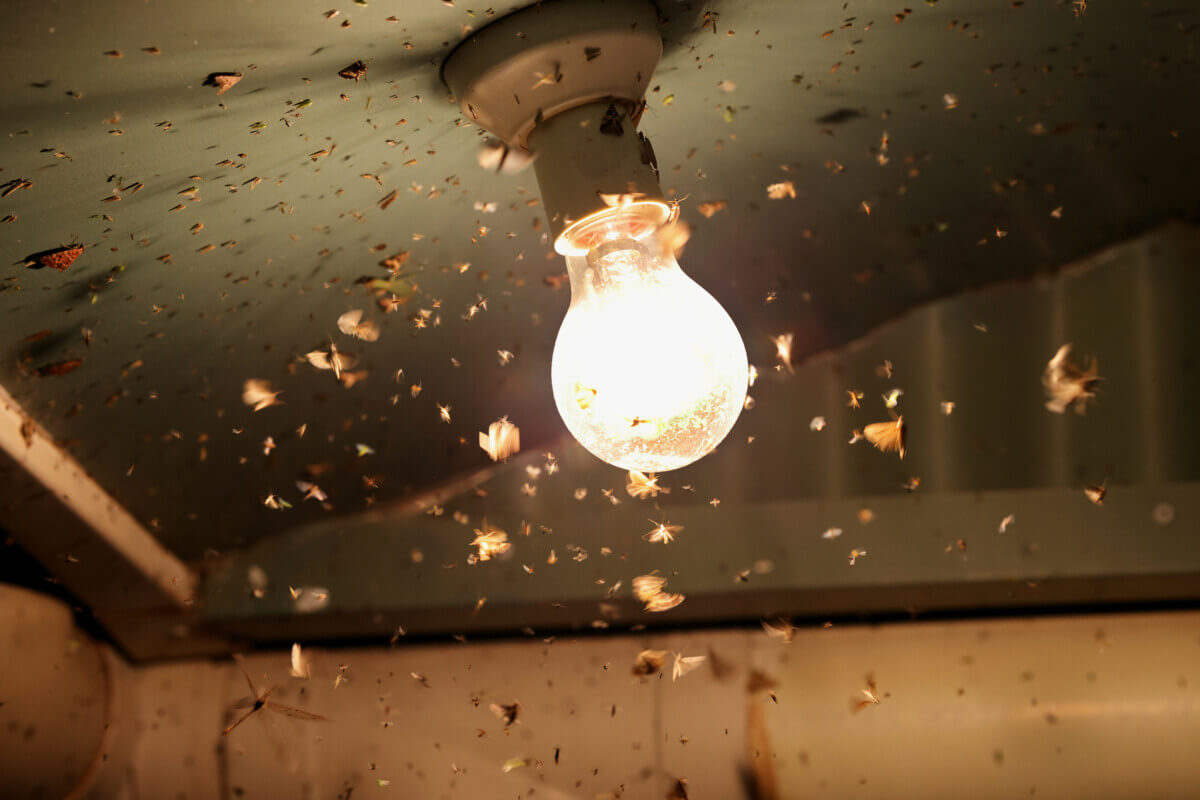
(Credit: Photo by Ken Griffiths on Shutterstock)
In a Nutshell
- Citizen scientists documented almost 24,000 wild creatures living or appearing inside homes and other buildings across the U.S. and Canada, representing close to 2,100 different species in total across the whole dataset.
- Arthropods accounted for about 95% of everything found indoors, with insects around 60% and spiders about 30%. Beetles, flies, moths, and true bugs led the insect tally.
- More than half of the species identified were spotted indoors only once, a sign that many may be occasional visitors rather than regular roommates.
Nearly 2,100 wild species have been photographed inside homes, offices, schools, and even airports across the United States and Canada, according to a massive new citizen science survey. Arthropods, the sprawling animal group that includes insects, spiders, and their relatives, accounted for about 95% of the nearly 24,000 sightings, but the dataset also turned up reptiles, mammals, fungi, plants, and other small creatures that wandered indoors, sometimes just passing through.
Researchers behind a citizen science project called Never Home Alone asked everyday people to photograph and log any wild creature they found indoors. Volunteers uploaded their finds to the nature-tracking app iNaturalist, and a team of species identification experts then worked to pin down what each organism was. The result, published in the journal Ecology, is the first continent-wide look at the wildlife living inside human buildings.
Nearly 3,000 observers contributed sightings collected between May 1996 and April 2024, and the data stretch across every U.S. state and Canadian province outside the territories. More than half of the species identified were spotted indoors only once, which may mean many are occasional visitors rather than permanent roommates.
How Citizen Scientists Tracked Wild Species Indoors
Volunteers did the legwork instead of professional researchers combing through buildings themselves. Anyone could snap a photo of a creature found indoors and upload it to iNaturalist, tagging it as part of the Never Home Alone effort. Submissions came with photos, location and date information, and sometimes notes from the person who made the discovery.
Starting in April 2024, the research team sorted through those submissions using two basic rules: the organism had to be wild, not a pet or domesticated animal, and it had to have been seen indoors rather than in a yard or on a porch. After that filtering, species identification experts stepped in and identified each observation as precisely as they could from the photo. Sometimes that meant naming the exact species. Other times, a photo simply did not offer enough detail, and the creature could only be sorted into a broader group.
That process left researchers with 23,782 verified observations submitted by around 3,000 different people. Most sightings came from inside homes, but people also reported finds in offices, schools, and airports, places not normally associated with wildlife.
Beetles, Spiders, and a Few Surprise Houseguests
Once the data were sorted, arthropods accounted for about 95% of everything recorded, led by insects and spiders. Insects alone made up roughly 60% of sightings, dominated by beetles, flies, moths, wasps and bees, and true bugs like stink bugs. Spiders accounted for close to 30%. Vertebrates, mainly reptiles and mammals, made up about 4%, and a final sliver included fungi, plants, worms, snails and slugs, and other small organisms.
A handful of species showed up again and again, appearing in more than 200 separate observations each. Topping that list was the Asian lady beetle, followed by the brown marmorated stink bug, the house centipede, the varied carpet beetle, the long-bodied cellar spider, the triangulate combfoot spider, the bathroom moth fly, and the Eastern parson spider. Many North Americans have likely crossed paths with these creatures without ever learning their names.
What stands out just as much is how many species barely registered. Across the entire dataset, researchers counted nearly 2,100 unique species, and that number is likely an undercount: 44% of observations could not be pinned to an exact species from photos alone, so the true tally of indoor life runs higher than the figures suggest.

Why This Database of Wild Species Matters
Indoor spaces have largely been left out of ecological research, even though people spend enormous amounts of time inside them. A few earlier studies had looked at indoor biodiversity, but those efforts were either limited to small areas or relied on genetic sampling methods that offered comparatively lower resolution for identifying exact species.
This dataset helps fill that gap, especially in understanding which species people are most likely to encounter indoors. As buildings continue to expand worldwide, researchers say this kind of data could help scientists study how certain species are adapting to life inside human structures, how they evolved to exploit that opportunity, and what it might mean for fields ranging from urban ecology to human health.
Researchers are upfront that the dataset has its own blind spots. Because data collection wasn’t standardized, researchers likely photographed and reported larger, more eye-catching creatures far more often than tiny or hard-to-spot organisms. Some of the animals counted were probably never living indoors at all, just creatures that slipped inside and got stuck before anyone noticed and photographed them.
Even with those limits, the scale of what ordinary people documented is hard to ignore. Homes are not sealed boxes separate from nature. They are overlooked habitats, home to far more neighbors than most residents realize, and many of those neighbors come and go without anyone ever knowing they were there.
Paper Notes
Limitations
Researchers note that because observations were submitted voluntarily rather than collected through standardized surveys, the dataset likely overrepresents larger, more easily photographed organisms while underrepresenting smaller or less visible species. Some organisms documented indoors were not necessarily living there regularly but instead became trapped inside human structures after wandering in from outside. In addition, 44% of observations could not be identified to the species level, meaning the dataset likely represents more species than the nearly 2,100 reported.
Funding and Disclosures
Authors state that they declare no conflicts of interest. The provided text lists no specific grant numbers or funding sources.
Publication Details
Paper Title: “The Biodiversity of Human Dwellings: A Dataset of 24,000 Observations of Indoor Life in the United States and Canada”
Journal: Ecology (2026), volume 107, issue 11, article e70628. Lead author Bradley C. Allf is joined by a large team of co-authors, including Matthew A. Bertone, Lauren M. Nichols, Jacob A. Gorneau, Roland Lupoli, Kyle E. Schnepp, Even Dankowicz, and many others listed in the full publication.
DOI: 10.1002/ecy.70628
Complete dataset and code are also available on Zenodo at https://doi.org/10.5281/zenodo.20722692. Data are available for reuse under CC BY 4.0 licensing.


