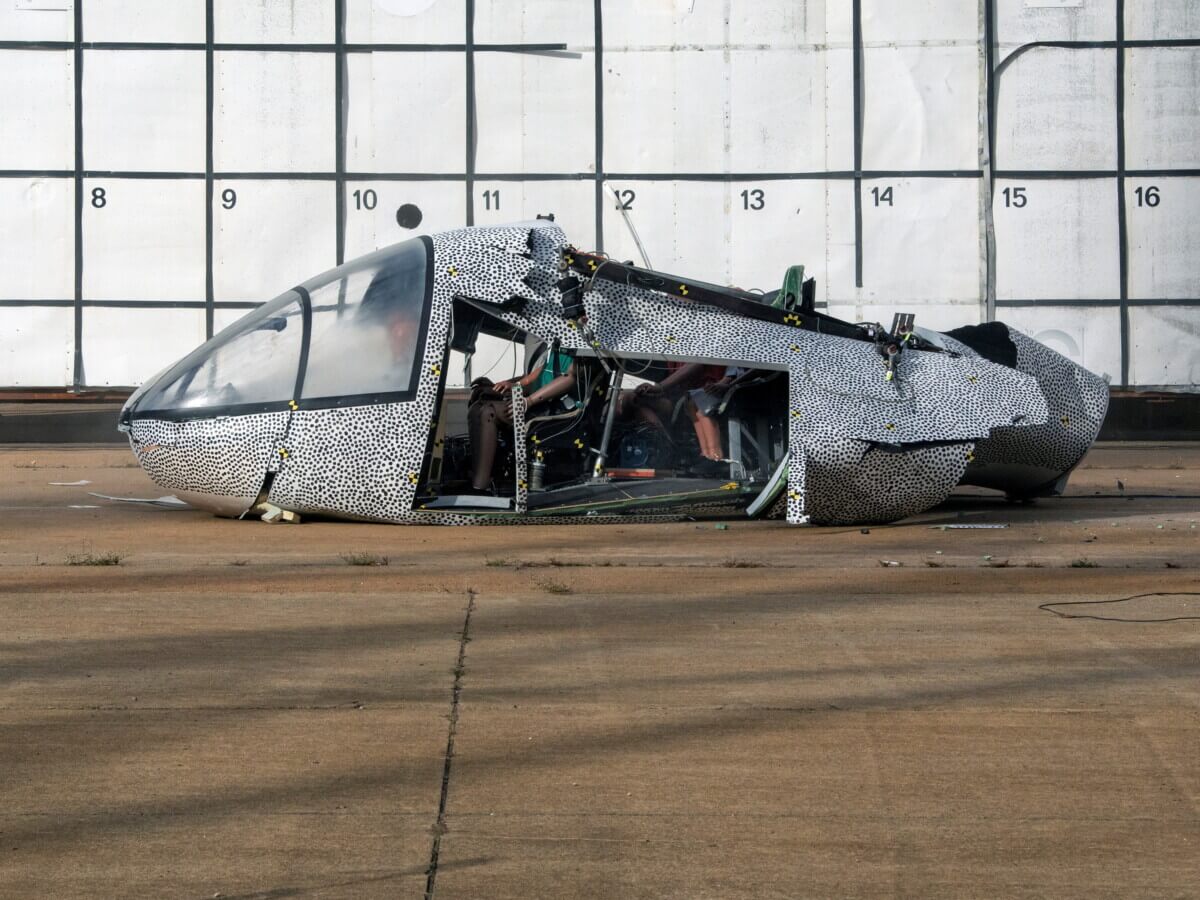
The RVLT Lift+Cruise Model rests on the ground after suffering a devastating crash. Tests like these enable researchers to understand how a vehicle's structure reacts to a crash. (Credit: Dave Bowman)
HAMPTON, Va. — With many still seeing flying cars as the future of travel, researchers as NASA conducted a crash test of a potential concept car — with “devastating” results!
Simulating a “severe crash,” engineers at NASA dropped a mock eVTOL electric aircraft containing six crash test dummies from a high point. While the test cockpit base and safety seats functioned as intended, the overhead structure collapsed and “the vehicle was destroyed beyond expectations.”
The test aircraft was a government reference design for a futuristic six-person all-composite eVTOL electric aircraft that would take off vertically and cruise like a conventional plane. Hoisted into the air at the Landing and Impact Research (LandIR) facility at NASA’s Langley Research Center in Hampton, Virginia, it was then released with pyrotechnic cutters.
The result was an “overall collapse” that went beyond computer predications as a simulated weight of flight mechanics above the cockpit seemingly crushed the passenger space.
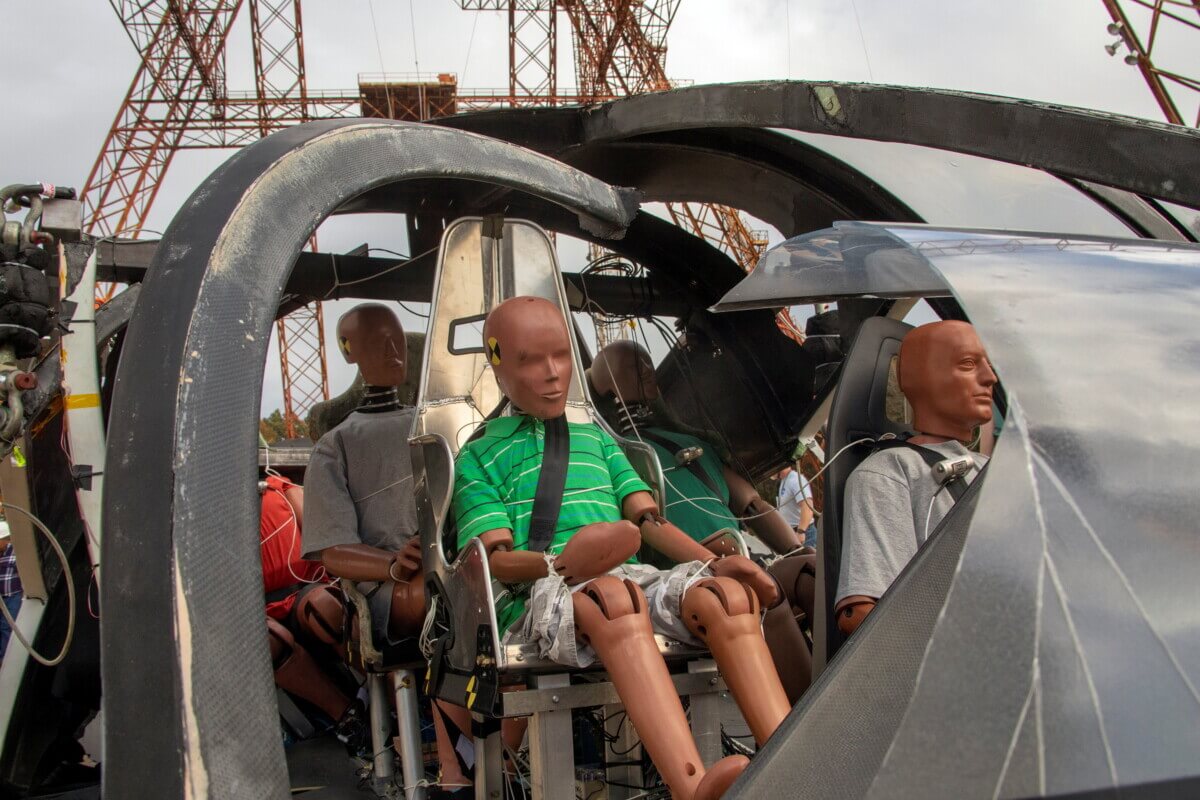
The NASA described the so-called RVLT Lift+Cruise Model as left resting “on the ground after suffering a devastating crash.”
“While we are still going through the data and video, and these results are preliminary, we see that there are two main events that occurred during this test,” says Justin Littell, a research assistant for Langley’s Structural Dynamics Branch, in a media release.
The report notes that the first event during impact “was the floor crushing and seat stroking.” Luckily, the vehicle’s subfloor and energy absorbing seats worked just like the engineers hoped they would, limiting the severity of the impact on the crash test dummies.
However, the second part of the report detailed the collapse of the overhead structure. The engineers are still determining how this part of the plane affected the test dummies. NASA acknowledged that varying eVTOL designs would perform differently and they’ll analyze the data in this and future drop tests.
A NASA Langley Research Center spokesperson adds, “for this test, an overhead-mass was designed to represent the wing structure, rotor and battery.”
Researchers assumed that all the weight of the overhead structure was over the cabin. However, the team notes that many other overhead-mass configurations could behave differently during a crash.
“The test was a great success for the crash-worthiness team at Langley,” Littell says. “We successfully tested the eVTOL vehicle concept representing a six-passenger, high wing, overhead mass, multiple rotor vehicle, obtaining more than 200 channels of data, and collecting over 20 onboard and off-board camera views.”
“Our computational pretest models did a good job predicting the composite deformation until overhead structural failure. However, the computational models did not predict the overall collapse as seen in the test.”
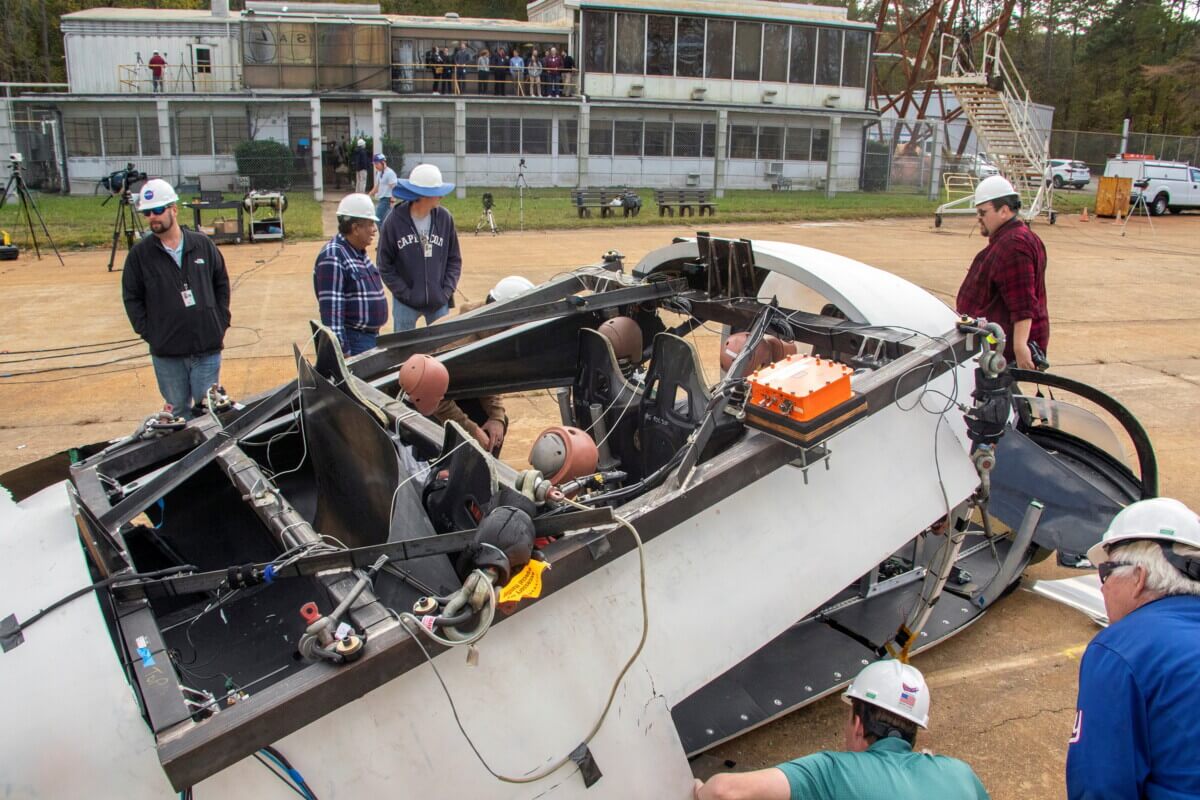
A variety of experiments were included on the test aircraft. These experiments involved several seat configurations including a NASA energy absorbing concept, various sizes of crash test dummies to study the effects of the crash loads on all sizes of occupants, and a modular NASA-developed energy-absorbing composite subfloor.
The full-scale testing data will be used to improve the simulation models such that in the future, the predictions will be more realistic. The data will further be used as the basis for evaluating potential test conditions and configurations that will be used during a drop test of a second test article, tentatively scheduled for late 2023.
NASA says their vision for Advanced Air Mobility (AAM) is to help emerging aviation markets safely develop an air transportation system that moves people and cargo between places previously not served or underserved by aviation.
“Understanding how these future aircraft may act in a crash scenario is another key point of research,” the team writes in a statement.
Report by Dean Murray, South West News Service


