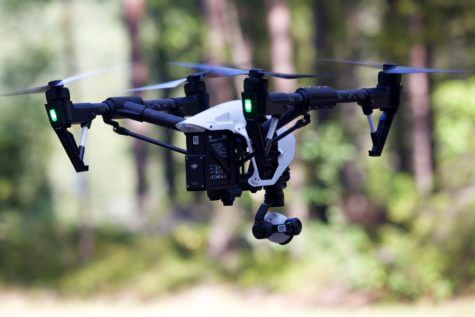
drone-2687890_1920

BLACKSBURG, Va. — By now you’ve probably seen a consumer drone buzzing around a beach or a public park. Ever wonder how bad it would be if it crashed into somebody?

While drones are steadily increasing in popularity, and multiple industries are showing interest in using them to deliver services, there is still relatively little research on what happens if they impact a bystander.
Drone
What would happen if a drone crashed into a person? A new study sought to answer that question by flying the unmanned aircraft into crash test dummies.

To answer these questions, researchers at Virginia Tech are dropping them on and flying them full speed — into crash test dummies.

“There’s a wide range of risk,” says one of the study’s leaders, Steven Rowson, in a press release. “In some instances it was low, and in some instances it was high, and there are lessons we can take away from that to reduce injury risk in a deliberate way through product design.”

Rowson, along with an injury biomechanics team, found that it is unsurprisingly the heavier drones that pose the most danger. In tests where the drone was dropped straight down, the smallest ones posed less than a 10 percent risk of severe neck injury. For the largest aircraft tested, the median risk was 70 percent.

To reduce the risk, especially in the larger drones, the team said design features such as break-away parts and shapes that deflected the aircraft to the side in an impact can make a big difference in safety.

“If you reduce the energy that’s able to be transferred to be head, you reduce the injury risk,” says Eamon Campolettano, a doctoral student and the research paper’s first author. “The overarching goal for manufacturers should be to limit energy transfer.”

With these and future impact tests as a guide, the researchers said they are working with individual companies to reduce risks.

While many have likely heard of plans by businesses like Amazon to use drones to deliver packages, the potential uses for these small drones is still just beginning to be explored.

For example, a group of researchers in Sweden are getting promising results on the possibility of using drones to speed delivery of defibrillators to help save heart attack victims.

Another study showed that consumer drones have already been used to spot and save hundreds of victims of natural disasters such as floods.

Before these and other uses can fully be rolled out in the United States, the Federal Aviation Administration will have to be assured that the drones won’t be too dangerous to the public.

“The big question right now is, what is the acceptable level of safety?” says Mark Blanks, the director of the Virginia Tech Mid-Atlantic Aviation Partnership, who also chairs an industry standards subcommittee developing recommendations for safe operations over people. “How much proof does the FAA need before they say, ‘Yes, that’s okay’? Once those standards are in place, we’re going to see huge expansion in the industry.”

The paper detailing the Virginia Tech team’s findings was published recently in the journal Annals of Biomedical Engineering.

About Calum Mckinney

I'm a writer and content creator focused on science and art. I live in Baltimore, Maryland with my cat Maggie.

Our Editorial Process

StudyFinds publishes digestible, agenda-free, transparent research summaries that are intended to inform the reader as well as stir civil, educated debate. We do not agree nor disagree with any of the studies we post, rather, we encourage our readers to debate the veracity of the findings themselves. All articles published on StudyFinds are vetted by our editors prior to publication and include links back to the source or corresponding journal article, if possible.

Our Editorial Team

Steve Fink

Editor-in-Chief

John Anderer

Associate Editor

Leave a Comment

2 Comments

  1. Jeff Bassett says:

    Absolutely yes, if a drone drops out of the sky, even a small drone weighing a little over half a pound, can do serious harm to people below.
    When drones were first being used for imaging and surveys, the FAA insisted that you had to provided solid study data on the potential injury / impact of a falling drone at the site you were flying for ALL commercial drone use. This made it impossible to actually get FAA permission to fly. It is such a useful tool, most companies just flew it ignoring the FAA. The FAA was seeing this so they created a new system where the industry did the study and then you applied that data to the request to fly at a site. If you were flying over people, 99.9% of request were still getting denied. Only large multi million dollar companies to provide the data the FAA requested. So again, people / companies were ignoring the FAA. Since there really were not people to police this, it could not be enforced. New safety systems like parachutes, drone Id and lighter drones made it easier to fly a bit more safely and made it into FAA regulations. With the FAA requiring drone users to be licensed and the drones registered, there has been better regulating of commercial use in the field. Still, the bureaucracy involved to do so can be daunting, especially for a small startup company. The real issue for companies flying is the liability if someone is hurt. This is what truly forces commercial use to follow the FAA regulations. If you are flying illegally and something goes wrong, even with insurance, the operator is not covered and has full liability.
    When my company had us flying over a university campus for a large scale project, we were required to document all the issues that could go wrong and how we did risk aversion to keep people on the ground safe. We had insurance riders created for that specific project. We noted times, conditions and issues that would prevent and or allow safe flight over the campus. We needed and did contact local hospitals that used low flying life flights about the times, areas and altitudes of drone flights so we could avoid any risk of collision. As well a means to immediately terminate drone flights if needed. We had parachute systems added to our drones, multiple observers as well redundancy systems employed. Before we submitted our plans to the FAA, we went through a university committee to also assess risk and ways to avert or minimize risk. Every flight was documented from preflight to the end of the day closing of operations. It was documented for review at all times. Once they were satisfied we had done everything possible to keep the project safe, we then applied to the FAA and received permission to fly. That really should be the way to do such a project, I doubt most drone companies would ever being so detailed about planning such projects.

  2. PJ London says:

    The chances of a private, recreational (< 250g) drone dropping straight down and hitting someone are effectively zero.
    If it happened, the chances of injury are effectively zero, not 10%.
    Only large commercial and police drones are dangerous, and they are dangerous whether they hit you or not.
    Ban all drones over 250 g!