
(Credit: muratart/Shutterstock)
The Black Market for Mummies Is Thriving on Facebook, and It’s Riskier Than You Think
In A Nutshell
- A study of 128 online posts found mummified human and animal remains being bought and sold across Facebook, Instagram, and other platforms, often with no safety guidance for buyers.
- Thirteen listings showed suspected fungal growth on the remains, and 22 posts showed people handling them bare-handed, without gloves.
- Most postal and courier services prohibit shipping human remains, but researchers found clear evidence, including a Royal Mail package, that sellers are mailing mummies anyway.
- Sellers use vague customs codes and avoid shipping to a handful of US states, showing they know the rules while still finding ways around them.
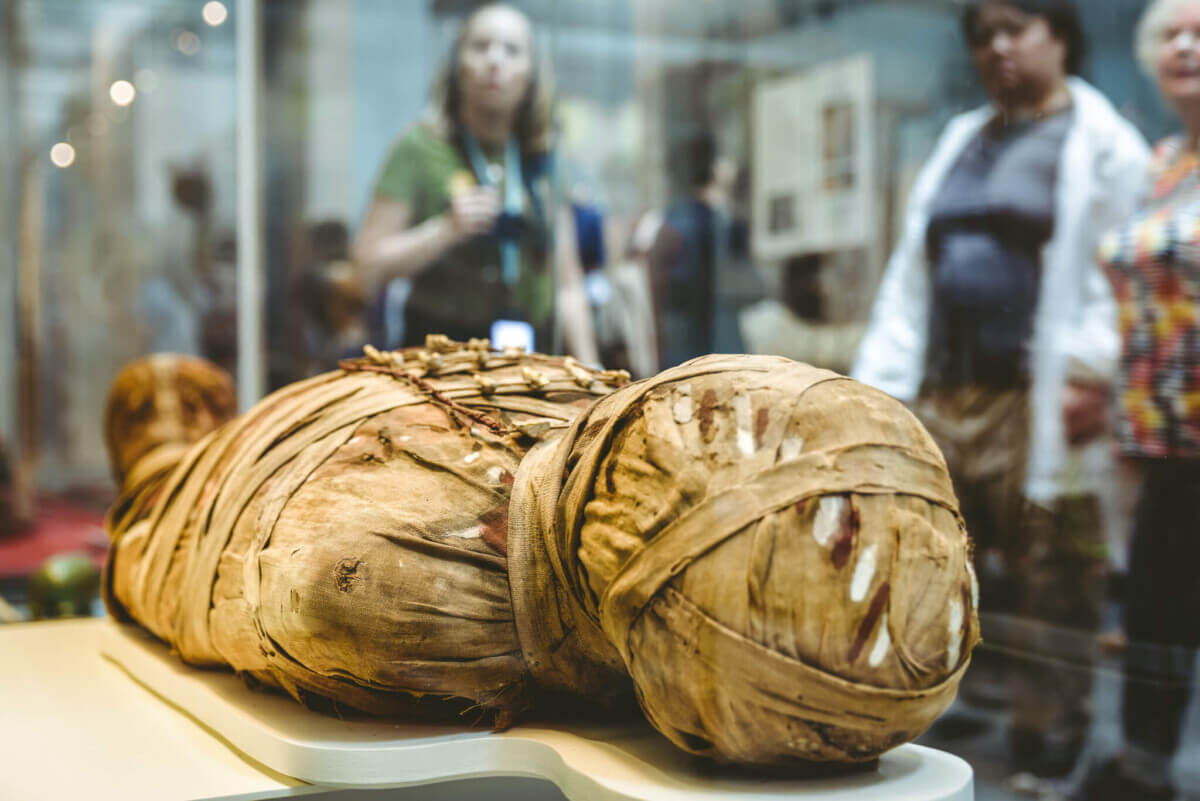
A growing black market for preserved human remains is turning a historical fascination into a public health problem. Researchers who spent years monitoring Facebook, Instagram, auction sites, and online storefronts found that mummified human bodies and body parts are being bought, sold, and mailed to private collectors with virtually no safety warnings, despite postal and courier restrictions. Some of those remains show suspected fungal colonization, and in documented cases, people handled them bare-handed, without gloves. What used to stay locked away in tombs and museum vaults is now getting boxed up and dropped off at the post office.
Historic preservation methods relied on toxic metals like arsenic, mercury, and lead, all of which stay dangerous long after death, and disturbing mummified remains can also release fungal spores that have lain dormant for centuries. The risk isn’t hypothetical. Exposure to Aspergillus spores has been linked to the deaths of 10 out of 12 conservation scientists who opened the tomb of King Casimir IV Jagiellon in Kraków in the 1970s, and a severe form of aspergillosis may have contributed to the death of Lord Carnarvon, the aristocrat present when King Tutankhamun’s tomb was opened.
Heads and Hands Dominate a 128-Post Mummy Sample
Published in the International Journal of Cultural Property, the findings come from an analysis of 128 online posts and auction listings collected from Facebook, Instagram, the Dutch e-commerce site Marktplaats.nl, online web stores, and auction houses between 2015 and 2025. Of those, 122 involved mummified human remains and six involved mummified animals, including a cat, a falcon, an ibis, a fish, and a primate skull. That sample came from years of monitoring plus keyword searches rather than an exhaustive census, so the findings show what this slice of the trade looks like, not how large the overall market is or whether it’s growing.
Isolated body parts, such as hands and feet, appeared most frequently, followed by whole mummified heads. More than half of all posts involved heads in some form, including partial heads, skulls with soft tissue attached, and so-called shrunken heads. Only one complete body appeared for sale across the entire sample. More than half of sellers who disclosed their location were based in the United States, concentrated in Pennsylvania and Colorado. Egypt was the most commonly stated origin, followed by South America, though those origins reflect seller claims rather than verified provenance.

Thirteen Facebook Listings Show Suspected Mold Growth
Visible biological growth on the remains is the most alarming finding. Thirteen posts, all from Facebook, showed suspected fungal colonization on mummified bodies, appearing as white spots, black patches, gray discoloration, and in one case a cotton-like white growth spreading across the surface. Photo quality made it impossible to identify the specific microbe involved. Eight of those thirteen were active sales listings, meaning someone was actively trying to ship potentially contaminated items to a buyer.
Fungal spores can persist in preserved remains for long periods and may become airborne when moved, opened, or disturbed. Certain molds, including types found in crypts and mummified collections, are known to cause serious lung infections, particularly in people with weakened immune systems. That’s why museum staff who handle mummies suit up in gloves, masks, and lab coats. In this study, 22 posts showed people handling mummified remains bare-handed, with no gloves at all.
Sellers Dodge Customs Codes to Mail Mummies Overseas
Most major postal and courier services prohibit shipping mummified human remains, though policies vary by carrier. Some permit cremated ashes under specific conditions, and Canada Post allows human remains under strict guidelines. Mummified bodies fall outside what’s permitted by DHL, FedEx, UPS, Royal Mail, Australia Post, and USPS. The study found clear evidence that sellers mail mummies anyway. One photograph posted to Facebook showed a package sent from the United Kingdom to a buyer in the United States, stamped and shipped through Royal Mail, in direct violation of that company’s own rules.
Sellers avoid detection by not declaring what’s in the box. Some shipments used customs codes meant for demonstrational models or archaeological and anatomical collectors’ pieces, codes the researchers say are vague enough to mask what’s actually inside. Eleven sellers stated they would not ship to Georgia, Louisiana, Minnesota, or Tennessee, showing awareness of state laws while operating everywhere else. Warehouse workers, postal employees, and customs officers who find these packages may have no way of knowing what’s inside a mislabeled box.
Researchers Call for Clearer Postal Rules and Reporting
Professionals who work with mummies follow strict safety protocols for a reason. This study shows a shadow economy operating with none of them, leaving buyers, sellers, and postal workers exposed. Researchers recommend clearer, more visible postal rules on human remains, updated customs codes, and protective gear plus law enforcement reporting for flagged packages. Anyone who spots mummified remains for sale online can screenshot and report the post, though removal is far from guaranteed.
Mummies spent centuries sealed in tombs. Now they’re traveling through the mail with false labels, passing from a seller’s living room to a sorting facility to someone’s front door, with no one along the way protected from what might be inside. Until regulators, postal services, and law enforcement coordinate a real response, that risk keeps moving right along with the box.
Disclaimer: This article is based on findings from a peer-reviewed study and is intended for general informational purposes. It does not constitute medical, legal, or safety advice. Anyone who encounters mummified remains or suspects a package contains such material should avoid direct contact and contact local authorities.
Paper Notes
Limitations
The researchers acknowledge that the sample was not collected through fully systematic searching. Many posts came from an archive built through opportunistic weekly-to-fortnightly monitoring over several years, rather than exhaustive database queries. This approach was chosen because of the irregular and unpredictable nature of how buyers and sellers post online, but it means the sample may not represent the full scope of the trade. Additionally, the quality of photographs in the posts made it impossible to identify the specific types of fungi, bacteria, or yeast visible on the remains, and none of the specimens were physically tested. The researchers also note that sellers may deliberately avoid photographing degraded remains, since better-preserved items fetch higher prices, meaning the true extent of biological deterioration in the market is likely underreported. Post counts over time were small enough that the researchers could not determine whether observed patterns were statistically significant, and stated countries of origin reflect seller claims rather than verified provenance.
Funding and Disclosures
Broader ethical approval for monitoring and using e-commerce and social media posts showing human remains trafficking was previously granted to DH and colleagues via Carleton University, the Social Sciences and Humanities Research Council of Canada, and the Canadian Tri-Council research ethics board. Ethical approval for the current study was submitted to the University of Staffordshire’s Ethics Committee on May 30, 2025, and approved on June 2, 2025 (ref: DEF-KES3-024). No external funding sources are explicitly identified in the paper.
Publication Details
Authors: Kirsty Squires (University of Staffordshire, Stoke-on-Trent, UK), Dario Piombino-Mascali (Vilnius University, Lithuania; University of Salento, Italy), Clara Urzì (University of Messina, Italy), and Damien Huffer (Adelaide University, Australia). Squires and Huffer are listed as joint first authors. | Journal: International Journal of Cultural Property | Paper Title: “The real mummy’s curse: Health risks associated with the sale and trade of mummified remains” | DOI: https://doi.org/10.1017/S0940739126100393 | Published: 2026, Volume 33, e22, pages 1–23, by Cambridge University Press on behalf of the International Cultural Property Society. Published under a Creative Commons Attribution-NoDerivatives (CC BY-ND 4.0) license.


