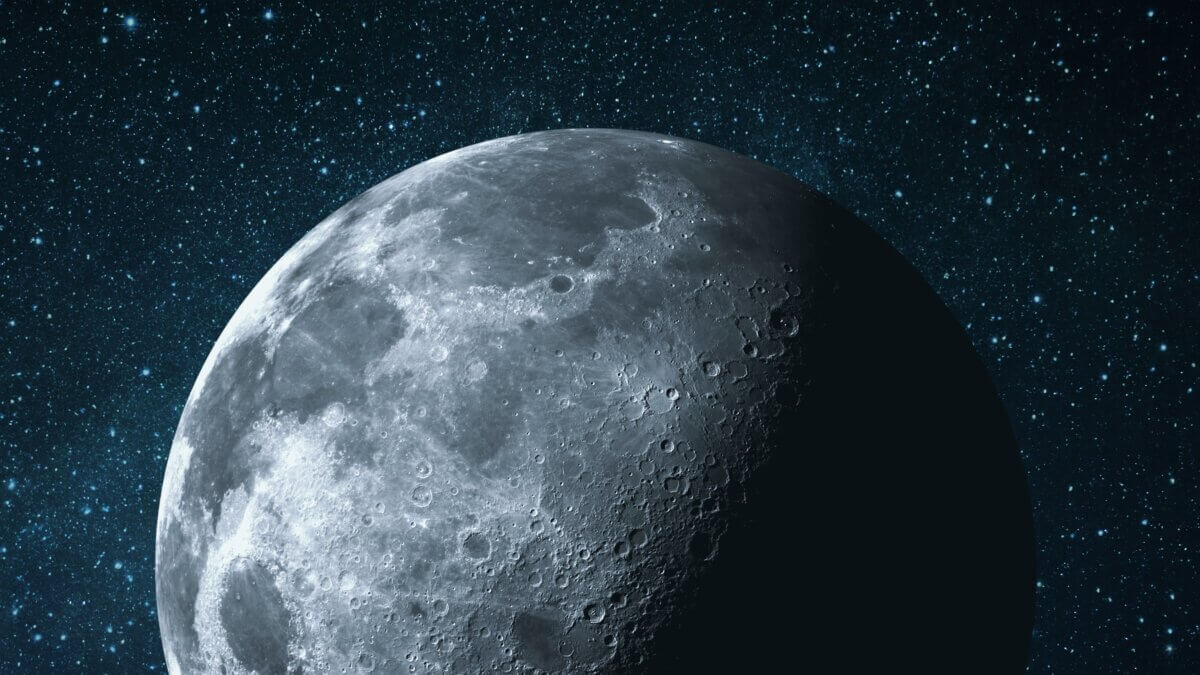
(Credit: Photo by Alones on Shutterstock)
In a Nutshell
- A billion tons of lunar water sounds massive but would only support a city of one million people for about 100 years, even with recycling as efficient as the International Space Station’s, which reclaims about 98% of its water.
- Power is not the limiting factor for a lunar settlement; solar arrays or nuclear reactors could realistically supply enough electricity for a city-sized population.
- Smaller lunar outposts, in the range of a thousand to 100,000 people, appear far more realistic and sustainable given the Moon’s actual water resources.
A city of one million people on the Moon would drain even the most generous estimate of lunar water, a full billion tons, in about 100 years. That is the sobering math behind a new analysis from astronomers at the Smithsonian Astrophysical Observatory that undercuts the sprawling lunar visions pitched by Jeff Bezos and Elon Musk.
Bezos wants to move heavy factories off Earth and onto the Moon. Musk has talked about self-growing lunar cities straight out of science fiction. The new study pours cold water, literally, on those dreams by comparing humanity’s real water needs against what the Moon actually has to offer.
A billion tons sounds like an impossible amount of water. Researchers calculate it would be enough to flood New York’s Central Park roughly 120 meters deep, taller than the Statue of Liberty. But weigh that supply against everything a real lunar city would need for drinking water, crops, breathable air and rocket fuel, and the number shrinks fast.
Generating power for a lunar city turns out to be the easy part, according to the analysis published in the journal Frontiers in Space Technologies. Solar panels mounted on tall towers near the Moon’s poles, or nuclear reactors, could realistically keep the lights on for a million residents. Water is the real problem. Unless engineers can cut water losses roughly tenfold below the space station’s rate, or someone discovers a far bigger reservoir of ice hidden somewhere on the Moon, a lunar city of millions simply doesn’t work.
How Scientists Calculated the Moon’s Water Budget
Researchers didn’t travel to the Moon to test any of this firsthand. Instead, they built their case using public research on lunar water deposits, along with real numbers on how much power and water people use on Earth and aboard the International Space Station.
Nearly all of the Moon’s water is thought to sit near its poles, frozen inside craters that haven’t seen sunlight in roughly 4 billion years. Scientists call these deep, permanently dark pockets “cold traps.” They stay cold enough that ice delivered by ancient comet and asteroid impacts would still be locked in place today. Spacecraft have searched for this ice for two decades using instruments that can detect it from orbit, and the estimates have swung wildly. An early 2013 study suggested several hundred million tons. A 2022 analysis was far more conservative, estimating that the eight richest craters hold only about 34 million tons of water combined. To give lunar settlement plans a fair shot, the authors deliberately used a generous baseline of one billion tons for their entire analysis, more than 10 times the water known to exist in the Moon’s shadowed craters.
Why Recycling Water Determines a Lunar City’s Future
Water needs pile up across drinking, hygiene, growing food, and even breathing, since the water vapor in every breath must eventually be replaced inside a sealed habitat. Combining U.S. water-use data with an optimistic assumption that lunar farms grow food far more efficiently than farms on Earth, the researchers estimate a single lunar resident would need roughly 500 tons of water a year. Multiply that by a million people, and even a full billion-ton reserve would run out in just 2.4 years if none of it were recycled.
Recycling is what makes or breaks the equation. The International Space Station already reuses about 98% of its water, thanks to a system upgraded in 2023. Apply that same rate to a lunar city of a million people, and the billion-ton supply stretches out to roughly a century. Shrink the population to 100,000, using that same technology, and the supply could last around a thousand years, a timeline the authors say could reasonably be called sustainable.

What Could Stretch the Moon’s Water Supply Further
Researchers lay out a few ways around the shortage. Recycling could theoretically improve beyond the space station’s current rate, though the authors point out that pushing past 99.75% efficiency and holding it there would be extremely hard for any population to sustain. Cutting demand through vertical farming or plant-based diets could help at the edges. Water could also be shipped in from asteroids or other bodies, though that would require a steady stream of landers arriving again and again. There’s also a chance that more ice exists deeper underground than current instruments can detect. Still, the authors doubt any single fix would be enough to support a city of millions for generations.
Why a Billion Tons of Water on the Moon Still Isn’t Enough for a City
None of this rules out humans living on the Moon. The authors suggest a “Moon Village” of around 1,000 people, similar in size to the winter population researchers keep in Antarctica, could operate without straining the water supply. The math only turns unforgiving once the population climbs into the millions, the scale a company or government would need to make real economic use of the Moon.
That distinction runs counter to the scale behind Bezos’s call to move factories to the Moon or Musk’s vision of self-sustaining lunar cities. To make a real dent in Earth’s economy, researchers reason, such a settlement would need something like 1% of Earth’s population, roughly 80 million people. Nothing in the current data on lunar water supports a settlement anywhere near that size lasting for generations.
A billion tons of water is still an extraordinary find, but it isn’t infinite, and treating it that way could set any future lunar economy up to fail before it starts. The authors aren’t arguing against building on the Moon. They’re arguing for planning the water supply carefully from day one, rather than racing to claim ice deposits before anyone has a plan for sharing them.
Paper Notes
Limitations
Estimates of lunar water are quite uncertain, as the authors themselves acknowledge, with some prior research putting the total water content of the richest polar craters at just 34 million tons, far below the billion-ton baseline used throughout the analysis. The authors chose that higher figure deliberately as a generous, best-case scenario to be fair to optimistic lunar settlement proposals. Water usage estimates for a future lunar population are also based on current U.S. consumption patterns, space station technology, and an optimistic assumption about food-growing efficiency, which may not perfectly reflect how a real lunar settlement would eventually operate. The paper also notes that recovery rates for extracting usable water from ice mixed into lunar soil are unknown until actual drilling and testing take place on site.
Funding and Disclosures
The authors stated that financial support was not received for this work or its publication. They disclosed no commercial or financial relationships that could represent a conflict of interest, though author Martin Elvis noted he was an editorial board member of Frontiers at the time of submission, which the journal states had no impact on the peer review process or final decision. The authors also disclosed that generative AI (ChatGPT) was used to assist with the literature search during the writing of the manuscript.
Publication Details
Paper Title: “No cities on the Moon: a billion tons of water is not enough for sustainability”
Authors: Martin Elvis of the Smithsonian Astrophysical Observatory, Center for Astrophysics, Harvard and Smithsonian, and Jonathan C. McDowell of the Smithsonian Astrophysical Observatory and the Space Research Centre at Durham University
Journal: Frontiers in Space Technologies, September 14, 2026, as a Brief Research Report, and corrected on September 17, 2026


