
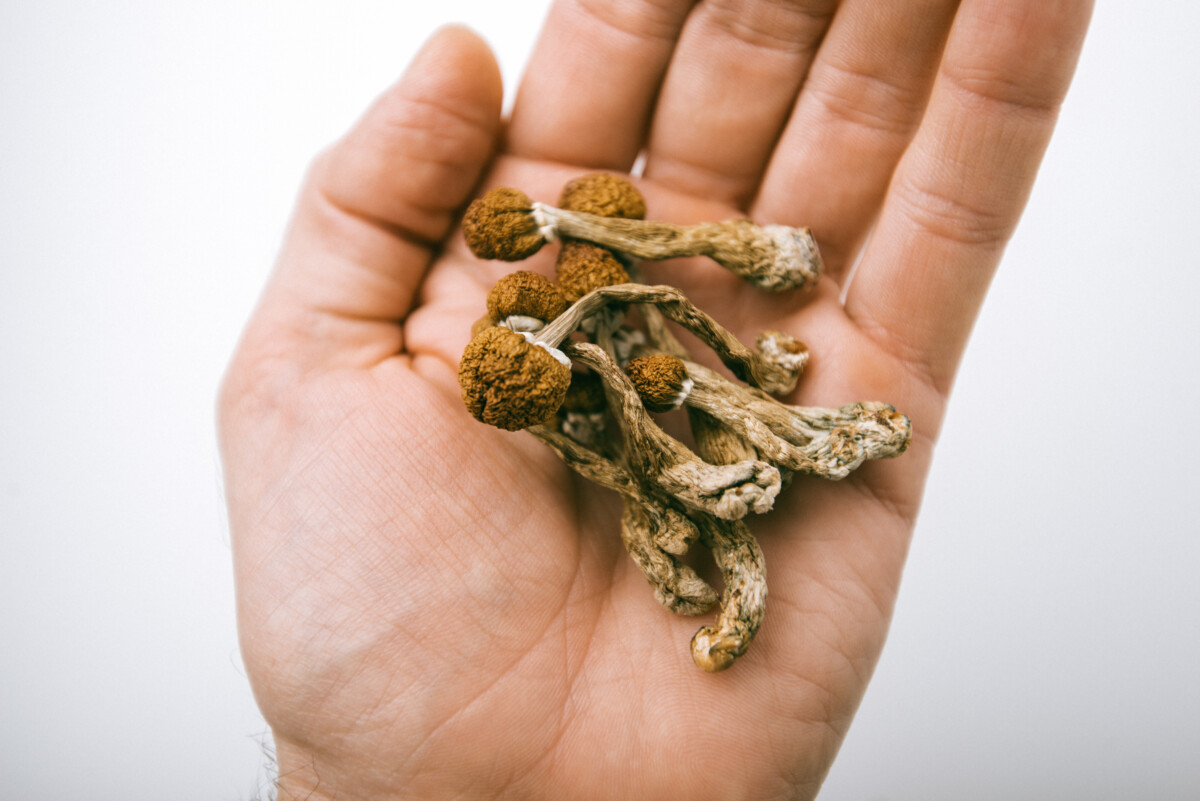
Dried psilocybin mushrooms. (Photo by Deep Roots on Shutterstock)
More Americans Are Taking Magic Mushrooms Than Ever. Many of Them Have Depression
In A Nutshell
- A new federal survey estimates roughly 8 million Americans used psilocybin in the past year, about 2.8% of the U.S. population.
- People who had experienced a major depressive episode were more likely to report past-year psilocybin use, even after accounting for other factors.
- Cannabis was the factor most strongly linked to psilocybin use, with users more than 13 times as likely to have also used psilocybin.
- Researchers say the findings are a call for doctors to screen for psilocybin use, especially in patients with depression or those who use other psychedelics.
Interest in magic mushrooms has surged in recent years, and new federal data put a number on just how widespread use has become. A federal survey found that roughly 8 million Americans used psilocybin, the active compound in magic mushrooms, last year.
Buried inside that figure is a pattern researchers say doctors need to pay attention to: people who had recently experienced a major depressive episode were more likely to be among those using it.
As psilocybin inches closer to mainstream medicine, the question of who is using it outside of controlled settings, and why, is becoming harder to ignore.
A Federal Survey Tracks Magic Mushroom Use for the First Time
For the first time, the 2024 National Survey on Drug Use and Health included questions specifically about psilocybin. Run annually and designed to reflect the broader U.S. population, previous versions of the survey either grouped psilocybin with other hallucinogens or only asked whether someone had ever tried it in their lifetime. By asking instead about use within the past year, researchers got a much sharper picture of who is actually using it now.
Led by Kevin H. Yang of UC San Diego and Joseph J. Palamar of NYU Grossman School of Medicine, the study was published in The American Journal of Psychiatry and analyzed responses from 58,633 participants. An estimated 8 million people ages 12 and older, about 2.8% of the U.S. population, reported past-year use. Because the survey captures a single point in time and relies on self-reported data, the findings describe associations rather than cause-and-effect relationships.
Who is using it? Mostly younger, college-educated, higher-income men. Young adults ages 18 to 25 had higher odds of past-year use than the 35-to-49 age group, while people 50 and older had much lower odds. Black individuals had about 60% lower odds and Hispanic individuals about 31% lower odds compared to White individuals, and people with a college degree had more than two and a half times the odds of those without a high school diploma. Throughout the study, “odds” refers to how common something was in one group relative to another, not the likelihood that any one person would use psilocybin.
Cannabis Use Was Most Strongly Linked to Magic Mushroom Use
Other drug use showed the tightest connections. People who had used cannabis in the past year had more than 13 times the odds of also having used psilocybin, making it the most strongly associated factor by a wide margin. Past-year LSD use carried nearly eight times the odds, ketamine about six times, and MDMA roughly three and a half times. Cocaine was linked to about twice the odds, and misuse of prescription stimulants showed a similar association.
Researchers noted that psilocybin use “commonly co-occurs with other substance use within the same year, consistent with a shared experimentation pattern among individuals who use psychedelics.” For clinicians, that clustering is a practical signal: when a patient mentions using one psychedelic, a broader conversation about substance use is probably warranted, including a look at potential interactions with antidepressants.
People With Depression Were More Likely to Use Psilocybin
Among past-year psilocybin users, 23.1% had experienced a major depressive episode in the past year, compared to 8.4% of non-users. These figures reflect differences between groups, not a change in individual risk caused by psilocybin. After adjusting for demographics, income, education, and other substance use, people with a recent depressive episode still had 37% higher odds of having used psilocybin.
That association matters given the momentum behind psilocybin as a potential depression treatment. The FDA granted psilocybin its “breakthrough therapy” designation for treatment-resistant depression in 2018 and for major depressive disorder in 2019. Clinical trials have shown promise, but those trials involve careful screening, controlled dosing, and professional psychological support before, during, and after the experience. None of those safeguards exist when someone takes mushrooms on their own, and the authors pointed out that adverse effects from unsupervised use, including anxiety, paranoia, and prolonged psychological distress, have been documented, with poison center reports involving psilocybin on the rise.
Whether the link reflects self-medication, shared risk factors, or psychological distress from unsupervised use remains an open question. Earlier studies examining lifetime use found psilocybin was associated with lower odds of depression, a discrepancy researchers attributed to the difference in timeframe: past-year use captures people much closer in time to their current mental health status. Longitudinal research will be needed to sort out the direction.
What Comes Next as States Expand Legal Access to Psilocybin
Oregon launched a regulated psilocybin services program in 2023, and Colorado followed in 2025, with other states pursuing decriminalization. None of that changes psilocybin’s federal Schedule I status, but the legal landscape is shifting fast. Researchers argued that use is now common enough that psychiatrists are “likely to encounter patients who use it outside of clinical settings,” and that screening should become routine, especially for patients who use cannabis or other psychedelics and those dealing with depression.
Eight million Americans using a powerful psychedelic is not a fringe phenomenon. People struggling with depression appear to be showing up in that group at elevated rates, and that warrants serious, evidence-based attention from clinicians and policymakers alike.
Disclaimer: This article is based on published academic research and is intended for informational purposes only. It is not intended as medical advice. Psilocybin remains a federally controlled substance. Consult a qualified healthcare professional before making any decisions related to mental health treatment.
Paper Notes
Limitations
Several limitations apply to this research. Because the survey captured a single point in time, it is impossible to determine whether depression drove psilocybin use, whether psilocybin use contributed to depressive symptoms, or whether both were influenced by other underlying factors. All data were self-reported, which may introduce biases related to social desirability or imperfect recall. Unsheltered homeless individuals and people living in institutional settings were underrepresented. Researchers also lacked information about frequency, dosage, and context of use, and could not distinguish between recreational use and legally supervised psilocybin services. The overall survey response rate was 11.3%, with an interview completion rate of 51.5% among those successfully screened, which may introduce nonresponse bias, particularly for lower-prevalence substances like psilocybin.
Funding and Disclosures
The study was supported by National Institute on Drug Abuse (NIDA) grants R21DA060362, R01DA057289, and U01DA051126, all associated with Dr. Palamar. The authors stated that the content is solely their responsibility and does not necessarily represent the official views of NIH. Dr. Palamar has served as a consultant for the Washington-Baltimore High Intensity Drug Trafficking Areas program. The other authors reported no financial relationships with commercial interests.
Publication Details
Authors: Kevin H. Yang, M.D. (Department of Psychiatry, University of California San Diego School of Medicine); Avery Eun, B.A. (Department of Psychiatry, University of California San Diego School of Medicine); Joseph J. Palamar, Ph.D. (Department of Population Health, NYU Grossman School of Medicine, NYU Langone Health). Journal: The American Journal of Psychiatry. Title: “Prevalence and Correlates of Past-Year Psilocybin Use in the United States.” DOI: 10.1176/appi.ajp.20251343. Published online April 22, 2026. Received December 22, 2025; revision received February 19, 2026; accepted March 3, 2026. The secondary analysis was exempt from review at NYU Langone Medical Center’s Institutional Review Board.


