
(© detry26 - stock.adobe.com)
In A Nutshell
- Salt Needs Damp Air: Pure sodium chloride starts pulling in enough water to turn into brine at about 75% relative humidity, far above the EPA’s advice to keep homes below 60% and ideally between 30% and 50%.
- The Proof Comes From Sealed Boxes: Lab and museum research shows saturated salt solutions can hold humidity steady inside closed chambers and display cases, but none of it shows a bowl of dry salt drying out a lived-in room.
- Fix The Source Instead: Federal guidance points to producing less moisture, venting kitchens, bathrooms and dryers outdoors, drying wet windows quickly and keeping the glass warmer.
Cold mornings can bring a familiar sight: beads of water running down the inside of the windows and collecting on the sill. One popular fix calls for nothing more than a pantry staple. Fill a bowl with salt, set it on the windowsill overnight and, the thinking goes, it will pull in the moisture before the dripping starts. One TikTok demonstration of the trick drew more than 3.2 million views.
The idea isn’t pulled from thin air. Salt does draw water out of the air, which may explain why the bowl can look damp by morning. But the studies showing salt holding humidity steady took place in sealed lab chambers and closed museum display cases, not in kitchens and bedrooms. Taken together with federal housing guidance, they suggest a bowl of salt is better at hinting that the air by your window is wet than at drying it out.
Why Does Salt React With Moisture At All?
Real chemistry, with a major condition. Salt is hygroscopic, meaning it can pull water vapor out of the surrounding air. Once the humidity climbs past a level called the salt’s deliquescence point, the crystals take up so much water that they dissolve into a liquid solution, or brine.
For sodium chloride, that point is about 75% relative humidity, according to a 2015 review in Restoration of Buildings and Monuments co-written by a scientist at the Smithsonian’s Museum Conservation Institute. Below that level, the authors note, building materials that contain salt tend to look dry.
The review also cautions that commercial table salt may contain anti-caking agents or other ingredients that change how it behaves. A kitchen shaker won’t necessarily act like pure sodium chloride.
That 75% figure matters because it is much damper than a home should be. The EPA advises keeping indoor humidity below 60%, ideally between 30% and 50%.
Why Can Salt Get Damp On A Windowsill?
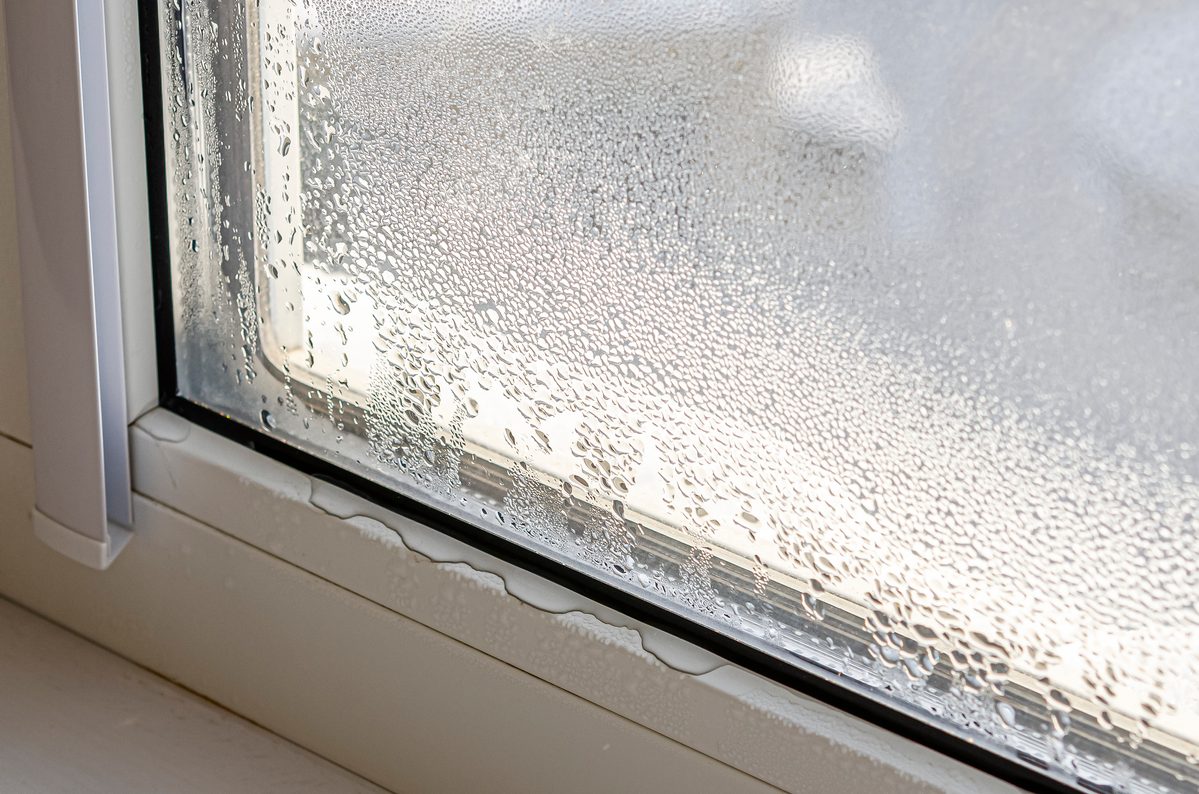
Possibly because the air right there is unusually humid. Cold air can’t hold as much moisture as warm air, which is why, as the EPA explains, water beads up on the inside of windows in cold weather. As room air cools against the glass, its relative humidity rises until droplets form.
That can leave a cold or poorly insulated pane dripping even when the room as a whole stays within a reasonable humidity range. Salt sitting nearby could meet air damp enough to cross its 75% threshold. That would explain why it turns clumpy while a hygrometer across the room shows a lower number.
That is a plausible explanation, not a measurement. Clumping doesn’t show how much water the salt removed or whether it prevented any condensation, and ingredients other than sodium chloride can also change how table salt clumps.
What Do Controlled Uses Actually Show?
Something much narrower. A 1977 compilation from the National Bureau of Standards, the agency now called NIST, describes how saturated salt solutions in sealed chambers settle at fixed, predictable humidity levels once they reach equilibrium. For sodium chloride, that level is about 75% relative humidity at 68 degrees Fahrenheit. Scientists use these setups as a simple, low-cost way to control humidity.
A 2022 study in npj Heritage Science by Gerhard Eggert of the State Academy of Art and Design in Stuttgart, Germany, applies the same principle to protecting museum objects. A saturated solution with extra solid salt can either dry or moisten the air inside a closed display case, holding it at the salt’s set point. Large cases take time to reach that level, so a wide solution surface helps. Tall cases that aren’t airtight may need a fan to keep the humidity even from top to bottom.
These uses show that salt solutions can regulate small, enclosed spaces. They don’t show that an open bowl of dry table salt removes a meaningful share of moisture from a home where people are cooking, showering and breathing.
What’s The Practical Takeaway?
Deal with the moisture, not the symptom. The EPA’s household moisture guidance lists long showers, boiling or steaming food, houseplants and drying clothes indoors as sources of extra moisture. It points out that tightly sealed, energy-efficient homes trap more of that moisture indoors, and it advises bathroom and kitchen exhaust fans that vent outside, not into the attic.
The agency’s mold and moisture guide recommends checking humidity with an inexpensive meter, fixing leaks, venting clothes dryers outdoors and running air conditioners or dehumidifiers when needed. When moisture collects on windows, it says to dry the wet surface quickly and cut back the source.
Building America guidance from Pacific Northwest National Laboratory and the University of Minnesota recommends exhaust fans and dryers ducted outdoors, careful air sealing, mechanical ventilation and, where needed, a dehumidifier. It warns that condensation that keeps coming back can rot sills and window frames, that humid air leaking into walls can condense out of sight, and that poorly drained or sealed slabs, basement walls and crawlspaces can add to a home’s moisture load.
Warmer glass helps too. The EPA says storm windows and caulking help keep window glass warmer, and interior storm windows lower the chance of condensation on the room side by giving it a warmer surface.
So the damp salt on your sill is telling you something real: the air at the glass is wet. Treat it as a rough warning sign, not a fix. Lasting control comes from producing less moisture, venting what you do produce, and keeping the inside of the glass warm enough to stay above the dew point, the temperature at which water starts to condense.
Research Notes
Limitations
The Charola and Bläuer review is an overview of how salts behave in porous building materials such as brick and stone. It was not written about household humidity control, and its table salt passage describes a simple demonstration (finely powdered salt exposed to humidity above 90%) rather than a measured study. The authors themselves note that commercial table salt may contain anti-caking agents or other ingredients that alter its behavior, so its figures for pure sodium chloride may not transfer exactly to a kitchen product.
The Greenspan compilation reports equilibrium humidity values for saturated salt solutions inside controlled, uniform-temperature enclosures. It fits data from 21 earlier investigations, made no attempt to evaluate water or salt purity, and limits extrapolation beyond measured temperatures to 2.5 degrees Celsius. It gives no equilibration times and does not address open rooms, air leakage or temperature gradients, all of which apply to a windowsill.
The Eggert study concerns closed museum display cases. It notes that large cases need time to reach the target humidity and that tall cases that are not airtight may develop humidity gradients, and its own list of open questions includes whether the desired humidity can be reached in cases that are not fully tight. A 2023 correction fixed transposed table values for calcium chloride hexahydrate and an HCl figure for magnesium chloride; neither affects the points used in this article.
The EPA and Pacific Northwest National Laboratory pages are general guidance documents, not studies, and do not evaluate salt as a moisture control method.
Funding and Disclosures
Charola and Bläuer: the repository copy of the paper contains no funding statement; its acknowledgment thanks Josef Pühringer for encouraging the work and three colleagues for comments. Greenspan: the work was carried out at the National Bureau of Standards, a federal agency; no separate funding or conflict statement was checked. Eggert: the funding and competing-interests statements could not be checked because the full text at Nature and the German National Library copy would not load; the abstract on DOAJ carries no disclosure. The Building America Solution Center guide states it was created with funding from the U.S. Department of Energy under PNNL’s operating contract (DE-AC05-76RL01830). EPA pages are federal agency publications.


