(Credit: © Victor Moussa - stock.adobe.com)
In a Nutshell
- Learning and memory problems were the most common issue found in former NFL players whose brains later showed confirmed CTE, affecting nearly two-thirds of those tested.
- The more abnormal tau protein buildup found in a player’s brain at autopsy, the worse that player’s memory test scores had been while alive.
- About 4 in 10 players with confirmed CTE, including several with high-stage disease, were officially rated as having no cognitive impairment under the standard test used for NFL concussion settlement claims.
A former NFL player sits down for a memory and thinking test, the kind meant to catch early signs of brain trouble. The official verdict comes back clean: no cognitive impairment. Years later, he dies, and an autopsy reveals his brain was riddled with an advanced form of chronic traumatic encephalopathy, the degenerative brain disease tied to repeated head hits. This isn’t a hypothetical scenario. It happened to several men in a new study, and it exposes a troubling gap between what’s happening inside a damaged brain and what the standard evaluation records while someone is still alive.
Chronic traumatic encephalopathy, or CTE, can currently only be confirmed after death, when doctors examine brain tissue directly. That’s made it extremely difficult to diagnose the disease in living people, since doctors are left guessing based on symptoms and history rather than a clear-cut test. A team of researchers, largely based at Boston University’s CTE Center, set out to fix part of that problem by studying former NFL players who had donated their brains for autopsy and also completed standardized cognitive testing while they were alive.
Their findings, published in JAMA Network Open, offer the clearest picture yet of what CTE actually looks like in a living person’s test scores, and they reveal some unsettling mismatches between brain damage and official diagnoses. Memory problems turned out to be the most common issue overall, but the study also found that a large share of men with confirmed, high-stage CTE, the more advanced form of the disease, were still rated as having no cognitive impairment under the current testing system used for NFL concussion settlement claims.
Inside the Study: How Researchers Tested NFL Players for CTE
Researchers pulled data from the Understanding Neurologic Injury and Traumatic Encephalopathy Brain Bank, a program that collects and studies the brains of people exposed to repeated head impacts. Out of nearly 400 former NFL players in that brain bank, 33 men had both a confirmed CTE diagnosis after death and had completed a standardized paper-and-pencil cognitive test called the Baseline Assessment Program, or BAP. This test was created as part of the NFL concussion settlement and is given by a neurologist and a specialist trained to evaluate how brain injuries affect thinking. It measures several areas of brain function, including memory, attention, language, problem-solving, and visual skills.
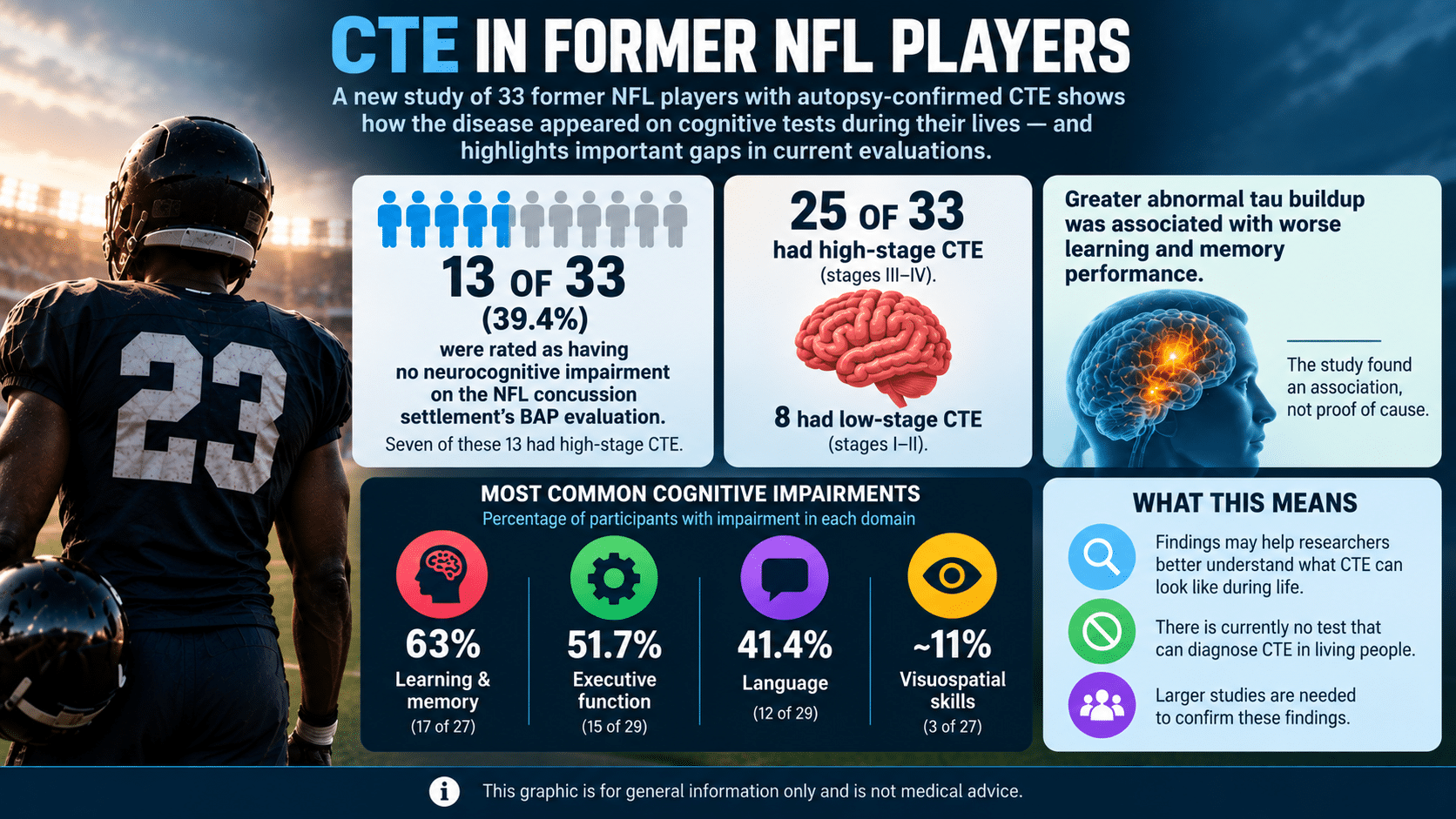
These 33 men had an average age of about 65 at the time of death, and cognitive testing had typically happened a little over two years before they died. Twenty-five of the men had high-stage, more advanced CTE, while eight had low-stage, milder disease. Researchers converted each man’s raw test scores into standardized scores based on age, sex, and education, then flagged scores as “impaired” if they fell well below what would be expected for a healthy person of similar background. A whole category of thinking skills, such as memory or language, was only counted as impaired if at least two separate tests within that category came back low, a step meant to avoid false alarms from a single bad test result.
Memory Problems Were the Biggest Red Flag in CTE Brains
Learning and memory were the most frequently affected areas, with 17 of 27 evaluable participants, or 63%, showing impairment. Problems with planning, focus, and flexible thinking, what researchers call executive function, affected about 52% of participants, and language difficulties showed up in about 41%. Visual and spatial skills were largely spared, with impairment in only about 11% of cases.
Men with more advanced, high-stage CTE generally scored worse across the board than those with milder disease. Among the memory tests, one that involved recalling a short story after a delay tripped up close to 60% of participants. An even tougher challenge came from a task measuring mental flexibility and switching between activities, which carried the single highest failure rate of any test in the battery, at nearly 68%.
How Tau Buildup Tracked With Worse Memory in CTE
Beyond simply cataloging symptoms, researchers wanted to know whether the actual severity of brain damage lined up with test performance. CTE is marked by a buildup of an abnormal form of a protein called tau, which collects in brain cells. Researchers measured how much of this tau buildup existed across 11 different brain regions and combined it into an overall severity score.
Higher tau buildup was closely tied to worse memory and learning scores, even after accounting for a participant’s age, education, and the time between testing and death. This relationship held up even after researchers removed nine participants who also had other brain diseases, like Alzheimer’s, that can independently cause memory loss. That strengthens the case that CTE-related brain changes, rather than other diseases alone, were linked to much of the memory decline seen in these men.
How Standard Cognitive Tests Missed Advanced CTE
Perhaps the most surprising result involved how these men were classified at the time of testing. Thirteen of the 33 participants, about 39%, received an official rating of “no neurocognitive impairment” on their concussion settlement evaluation. Seven of those 13 men had high-stage CTE at autopsy. Many showed clear impairment on individual objective tests but did not meet the specific combination of criteria required for an official diagnosis under the settlement’s rules.
Researchers pointed to differences in how impairment is defined as a likely explanation. The settlement’s diagnostic system requires decline across multiple specific categories along with a certain severity threshold tied to daily functioning, a stricter bar than more commonly used clinical definitions of cognitive decline, which only require a problem in one area of thinking. In practical terms, a man could be struggling with real, measurable memory or language problems tied to confirmed CTE and still walk away from testing with a clean bill of cognitive health.
Researchers also noted that performance validity checks, tools used to determine whether someone was trying their best on the tests, showed a lower rate of questionable effort in this group than is typically seen in other legal or disability-related testing settings. That detail matters because it suggests the impairment patterns found here likely reflect genuine cognitive struggles rather than random noise or test gaming.
CTE cannot be diagnosed while someone is alive, and that single fact has left families, doctors, and former athletes guessing for years about what might be happening inside a struggling person’s brain. This study doesn’t solve that problem outright, but it does something arguably more urgent: it shows that the impairment ratings used in the concussion settlement can classify men with confirmed CTE as cognitively normal, even when objective tests point to real problems. Worse memory performance went hand in hand with greater tau buildup in these men, a real and measurable pattern rather than a vague complaint, and a system that rated nearly 4 in 10 of them as having no cognitive impairment, despite confirmed CTE and clear struggles on individual tests, deserves a hard second look.
Paper Notes
Limitations
Researchers described this as a small, convenience sample of brain donors, meaning the 33 men studied were not randomly selected and may not represent all former NFL players or people exposed to repetitive head impacts more broadly. All participants had extensive head impact exposure from playing professional football, so the findings cannot speak to CTE or cognitive function in people with lower levels of head impact exposure. The tau protein measurements were not exclusive to CTE and could reflect overlapping damage from other brain diseases in some regions, though the main findings held up after removing participants with Alzheimer’s disease or a related condition called frontotemporal lobar degeneration tau. The study had no comparison group of people without CTE, and because it looked at a single point in time rather than tracking people over years, it cannot show how cognitive decline changes as the disease progresses. Missing test data reduced sample sizes for some measures, and the standard test battery used did not include certain memory tests common in other neurodegenerative disease research.
Funding and Disclosures
This study was supported by grants from the National Institute of Neurological Disorders and Stroke and the National Institute on Aging. The funders had no role in the design or conduct of the study, data collection or analysis, manuscript preparation, or the decision to publish. Several authors disclosed financial relationships outside this specific study, including consulting, expert witness work, grants, royalties, or stock options tied to organizations such as the NFL Concussion Settlement Players Advocacy Committee, the Concussion & CTE Foundation, and various federal research agencies. Full disclosure details are listed in the original publication.
Publication Details
Paper Title: “Neuropsychological Profile of Autopsy-Confirmed Chronic Traumatic Encephalopathy”
Authors: Anna Aaronson, MS, and colleagues, with corresponding author Michael L. Alosco, PhD, of the Boston University Chobanian and Avedisian School of Medicine.
Journal: JAMA Network Open, 2026;9(9):e2631754


