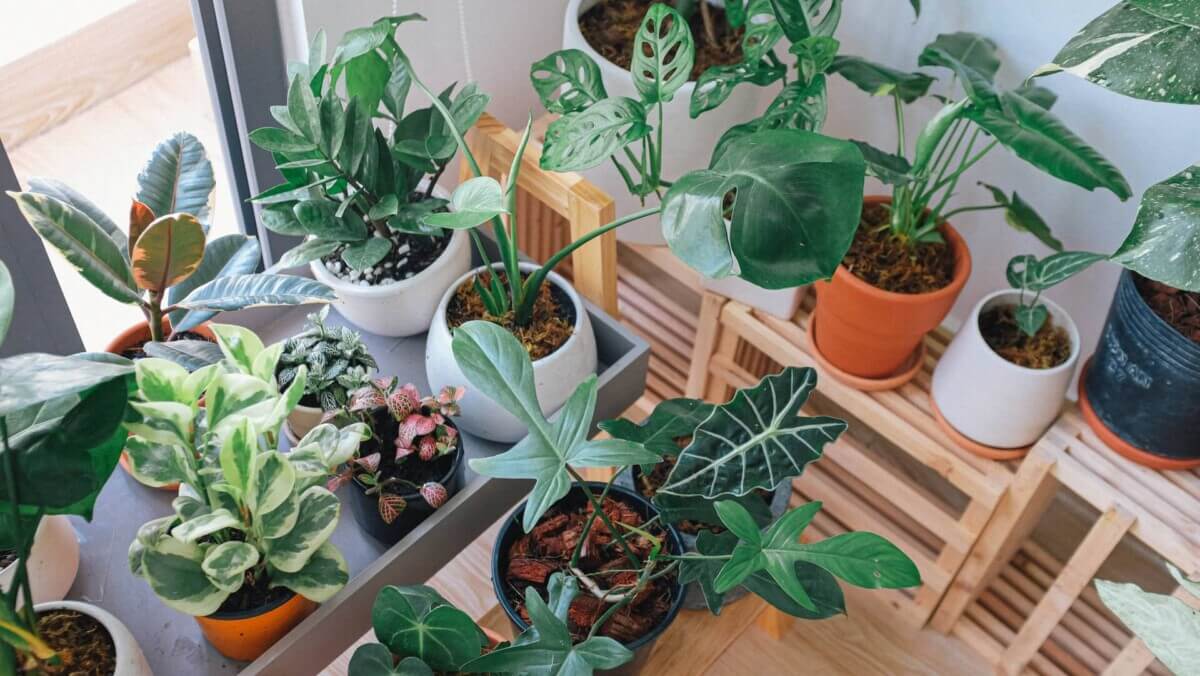
(Photo by Huy Phan from Pexels)
In A Nutshell
- Indoor plants deliver real psychological and comfort benefits, but mostly through how they make people feel, not through measurable air purification.
- You would need between 10 and 1,000 plants per square meter of floor space to match what a standard ventilation system already does for air quality.
- Several studies show people in plant-filled rooms report feeling cooler and less stressed even when temperature readings are identical to plant-free rooms.
- Engineered green wall systems outperform potted plants significantly, but come with steep installation and maintenance costs most homeowners cannot justify.
Walk into a room with a few leafy plants on the windowsill, and something shifts. The space feels a little calmer, maybe a touch cooler, a bit more pleasant to be in. A large scientific review published in the journal Building and Environment suggests that feeling is real, and yet, the most reliable benefits of indoor plants have little to do with air purification at all.
Researchers from more than a dozen institutions across the United States, United Kingdom, Brazil, Australia, and Europe spent years synthesizing what science actually knows about how indoor plants affect the places where people live and work. They concluded that plants deliver genuine psychological and comfort benefits, but through a mechanism most people would not expect, and that the wellness industry rarely bothers to explain honestly.
Most adults in wealthy countries now spend roughly 90% of their lives indoors. What happens inside those buildings, to the air, the temperature, and the emotional state of the people in them, has real consequences for health and daily functioning. Indoor plants have long been marketed as a natural fix for all of it. The science tells a more careful story.
The Real Reason Indoor Plants Make You Feel Better
Several controlled studies reviewed by the research team found that people in rooms with visible plants consistently rated their environment as more comfortable, cooler, and more pleasant, even when the actual temperature and humidity were identical to plant-free rooms. In one classroom study conducted in India, students near potted plants reported feeling meaningfully cooler and more comfortable than those without plants nearby. The thermometer told a different story: the measured air temperature in both rooms was the same.
Similar results showed up in Dutch offices, where workers surrounded by substantial indoor planting reported higher rates of thermal comfort across all four seasons, including winter, when measurable temperature effects are limited.
That single detail is telling. If the benefit were purely physical, it would disappear in winter. It does not. What researchers are observing is something more psychological, a phenomenon environmental scientists call biophilic response. Humans appear to be wired to find natural settings calming and restorative, and simply seeing plants seems to trigger that response whether or not the plants are doing anything measurable to the air around them.
Several short-term lab and field studies report lower stress markers and shifts toward relaxed physiological states in people exposed to indoor greenery. Some studies suggest patients report lower anxiety and improved mood in rooms with plants. In classrooms, students in plant-containing environments showed modest but consistent gains in test scores and response times across multiple independent studies.
People also describe something harder to quantify. Interviews and observational research show that individuals in greener spaces develop a stronger sense of connection to their surroundings, a feeling of belonging that shows up even in difficult circumstances. In a Syrian refugee camp in northern Iraq, community gardens and green walls planted alongside tents provided cooling relief during extreme heat while also giving many residents a sense of place and agency in conditions that stripped away most of both.
Not everyone welcomed the plants. Some residents saw them as an unwanted symbol of permanence in displacement. Those divergent reactions are a reminder that the relationship between people and indoor greenery is shaped by personal history and circumstance, not just square footage.

What Houseplants Actually Do to the Air
None of this means plants have no physical effect on indoor air. Certain common houseplants, including the peace lily and the corn plant, have demonstrated real pollutant-removal abilities under controlled conditions, absorbing nitrogen dioxide and various chemicals released by building materials, cleaning products, and furniture. Plants also release water vapor through their leaves, which can raise indoor humidity modestly and slightly lower the temperature of the air immediately around them.
The practical limits of these effects, however, are steep. Under typical ventilation rates found in American homes and offices, researchers estimate that between 10 and 1,000 plants per square meter of floor space would be needed to match what a standard ventilation system already does. A well-ventilated room, in short, renders a shelf full of houseplants largely irrelevant as an air-cleaning strategy. For carbon dioxide specifically, the amounts people exhale indoors far exceed what any realistic collection of plants could offset.
Temperature and humidity effects are real but small. In typical indoor settings, plants lowered air temperature by roughly 1 to 2 degrees Fahrenheit and raised humidity by between two and five percent, often below the threshold most people can actually feel. In rooms with active heating or air conditioning, even those modest shifts can disappear entirely.

Bigger Systems, Bigger Results, at a Price
Engineered green wall systems, the kind that actively pull air through soil and plant roots rather than just sitting passively on a windowsill, perform considerably better on every environmental measure. In controlled pilot installations with active airflow and specialized design, one professionally monitored living wall reduced nearby air temperature by up to roughly 8 degrees Fahrenheit and cut carbon dioxide concentrations by up to half. Energy savings in some installations have been documented in the range of 6 to 12 percent. These are best-case results from optimized systems, not what a few plants on a shelf will deliver.
Getting there is expensive and complicated. Installing a living wall in an existing building involves structural load limits, plumbing requirements, lighting needs, and ongoing upkeep that the review describes as substantial and often prohibitive. Maintenance demands, including clogged irrigation lines, pest control, and regular pruning, can accumulate significantly over time. Clear performance standards and certification frameworks for indoor green infrastructure are still limited, which makes schools, hospitals, and commercial buildings hesitant to commit resources without clearer guarantees.
For most people, the realistic version of indoor greening is a few well-chosen plants near a window. That is not nothing. The psychological benefits are consistent across enough independent studies, climates, and building types to be taken seriously, particularly for people in low-income housing, crowded apartments, or places with limited access to outdoor green space. A potted plant requires no permits, no structural modifications, and no expert maintenance. The return on a few dollars spent at a garden center turns out to be more about how a room feels than what it measures, and for a lot of people, that may be exactly enough.
Paper Notes
Study Limitations
Most studies examined in this review were conducted in controlled laboratory or chamber settings rather than occupied real-world buildings, which limits how broadly findings can be applied. Sample sizes in individual studies were often small, and exposure periods were frequently short. The majority of research focused on specific plant species or isolated pollutants rather than the full range of conditions found in actual homes and offices. The authors note a positive bias in the published literature, with comparatively few studies reporting neutral or adverse outcomes from indoor greening. Long-term field studies tracking both environmental and health outcomes remain scarce, and most psychological research relied on student samples with short exposure durations, leaving questions about lasting effects across diverse populations.
Funding and Disclosures
This research was conducted under the UKRI (EPSRC)-funded GREENIN Micro Network Plus (Grant No. APP55977) as part of its rapid reviews series, with additional support from the UGPN-funded tri-lateral GREENICON project involving institutions in the United Kingdom, United States, and Brazil. The corresponding author and colleagues also received support from the RECLAIM Network Plus (EP/W034034/1; EP/W033984), GP4Streets (UKRI1281), and GreenCities (NE/X002799/1; NE/X002772/1) projects, as well as from CNPq and FAPESP (Process no. 2024/01097-2). The authors declared no competing financial interests or personal relationships that could have influenced the work.
Publication Details
“Ten questions on indoor greening and environmental quality” was authored by Prashant Kumar, Hao Sun, Akash Biswal, Anubhav Kumar Dwivedi, Ho Yin Wickson Cheung, Kamaldeep Bhui, Tijana Blanusa, Bert Blocken, Nicole van den Bogerd, John Kaiser Calautit, Nicola Carslaw, Brian Considine, Frederic Coulon, Tracy Epton, H. Christopher Frey, Andrew Grieshop, Laurence Jones, Supreet Kaur, Aonghus McNabola, Sumit Kumar Mishra, Lidia Morawska, and numerous additional co-investigators from institutions across the United Kingdom, United States, Brazil, Australia, Netherlands, Germany, and Belgium. Published in Building and Environment, Volume 294 (2026), Article 114336. Received November 20, 2025; revised February 4, 2026; accepted February 5, 2026; available online February 6, 2026. DOI: https://doi.org/10.1016/j.buildenv.2026.114336. Corresponding author: Prashant Kumar, University of Surrey, Guildford, UK ([email protected]).


