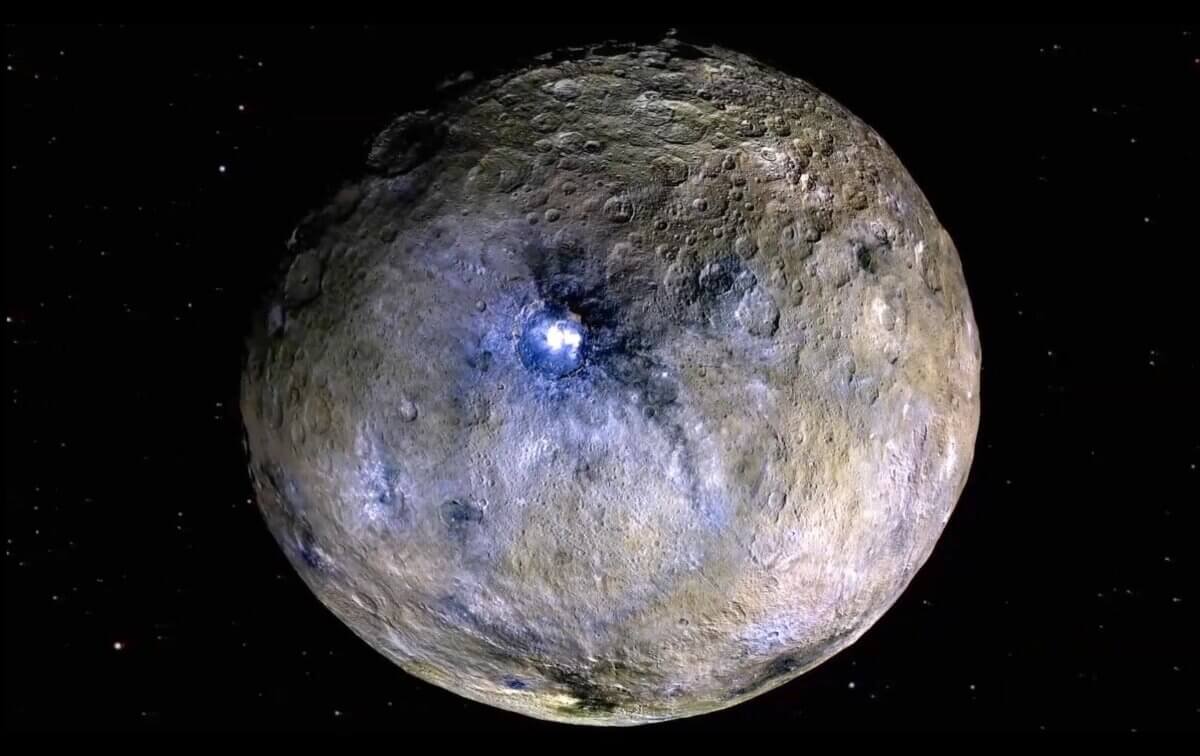
Dwarf planet Ceres (Credit: NASA/JPL-CalTech/UCLA/MPS/DLR/IDA)
WEST LAFAYETTE, Ind. — A dwarf planet hiding right in the middle of our solar system could be a surprising source of frozen water, astronomers reveal. A new study finds that Ceres, which sits in the asteroid belt between Mars and Jupiter, has a crust that’s 90% ice.
The discovery of this dirty ice crust has led scientists to believe this giant asteroid used to be a muddy water world. Astronomers have studied Ceres since it was first discovered in 1801. It is both a dwarf planet and the largest asteroid in our solar system. The protoplanet is spherical, with a diameter of approximately 590 miles, and is riddled with craters, volcanoes, and landslides. In 2007, NASA sent the Dawn spacecraft to study Ceres. It reached the dwarf planet in 2015 and orbited it until 2018.
While examining the rough surface, astronomers ruled out any signs of water existing on the asteroid because of the visible craters all over the surface. The common belief was that Ceres is relatively dry, with less than 30% ice.
However, the new study, published in the journal Nature Astronomy, argues that scientists might have judged this crater-rich planetoid too soon. The way the craters formed and the planet’s mass suggest an ice-rich environment. Using spectrographic data from the Dawn mission and computer simulations, the researchers noticed that there may be ice in Ceres’s subsurface. Gravity data also showed a density value close to that of impure ice.
“We think that there’s lots of water-ice near Ceres surface, and that it gets gradually less icy as you go deeper and deeper,” says Mike Sori, an assistant professor in Purdue University’s Department of Earth, Atmospheric, and Planetary Sciences, in a media release. “People used to think that if Ceres was very icy, the craters would deform quickly over time, like glaciers flowing on Earth, or like gooey flowing honey. However, we’ve shown through our simulations that ice can be much stronger in conditions on Ceres than previously predicted if you mix in just a little bit of solid rock.”
The researchers mapped out a geographical profile of an actual crater from Ceres and used the information to create computer simulations. The computer simulations modeled how the dwarf planet’s craters relax and deform over billions of years.
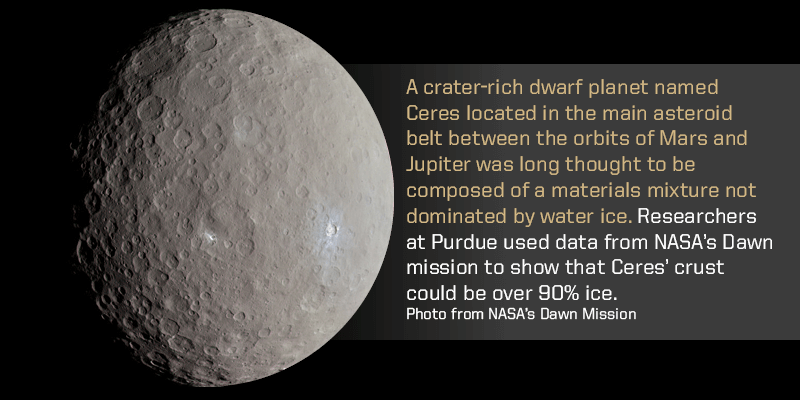
According to the authors, the findings suggest Ceres was once a frozen ocean world similar to one of Jupiter’s moons, Europa. The muddy ocean froze over time, creating an icy crust with some trapped rock. The ice-rich crust had found some way to resist crater relaxation.
“To me the exciting part of all this, if we’re right, is that we have a frozen ocean world pretty close to Earth,” adds Sori. “Ceres may be a valuable point of comparison for the ocean-hosting icy moons of the outer solar system, like Jupiter’s moon Europa and Saturn’s moon Enceladus.”
The new findings could also warrant a manned space mission to the crater-rich dwarf planet as it may be one of the best chances astronauts have to visit an icy world.
“Some of the bright features we see at Ceres’ surface are the remnants of Ceres’ muddy ocean, now mostly or entirely frozen, erupted onto the surface. So we have a place to collect samples from the ocean of an ancient ocean world that is not too difficult to send a spacecraft to,” Sori concludes.
Paper Summary
Methodology
The researchers used computer simulations to study how craters on the dwarf planet Ceres might change shape over time. They created virtual models of Ceres’ crust with different amounts of ice and other materials. Then, they simulated what would happen to craters of various sizes over a billion years. They did this for different areas of Ceres, from the equator to the poles, because temperature affects how materials behave.
Key Results
The study found that Ceres can have a lot more ice in its crust than scientists previously thought while still keeping its cratered surface. This is because even a small amount of other materials mixed with the ice makes it much stronger. The researchers found that a crust with about 90% ice near the surface, gradually decreasing to 0% ice deeper down, best matches what we see on Ceres. This structure allows Ceres to keep its craters without much change over long periods, even though it has a lot of ice.
Study Limitations
The study only looked at craters up to 40 km wide. Larger craters might behave differently. The simulations assumed the craters were perfectly round, which isn’t always true in real life. The study didn’t consider all possible materials that might be in Ceres’ crust, focusing mainly on ice and rock. Computer simulations, while helpful, can’t perfectly replicate real-world conditions.
Discussion & Takeaways
Ceres likely has more ice in its crust than previously thought, making it more similar to icy moons in the outer solar system. The dwarf planet’s crust probably formed from a frozen ocean that became more mixed with other materials as it froze from top to bottom. This new understanding of Ceres’ structure could change how we plan future missions to explore it. The study shows that even a small amount of impurities can greatly strengthen ice, which could be important for understanding other icy worlds.
Funding & Disclosures
The research was funded by NASA’s Discovery Data Analysis Program (DDAP) through grant 80NSSC22K1062. All authors received funding from this grant. The researchers declared no competing interests, which means they didn’t have any financial or personal relationships that could have inappropriately influenced their work.


