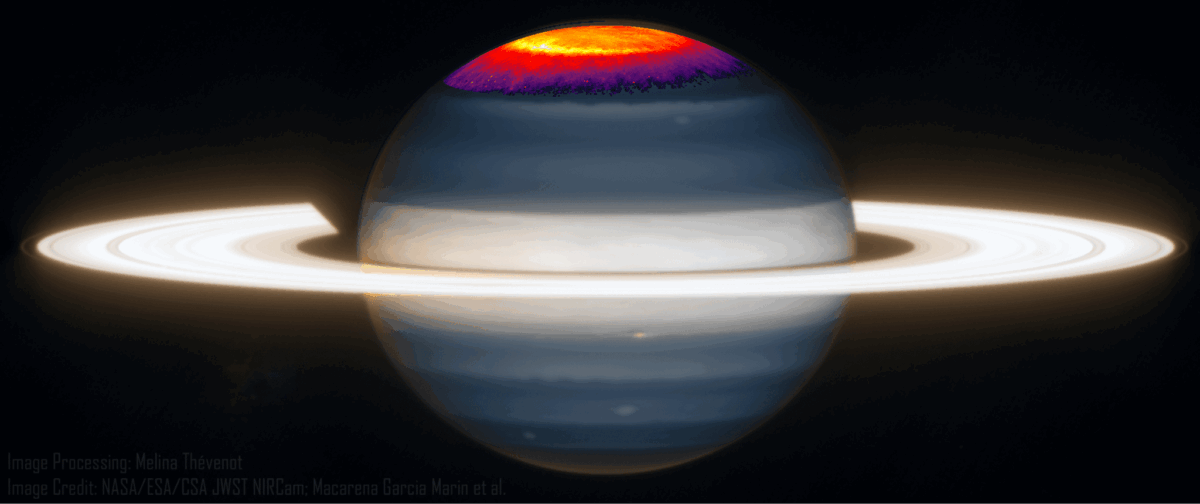
Shows the asymmetric temperature structure revealed in the paper, as it was observed from JWST. These are offset from where the currents flow into and out of the planet, but ultimately, the winds generated by this temperature offset are what drive those currents. (Credit: NASA/ESA/CSA, Tom Stallard (Northumbria University), Melina Thévenot, Macarena Garcia Marin (STScI/ESA).
In A Nutshell
- Scientists have struggled for decades to measure Saturn’s rotation because the radio signals they rely on keep drifting, sometimes by minutes
- James Webb Space Telescope observations of Saturn’s aurora revealed rotating patterns of heating and cooling in unprecedented detail, matching decades-old theoretical predictions
- Saturn’s own aurora appears to operate like a self-sustaining heat pump, feeding energy back into the atmospheric current system that causes the signal drift
- Future modeling using these new temperature maps should help scientists untangle what drives the variability in Saturn’s apparent day length
Scientific study of the planet Saturn has often been bogged down by a seemingly simple yet impossible to answer mystery. How long is a day on the sixth planet from the sun?
Unlike Earth, where a coastline or mountain traces a reliable arc across the sky every 24 hours, Saturn is a featureless ball of gas with no surface to track and no landmarks to time. For decades, scientists relied on the planet’s radio signals as a substitute clock, but those signals kept drifting, sometimes by minutes, with the northern and southern hemispheres occasionally giving different readings entirely. Now, by turning the James Webb Space Telescope toward Saturn’s aurora for the first time, researchers think they’ve found strong evidence pointing to a likely culprit: Saturn’s own upper atmosphere has been generating electric currents that shift the signals scientists use to track its spin.
A study in the Journal of Geophysical Research: Space Physics captured rotating patterns of heating and cooling in Saturn’s upper atmosphere at a level of detail no previous telescope could produce. What researchers found matched old theoretical predictions closely enough to support a long-debated idea: that Saturn’s aurora, its version of the northern lights, operates like a self-sustaining heat pump, drawing power from the planet’s magnetic field. That heat pump, researchers strongly suspect, is what has been throwing off the clocks all along.
Saturn’s auroras, like Earth’s, flare near the poles, but Saturn’s work a bit differently. On Earth, auroras are triggered by charged particles streaming in from the sun. At Saturn, a separate layer of electric currents driven by winds in the upper atmosphere also contributes, creating a rotating bright spot that pulses as the planet spins. That pulsing signal is what scientists have historically used to estimate Saturn’s “day.”
Why Saturn’s Rotation Has Baffled Scientists for Decades
Saturn’s radio-measured “day” has never kept steady time. Its true interior rotation has been estimated at around 10 hours and 33 minutes, calculated from the planet’s gravitational field and the vibrations of its rings. Yet the radio-based estimate has drifted between roughly 10.6 and 10.8 hours over the years, and the north and south hemispheres haven’t always agreed. When the Cassini spacecraft ended its mission in 2017, tracking became even harder. By 2024, researchers estimated the accumulated uncertainty in the northern hemisphere’s signal had ballooned past 56 full Saturnian days. Something in the atmosphere was clearly drifting, but nobody could pin down what was driving it.
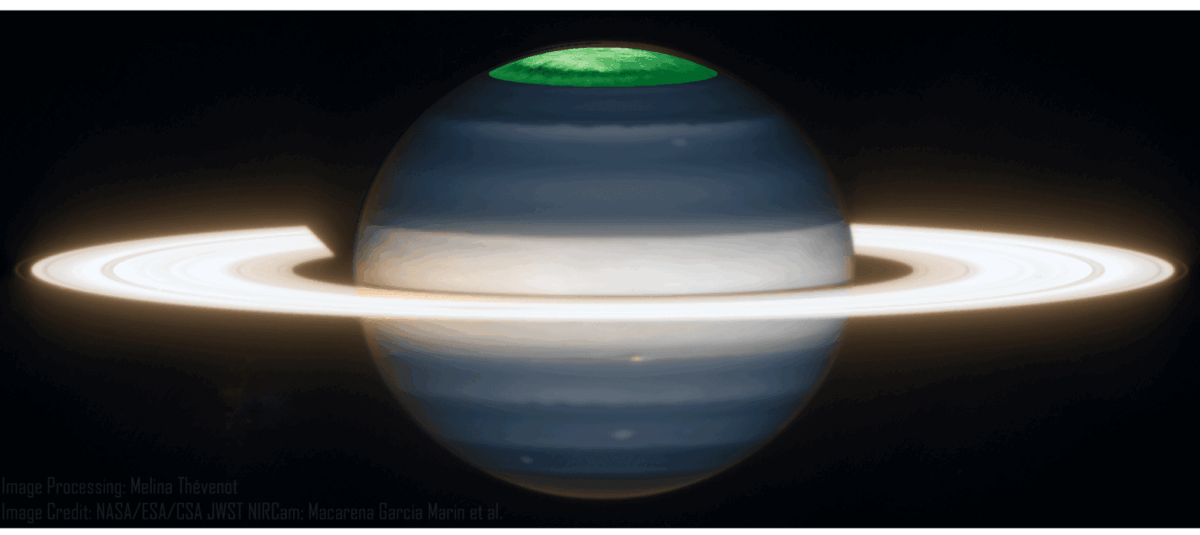
Observations made on November 29, 2024, offered the most detailed view of Saturn’s northern auroral region ever recorded. James Webb mapped temperature and electrically charged particle levels across the aurora at better than 500 kilometers per pixel, at least ten times finer than any prior instrument. What came back was a highly organized rotating pattern of heating and cooling that matched model predictions surprisingly well, consistent with the structure theorists had long predicted would be responsible for the drift.
A Heat Pump Hiding in Saturn’s Aurora
Across Saturn’s auroral zone, one side of the pole runs measurably hotter than the other, with peak temperatures around 480 K on the warm side and around 400 K on the cool side. That lopsided pattern turned out to be the key. Earlier models predicted that an uneven heat source in the upper atmosphere would generate winds, and those winds would drag charged particles through Saturn’s magnetic field, producing the currents that shift the apparent rotation rate.
What makes this persuasive is where the heat sits. Its location lines up closely with where models predict incoming auroral particles are raining down hardest. Saturn’s own aurora, in short, appears to be powering the atmospheric current system. Energy flows in from the magnetic field, heats one side of the upper atmosphere, drives winds, which push particles through the magnetic field, which generate currents, which strengthen the aurora. Researchers describe this as a feedback loop, one that supplies energy to itself in exactly the right place to keep running. Whether the upper atmosphere alone sustains this, or whether deeper layers contribute too, remains open. Observations showed signs of auroral energy extending deeper into the atmosphere, suggesting the process may reach well below the main auroral zone.
How Scientists Finally Got a Clear Look at Saturn’s Rotation
Earlier attempts to map Saturn’s auroral temperatures required stitching together data from multiple telescope sessions and averaging away fine detail in the process. Measurement errors were often as large as the temperature differences researchers were trying to detect, making firm conclusions elusive.
James Webb changed the math. Each data point in the new maps covers about 500 kilometers, with more than 20 separate measurements contributing to each location. Temperature shifts of just 20 to 30 degrees became detectable. Readings of charged particle levels, which show the strength and direction of electric currents, improved by a comparable margin. Bands of upward and downward current flowing through the auroral region matched patterns Cassini had recorded from far outside Saturn’s atmosphere, now confirmed from directly above it.
One detail stood out. In several areas across Saturn’s auroral zone, temperature and charged particle levels rose together, a sign of localized heating rather than shifts in how deep incoming particles are burrowing. Pinning that down matters for identifying exactly where the heat source lives.
The study brings Saturn’s rotation mystery meaningfully closer to resolution. Future modeling, now equipped with precise temperature maps, should help clarify how much of the drift comes from upper atmospheric winds versus deeper electrical processes. Saturn has been keeping this secret for decades. Scientists are finally starting to read it.
Paper Notes
Limitations
This study is based on a single observing session of approximately 10 hours on November 29, 2024, covering one Saturnian day. Researchers acknowledge that the degree of atmospheric control observed may not represent typical conditions, and that during periods of elevated solar wind activity, local-time-dependent processes would likely dominate. Because observations were assembled from data taken at various times across a single rotation, local-time effects were smoothed over rather than resolved independently. Total emission error values could not be directly calculated and require empirical modeling to estimate. Raw data remains under embargo with the Mikulski Archive for Space Telescopes at time of publication.
Funding and Disclosures
Tom S. Stallard and Emma M. Thomas were supported by the STFC Consolidated Grant (ST/W00089X/1). Henrik Melin was supported by the STFC James Webb Fellowship (ST/W001527/2). Luke Moore acknowledges support from program number JWST-GO-05308.001-A, provided through a grant from the Space Telescope Science Institute under NASA contract NAS5-03127. James O’Donoghue was supported by the STFC Ernest Rutherford Fellowship (ST/X003426/1). Rosie E. Johnson was supported by NERC Grant NE/W002914/1. Paola I. Tiranti was supported by an STFC PhD studentship (ST/X508548/2). Katie L. Knowles was supported by a Northumbria University Research Studentship. Sarah V. Badman was supported by STFC Grant ST/Y002393/1. Authors declare no conflicts of interest.
Publication Details
This study was conducted by Tom S. Stallard, Luke Moore, Henrik Melin, Chris G. A. Smith, Omakshi Agiwal, M. Nahid Chowdhury, Rosie E. Johnson, Katie L. Knowles, Emma M. Thomas, Paola I. Tiranti, James O’Donoghue, Khalid Mohamed, Ingo Mueller-Wodarg, John C. Coxon, Sarah V. Badman, and Joe A. Caggiano, representing institutions including Northumbria University, Boston University, the University of Leicester, Aberystwyth University, the University of Reading, Imperial College London, Lancaster University, and Johns Hopkins University Applied Physics Laboratory. Published in 2026 in the Journal of Geophysical Research: Space Physics, volume 131. Paper title: “JWST/NIRSpec Reveals the Atmospheric Driver of Saturn’s Variable Magnetospheric Rotation Rate.” DOI: 10.1029/2025JA034578.


