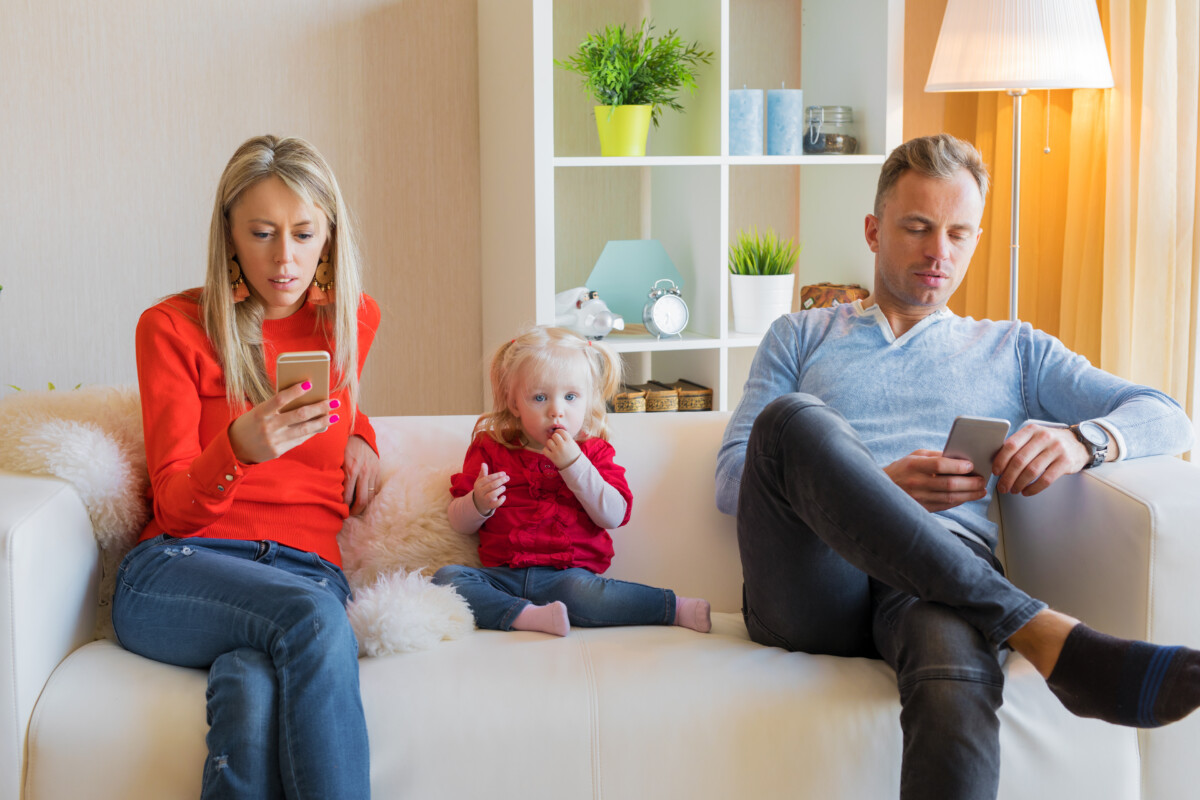
(Photo by Kaspars Grinvalds on Shutterstock)
Studies Show Why Moms & Dads Glued To Their Phones Make Family Time Feel Less Close
In A Nutshell
- Research suggests that when parents use their phones during family time, everyone can feel less connected in the moment. The long-term links to how kids develop are small and appear to run in both directions.
- Lab experiments, playground observations and a review that pooled 21 studies with about 14,900 participants point the same way. Other research suggests full absorption in a phone matters more than quick glances, and one study linked mothers’ feelings about their phone use, not the amount, to the quality of a feeding interaction.
- The problem appears to be split attention more than the device itself, so short phone-free stretches during meals, play and conversation may matter more than cutting out screens entirely.
A first-grader stands at the kitchen counter holding up a crayon drawing of a dragon with seven legs. She’s explaining why it needs the extra legs (something about climbing volcanoes) when her dad says, “Wow, awesome,” without looking up from his screen. She explains again, louder. He nods. Eventually she wanders off to show the dog.
Nothing dramatic happened here. Nobody yelled, and the dad would probably say he was listening. Researchers even have a name for moments like this one: “technoference,” meaning the everyday interruptions technology causes when people are spending time together. Over the past decade, scientists have been testing whether these half-present moments add up to families that feel less connected.
What they’ve found is more nuanced than “phones are ruining families,” and more useful. Phones don’t seem to break family bonds the way a power outage kills the lights. They act more like a dimmer switch. They turn down the warmth of a moment, usually only a little, and usually only while the screen has someone’s attention. How far the light dims seems to depend less on the gadget than on how completely it pulls a parent away.
What Happens When Parents’ Phone Use Interrupts Time With Kids?
Studies suggest children notice right away, and parents may feel less connected too.
One way scientists test this comes from decades of infant research. A parent plays normally with a baby, stops responding for a short stretch, then reconnects. In a 2018 study in Developmental Science, researchers ran this test with 50 babies between about 7 and 24 months old. During the unresponsive stretch, mothers looked at a mobile device. The babies reacted the way babies do in the classic version of the test: they smiled less, fussed more and made the most attempts to get their mother’s attention back.
The researchers also asked mothers how much they use their devices in daily life. Babies whose mothers reported heavier use showed less happiness and explored the room less during the phone phase. They also had a harder time bouncing back once their mothers re-engaged. That comparison relies on mothers’ own reports, so it shows a link, not proof that heavy device use caused the weaker recovery.

Real life looks similar. For a 2020 study in Cyberpsychology, Behavior, and Social Networking, researchers quietly watched 53 parents with children age 5 or younger in waiting rooms and on playgrounds. They broke the observations into more than 1,000 ten-second slices. In 641 of those slices, the child tried to get the parent’s attention. When parents were using a phone, the odds that they responded were five times lower. When they did respond, their responses were slower, weaker and less warm.
Parents seem to pay a price too. In a field experiment published in the Journal of Social and Personal Relationships, psychologists Kostadin Kushlev and Elizabeth Dunn randomly assigned about 200 parents visiting a science museum with their children to one of two groups. One group used their phones as much as they safely could; the other used them as little as possible. Parents who used their phones more felt more distracted. That distraction was tied to feeling less connected to their kids and finding less meaning in the outing.
A follow-up diary study of nearly 300 U.S. parents found the same pattern in everyday life. When parents had not used their phones at all in the previous half hour, they felt less distracted around their children, and that was tied to feeling closer.
The pattern isn’t limited to parenting. A study of more than 300 people sharing a restaurant meal with friends or family found that diners who were told to keep their phones on the table felt more distracted. They also enjoyed the meal about half a point less on a seven-point scale than diners told to put their phones away. That’s a modest dip, small enough that most people wouldn’t notice it happening.
Is The Phone The Problem, Or The Distraction?
Research suggests attention matters more than the device itself.
If phones carried some special power to disconnect people, other distractions shouldn’t hurt as much. Two experiments tested that idea directly. In a 2021 study in Frontiers in Psychology, 54 German mothers played with their toddlers, who were 20 to 22 months old. Partway through the play session, some mothers got a text asking them to fill out a two-minute questionnaire on a smartphone. Others filled out the same questionnaire on paper, and a third group kept playing. Mothers in both interrupted groups became less responsive, and their toddlers made more friendly bids for attention. But the smartphone mothers and the paper mothers looked about the same. The researchers concluded that “technoference might operate in similar ways to other types of interruptions.” Once the two minutes ended, the mothers’ responsiveness returned to normal.
A study in Child Development from Tel Aviv University found a similar result. Thirty-three Israeli mothers and their 2- to 3-year-olds went through three sessions: the mother used a smartphone, the mother read a printed magazine, or the two simply played together. In both the phone and magazine sessions, mothers spoke less, missed more of their child’s bids, responded less often and traded fewer back-and-forth turns of conversation.
So why do phones get singled out? The playground study offers a clue. Quick glances at a phone didn’t reduce parents’ responsiveness, but getting fully absorbed did. Absorbed phone use was no worse than getting deeply caught up in other activities that had nothing to do with the child. Parents just got absorbed in their phones more often. Phones are built to hold attention, and they’re always within reach.
How parents feel about their phone use may matter too. One 2025 study in Frontiers in Developmental Psychology suggests that how mothers felt about their phone use was more closely linked to the quality of a feeding interaction than the amount of phone use recorded in daily life. Researchers tracked phone use with apps for five days around the time 147 babies were about 2 months old and videotaped a feeding. The share of time mothers spent on their phones while with their babies wasn’t linked to interaction quality. Mothers who said their phones helped them, for example by making them feel more confident as parents, had higher-quality interactions. The study captured one point in time, its effects were small, and the authors note it doesn’t contradict experiments showing that phone use disrupts interaction in the moment. In the museum experiment, one kind of phone use even went along with more connection: looking up information about an exhibit for the kids.

Does Parents’ Phone Use Affect Children Over Time?
Large reviews link it to small differences in behavior and development, and the connection seems to run both ways.
The broadest look so far is a 2025 meta-analysis in JAMA Pediatrics led by researchers at the University of Wollongong in Australia. A meta-analysis pools the results of many studies. This one combined 21 studies covering about 14,900 participants in 10 countries. Children under 5 whose parents used technology more around them tended to score slightly lower on thinking skills, helpful and cooperative behavior, and attachment to their parents. They also tended to score slightly higher on emotional and behavior problems and spent more time on screens themselves. Language was the one outcome with no clear link. Whether parents were simply distracted by a device or actively interrupted an interaction to use it made no measurable difference. The authors stressed that these associations held “although the effect sizes were small.” Most of the studies captured a single moment in time, so they can’t show that parents’ tech use caused the differences.
Studies that follow families over time suggest a two-way cycle. In 2018, Brandon McDaniel of Illinois State University and Jenny Radesky of the University of Michigan Medical School studied more than 170 two-parent families with a child age 5 or younger, surveying them several times over six months. Children who acted out more, with tantrums or frustration, tended to have parents who grew more stressed and then turned to their devices more. That device use, in turn, often predicted more acting out later on. These patterns came from statistical models of parents’ survey answers, so they show how the problems tended to move together over time, not proof that one caused the other. For a stressed parent, the phone can work like a pressure valve that, over time, may add to the pressure.
A similar cycle showed up in older kids. A 2024 study in JAMA Network Open followed 1,303 Canadian children at ages 9, 10 and 11. The children were asked whether they wished their parent spent less time on devices, and whether they got frustrated when a parent was on a phone during time together. Kids with more anxiety symptoms reported more parental device distraction a year later. Kids who reported more distraction showed slightly more attention problems by age 11. All the effects were small, and some estimates were uncertain. All the answers came from the children themselves, and the data were collected during the COVID-19 pandemic, when family screen habits changed.
Are Kids’ Own Devices Weakening Family Bonds?
One large study found little evidence that daily use causes consistent harm.
If parents’ phones carry measurable costs, it seems natural to assume kids’ phones do too. The evidence there is weaker. A study in the Journal of Research on Adolescence surveyed 2,104 North Carolina students with an average age of about 12. Then 388 of them answered short phone check-ins several times a day for two weeks. Days with more technology use were not consistently linked to worse interactions with parents or less time with close family and friends. Simply owning a phone wasn’t linked to household chaos either. The one warning sign came from the larger survey: kids who used social networking sites more reported more household chaos and more problems with parents tied to their online lives. Those links came from a single survey at one point in time, so they don’t prove cause.
Taken together, the research gives a fairly clear picture. Smartphones don’t appear to wreck family relationships on their own. The long-term links are small and tangled up with stress, behavior problems and the push and pull of everyday parenting. But in the moment, the evidence from labs, playgrounds and dinner tables lines up: when a screen fully captures a parent’s attention, kids notice and try harder to reconnect, and parents come away feeling a little less close.
That suggests the answer is less about banning devices and more about protecting certain moments. Radesky has said that cutting out home technology entirely may be neither realistic nor necessary, but that boundaries “can help parents keep smartphones and other mobile technology from interrupting quality time.” Back at the kitchen counter, the seven-legged dragon takes about 90 seconds to explain. Setting the phone aside for that long costs almost nothing, and the research suggests it may be one of the easiest ways to keep a family’s dimmer switch turned all the way up.
Disclaimer: This article summarizes several kinds of research: short laboratory experiments with infants and toddlers, naturalistic observation of parents in public settings, an infant-feeding study with app-tracked phone use, field and dinner-table experiments with adults, diary and repeated-survey studies, longitudinal cohort studies and a meta-analysis that pooled mostly cross-sectional studies. The experiments measured reactions over minutes or hours, not lasting outcomes, and the longer-term studies relied largely on parent or child self-reports and cannot establish cause and effect. The studies reviewed here focused on smartphones, tablets and similar screens, not smart speakers or other connected home devices. Effect sizes were generally small, and several studies found that child behavior and family stress may drive parents’ device use as much as the reverse. This article is for general information and is not a substitute for advice from a pediatrician, psychologist or other qualified professional.


