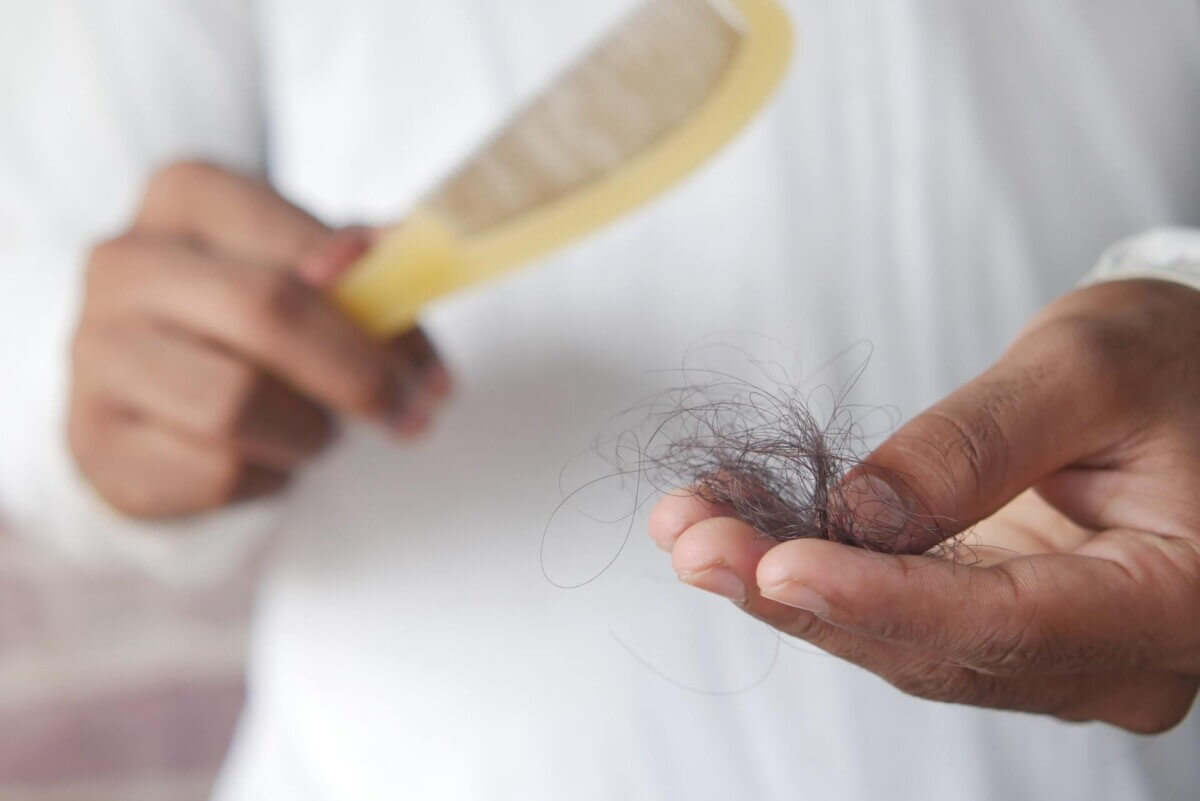
(Photo by Towfiqu barbhuiya from Pexels)
Ozempic and Hair Loss: What a New Study Found
In A Nutshell
- A large study of tens of thousands of adults with type 2 diabetes found people on GLP-1 drugs like Ozempic and Wegovy were more likely to be diagnosed with hair loss than people on two other common diabetes medications.
- The increased risk sounds bigger in percentage terms (37% to 68% higher) than it looks in real numbers: about 7 in 1,000 GLP-1 patients per year got a hair loss diagnosis, versus 4 to 5 in 1,000 on the comparison drugs.
- Most of the added risk came from a temporary, usually reversible type of shedding linked to rapid weight loss and reduced calorie intake, not permanent damage to hair follicles.
- The study only involved people with type 2 diabetes, so it’s still unclear whether the same pattern holds for the much larger group now taking these drugs purely for weight loss.
People taking GLP-1 drugs like Ozempic, Wegovy, and Mounjaro may be more likely to end up with a hair loss diagnosis than people on certain other diabetes medications, according to a large new study in the BMJ. Mounjaro, known generically as tirzepatide, works a bit differently since it activates two gut hormone receptors instead of one, but researchers grouped it with the broader GLP-1 category here.
Researchers combed through health records from tens of thousands of adults with type 2 diabetes and found that those on GLP-1 drugs were more likely to be diagnosed with hair loss than those on two other diabetes medications. The study puts real numbers behind what had mostly been scattered patient complaints online. Hair loss doesn’t carry the danger of a heart attack or kidney failure, but for people going through it, that hardly matters. It can hit self-esteem hard, and it’s often the reason someone stops taking a medication that’s otherwise helping them.
First Large Population Study Links GLP-1 Drugs to Hair Loss
Until now, evidence linking GLP-1 drugs to hair loss came mostly from scattered case reports and informal complaints to the FDA, which said in 2023 it was looking into a possible safety concern. This is the first large study the authors could find that puts the question to a systematic test, using health records from Penn Medicine, an academic system covering more than 6.5 million patients around Philadelphia, Delaware, and southern New Jersey.
Nearly 24,000 Patients Compared in Two Real-World Analyses
Since this wasn’t a clinical trial with random assignment, researchers instead combed through years of medical records and built the comparison as carefully as they could to mimic one. They looked at adults with type 2 diabetes who started one of three drug types between 2019 and 2024: GLP-1 drugs, or two other common diabetes drugs called SGLT-2 inhibitors and DPP-4 inhibitors. Nobody with a prior hair loss diagnosis was included. About 12,000 people starting GLP-1 drugs were compared against roughly 15,200 starting SGLT-2 inhibitors, and a separate group of about 12,000 GLP-1 starters was compared against 11,233 starting DPP-4 inhibitors.
Researchers chose other diabetes drugs as the comparison, rather than people on nothing, since patients starting any of these drugs tend to look similar health-wise, then used statistics to smooth out remaining differences, like GLP-1 starters being younger and heavier on average.

GLP-1 Users Faced Up to 68% Higher Hair Loss Risk
After accounting for those differences, people on GLP-1 drugs were about 37% more likely to be diagnosed with hair loss than people on SGLT-2 inhibitors, and about 68% more likely than people on DPP-4 inhibitors. Those numbers sound bigger than they are: even after the increase, only about 7 in 1,000 GLP-1 patients per year ended up with a hair loss diagnosis, versus roughly 4 to 5 in 1,000 on the other drugs. Most cases showed up within the first year, clustering just before the one-year mark.
Most of that added risk traced back to a specific, usually temporary kind of shedding called telogen effluvium, where physical or metabolic stress pushes hair into a resting phase and it falls out more than usual. This kind of hair loss often reverses on its own, though the study didn’t track whether hair actually grew back. A permanent, scarring type of hair loss, and an autoimmune type called alopecia areata, showed no clear link to the drugs.
The pattern held up fairly consistently regardless of a patient’s age, sex, race, weight, or which specific GLP-1 drug they took, though researchers noted some of those breakdowns relied on smaller numbers and should be read cautiously.
Weight Loss, Not Drug Toxicity, Is the Likely Culprit
So why would a diabetes and weight-loss drug cause hair to fall out? The researchers’ best guess isn’t that the drug damages hair follicles directly. It’s simpler: losing weight fast, and eating less along the way, is a known trigger for this kind of temporary shedding. Cutting calories fast can also leave people short on nutrients like iron, zinc, and biotin, which hair needs to grow normally.
That theory lines up with what the study found: the hair loss was mostly the reversible kind, and cases were concentrated in the first year, a stretch when many patients on these drugs are losing weight quickly. Researchers also floated broader hormonal and immune effects as possible secondary factors, though they see weight loss as the likelier explanation.
Doctors Urged to Discuss Hair Loss Before Prescribing
GLP-1 medications still come with real, well-proven benefits for blood sugar and weight, and doctors aren’t suggesting anyone panic. But hair loss matters to patients regardless of how minor it looks on paper, and it can be reason enough to quit a medication that’s working. Their advice: doctors should bring it up before starting patients on these drugs, watch for it in the first year, and make sure patients are eating enough while losing weight.
Since everyone in this study had type 2 diabetes, it’s still an open question whether the same pattern shows up in the far larger group now taking these drugs purely for weight loss.
Disclaimer: This article summarizes findings from a peer-reviewed observational study and is intended for general informational purposes only. It is not medical advice. Anyone with concerns about hair loss or their current medications should talk to a doctor before making any changes to treatment.
Paper Notes
Limitations
This was an observational study, meaning it cannot definitively prove cause and effect. Even with statistical adjustments, residual confounding from factors not captured in health records, such as family history of hair loss, lifestyle habits, or precise nutritional status, cannot be fully ruled out. Hair loss diagnoses were identified through billing codes, so mild or transient cases that didn’t prompt a doctor’s visit would not be counted, meaning the true rate may be higher than reported. Because the data came from prescribing records rather than pharmacy dispensing records, researchers cannot confirm patients actually took their medication as prescribed throughout follow-up. Detailed clinical measures of hair loss severity, extent, or reversibility were not available. The study population was drawn entirely from one regional health system in the mid-Atlantic United States, which may limit how broadly the findings apply elsewhere.
Funding and Disclosures
This work was supported in part by the National Institutes of Health (grant numbers RF1AG077820, R01AG073435, and R56AG074604). One author (DAA) has received consulting fees from VAL Health, Thrive Global, and SelectDr, and payment from Deloitte, outside the submitted work. Another author (YL) has received grants or contracts from the National Heart, Lung, and Blood Institute, the Patient-Centred Outcomes Research Institute, Sentara Research Foundation, and Novartis, outside the submitted work. No other relevant relationships were declared. The funding institution had no role in the design, conduct, analysis, interpretation, or reporting of the study. Ethical review was waived by the University of Pennsylvania Institutional Review Board.
Publication Details
Paper Title: Risk of hair loss associated with glucagon-like peptide-1 receptor agonists in adults with type 2 diabetes: target trial emulation | Authors: Huilin Tang, Bingyu Zhang, Yiwen Lu, Dazheng Zhang, Ruishan Liu, Yuan Lu, George Cotsarelis, David A. Asch, Yong Chen | Affiliations: University of Pennsylvania (multiple departments including Biostatistics, Epidemiology and Informatics; Center for Health AI and Synthesis of Evidence; Department of Dermatology; Leonard Davis Institute of Health Economics; Wharton School; Penn Medicine Center for Evidence-Based Practice; Penn Institute for Biomedical Informatics); University of Southern California Department of Computer Science; Yale School of Medicine and Yale New Haven Health | Journal: BMJ | Citation: BMJ 2026;394:e100077 | DOI: 10.1136/bmj-2026-100077 | Published: July 22, 2026


