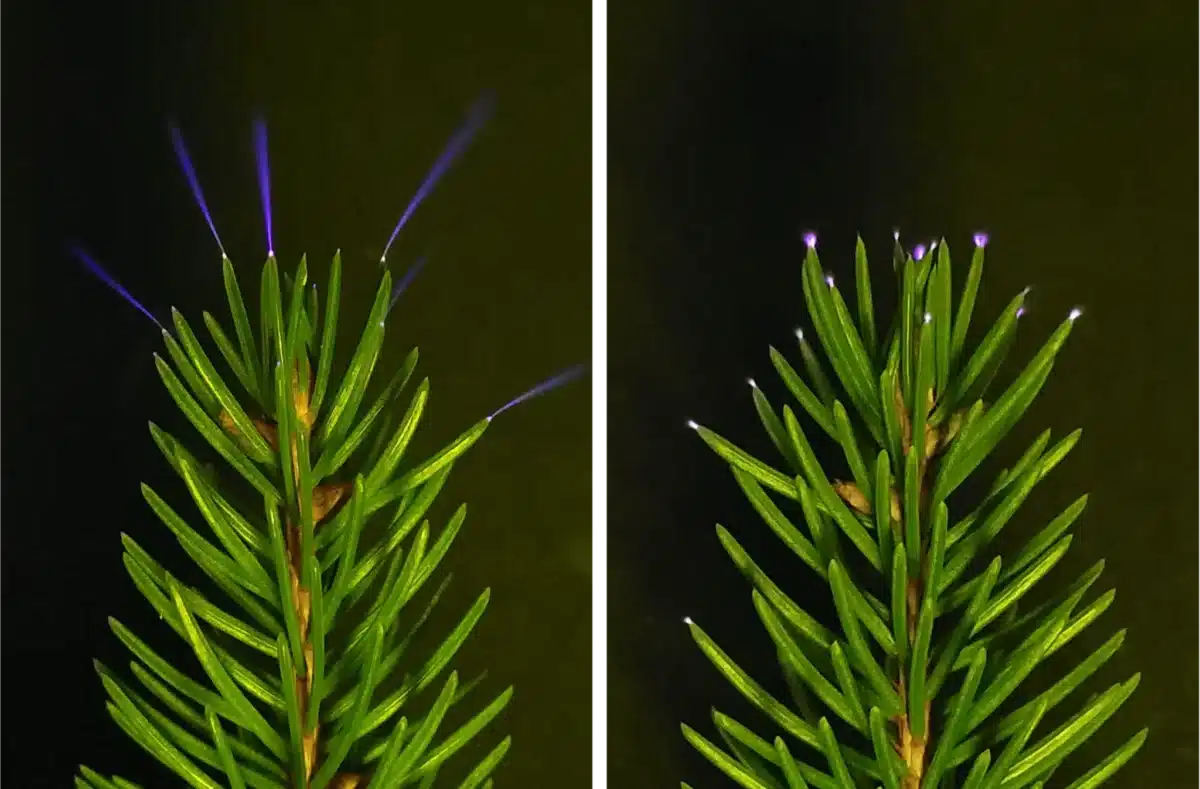
Coronae glow on the tips of spruce needles, induced by charged metal plates in a laboratory. These weak electric discharges subtly singe the tips of leaves and needles, and new observations indicate they may occur ubiquitously across treetops under thunderstorms. (Credit: William Brune)
In A Nutshell
- Penn State scientists captured the first direct evidence of trees producing faint electrical glows, called coronae, during live thunderstorms.
- The discharges hop erratically from leaf to leaf and were observed on multiple tree species across five storms from Florida to Pennsylvania.
- Coronae may generate atmospheric cleaning molecules at rates far exceeding all other known mechanisms near a treetop, and could gradually damage upper canopy branches in storm-prone regions.
- The discovery opens new questions about how thunderstorms shape forest health, air chemistry, and their own electrical behavior.
Every time a sufficiently charged thunderstorm rolls over a forest, it may be making the trees glow. Not with fire, not with lightning, but with a faint, flickering electrical light that pulses across the leaves and hops from branch to branch while the storm passes overhead. No human eye has ever seen it. It is invisible without equipment that did not exist until recently. And for nearly a hundred years, scientists could only theorize it was happening at all.
Now, a team of researchers at Penn State University has confirmed it. Using a custom-built ultraviolet camera, they captured the first-ever direct observations of what are called corona discharges on trees during live thunderstorms, a finding published in the journal Geophysical Research Letters. Coronae, as the phenomenon is known, are weak electrical discharges that form on tree leaves when storm clouds pass overhead and charge the air with electricity.
They glow with ultraviolet light, carry tiny electrical currents, and skitter erratically from leaf to leaf as the storm moves through. They have been theorized, suspected, and even proposed as a scientific explanation for the biblical burning bush. Until this study, no one had ever directly observed them in the wild, measured their intensity, or documented their behavior.
Observations across five thunderstorms from Florida to Pennsylvania suggest coronae may be widespread across treetops beneath electrified storms, forming on whatever leaves are most favorably positioned as long as a charged storm core is overhead. As the paper puts it, the observations “give rise to a vision of swaths of scintillating corona glow as the electrified thunderstorm passes over a forest.” If that holds up across further research, forests around the world may be silently lighting up during thunderstorms in a way humanity has never witnessed.
A Camera Built to See the Invisible
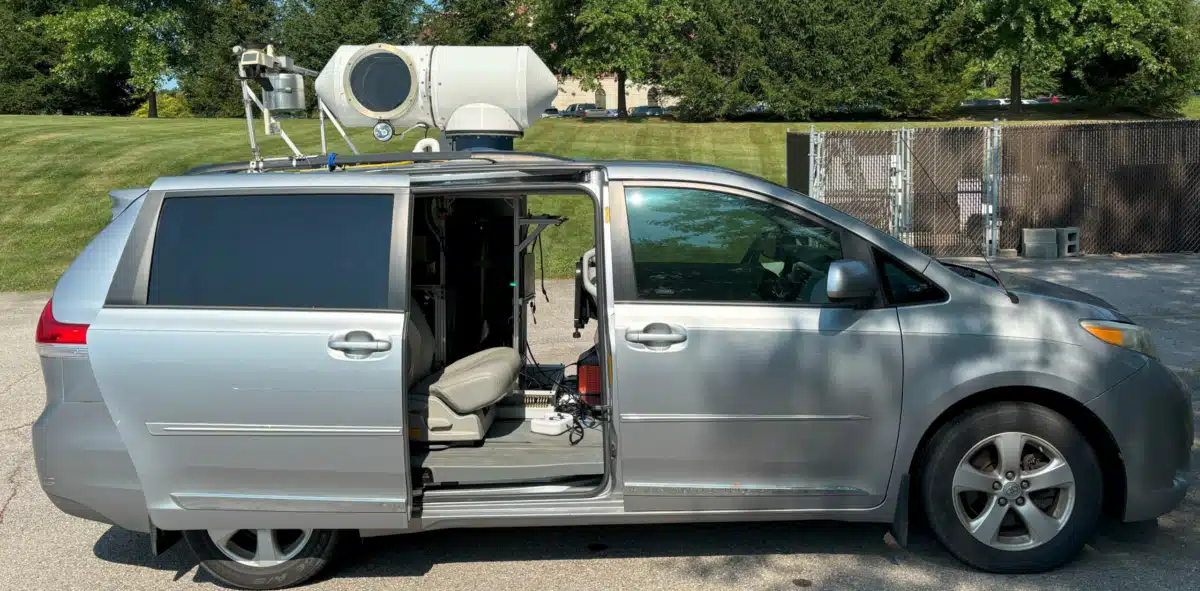
Capturing something the human eye cannot detect required building a specialized instrument from scratch. The team assembled what they called the Corona Observing Telescope System, or COTS, built around a camera sensitive only to a narrow band of ultraviolet light that Earth’s ozone layer completely blocks from sunlight. That is the key to the whole setup. At ground level, the only things that produce UV radiation in that specific range are electrical discharges, very hot fires, and specialized laboratory lamps. During a rain-soaked thunderstorm with no fires present, any UV signal the camera picked up was almost certainly a corona discharge.
The system was mounted inside a research vehicle. Researchers drove to open areas near trees and parked while storms moved overhead, recording the treetops while an electric field sensor on the roof tracked the storm’s electrical intensity in real time. Careful lab calibration beforehand meant the team could translate raw camera footage into actual estimates of light intensity and the electrical currents flowing through the branches.
Leaves That Flicker, Hop, and Glow
On June 27, 2024, the research vehicle parked at an open lot on the University of North Carolina Pembroke campus and pointed its camera at a sweetgum tree about 100 feet away. Over roughly 90 minutes, the instrument detected 859 separate UV signals across three branches. Each discharge lasted a fraction of a second to a few seconds. Rather than staying fixed in one spot, the discharges jumped constantly from leaf to leaf. Sometimes a corona tracked along a branch as the wind moved it, the glow literally following the swaying limb.
After finishing with the sweetgum, the team repositioned to observe a loblolly pine nearby. In just 20 minutes, the camera detected 93 more UV signals on that tree. Despite the dramatic difference in leaf shape between the two species, broad and star-shaped on the sweetgum versus long slender needles on the pine, the corona behavior was nearly identical. The same general pattern held across every additional storm intercept the team conducted, on multiple tree species across the eastern United States.
Electrical currents estimated from the observed coronae were tiny, far below what a person could sense. The camera, however, was only aimed at a small slice of each canopy at any given time. Researchers calculated that if coronae were forming uniformly across the full canopy of the sweetgum tree, the estimated total electrical current through that single tree during an active storm would be dozens to a few hundred times higher than what the instrument recorded from its narrow vantage point. That estimate is a modeled projection, not a direct measurement, but it hints at how much electrical activity may be occurring just out of view.
Why It Matters That Trees Glow
“Coronae on trees under thunderstorms have been mentioned in the science literature for almost a century,” the authors write. “Not until now, however, have coronae been directly observed, their behavior described, their UV emissions quantified, and their relationship with current demonstrated.”
That century-long gap matters because coronae are not just a curiosity. Among their most significant potential effects is the production of hydroxyl radicals, reactive molecules that act as the atmosphere’s primary chemical scrubbers, breaking down pollutants and natural gases released by trees. Earlier laboratory and modeling work by members of the same research team estimated that coronae around a single treetop during a thunderstorm could generate these molecules at a rate at least a thousand times greater than all other known production mechanisms near that treetop combined. Those estimates were not directly measured in this field campaign, but the new real-world data makes refining them possible for the first time.
Laboratory experiments also showed that fine leaf tips exposed to electrical fields similar to those found under real thunderstorms became visibly scorched within seconds. Whether that kind of damage accumulates meaningfully in real forests over time remains an open question, but in regions where thunderstorms are frequent, researchers suspect repeated corona exposure could gradually damage upper canopy branches in ways that have previously gone unattributed.
As thunderstorms potentially increase in frequency with a warming climate, understanding what they do to the forests beneath them may become an increasingly practical concern.
Paper Notes
Study Limitations
The COTS instrument captured UV signals from only a small section of any given tree canopy at one time, roughly one square meter, so the total extent of corona activity across a full treetop was estimated rather than directly measured. Some corona signals may have been blocked by foliage between the camera and the discharge location, though researchers estimated this blockage at no more than 20 percent. Up to 25 percent of potential corona clusters, groupings of UV signals, were removed during noise filtering, meaning reported corona frequency is likely an undercount by a similar margin. The equations linking UV emissions to electrical current were developed using small potted trees in a laboratory setting and may not translate perfectly to mature trees under natural storm conditions. Canopy-wide current estimates and long-term ecological effects remain modeled projections rather than confirmed findings. Additional studies are needed to establish more universal relationships across a broader range of tree species and forest environments.
Funding and Disclosures
This research was supported by the National Science Foundation under Grant AGS-2323203, awarded to co-author William H. Brune. OFiL Systems, LTD provided the solar-blind ultraviolet cameras used in field observations. Field work was conducted with permission at the University of North Carolina Pembroke campus. The authors declare no conflicts of interest.
Publication Details
Authors: P. J. McFarland, W. H. Brune, D. O. Miller, and J. M. Jenkins, all with the Department of Meteorology and Atmospheric Science, The Pennsylvania State University, University Park, Pennsylvania. | Journal: Geophysical Research Letters, Volume 53, 2026, Article e2025GL119591. | Paper Title: “Corona Discharges Glow on Trees Under Thunderstorms” | DOI: https://doi.org/10.1029/2025GL119591 | Received: September 19, 2025. Accepted: January 6, 2026. Published open access under the Creative Commons Attribution License. Data available via Penn State Data Commons at https://doi.org/10.26208/9CZM-6Z29.


