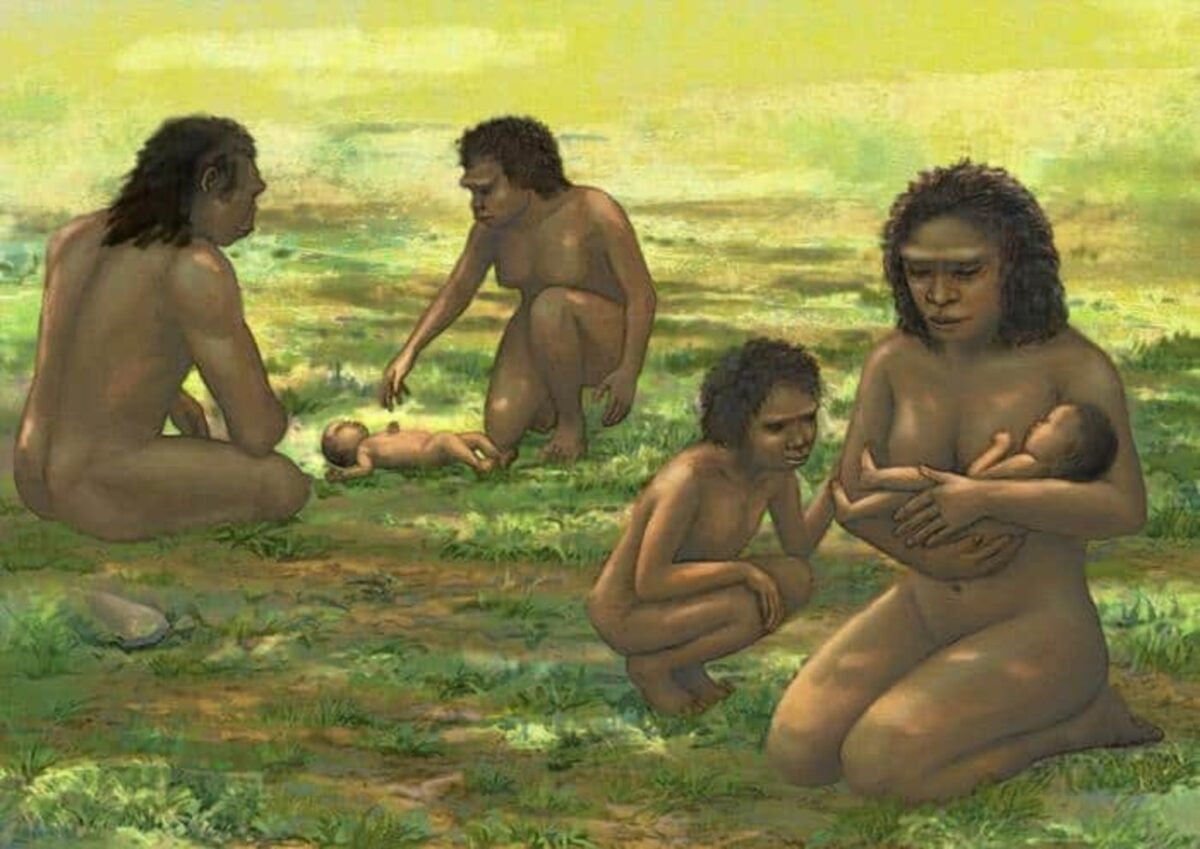
(Credit: Illustration by Utako Kikutani © Yousuke Kaifu CC BY)
In a Nutshell
- A partial skull known as DNH 127, recovered in 2008 at Drimolen Main Quarry in South Africa, has been tentatively identified as Homo erectus, adding evidence that the human genus was in the region roughly 2 million years ago.
- Scientists re-examined 18 previously undescribed fossils and found 14 belonged to a heavy-jawed cousin species, Paranthropus robustus, one to Homo erectus, and three that could not be firmly identified.
- Researchers had mistakenly filed two of the bones as non-human animal remains before recognizing them as belonging to ancient human relatives.
A partial skull dug up at a South African cave site in 2008 sat unstudied for 17 years before scientists tentatively identified it as Homo erectus, an early relative of modern humans living roughly 2 million years ago. Two other fossils from the same collection had been mistakenly filed away for years as ordinary animal bones, only to be recognized now as belonging to early human relatives after all.
That skull fragment is part of a bigger find. Writing in the journal Annals of Human Biology, researchers re-examined 18 skull and jaw fossils dug up from the site between 1992 and 2019, bones that had never been fully described despite decades sitting in storage. Of those, one was assigned to Homo erectus, 14 were placed in a heavy-jawed cousin species called Paranthropus robustus, and three could not be confidently sorted into either group.
Why does a filing mix-up matter? Drimolen has already produced some of the most important fossils in the story of human evolution, including a nearly complete Paranthropus robustus skull and the earliest known evidence of Homo erectus in the region. This new batch of bones supports two long-standing ideas: that early members of the human genus shared the region with a very different, heavily built relative nearly 2 million years ago, and that the local population of Paranthropus robustus changed slowly over time rather than simply showing differences between males and females.
A Cave Full of Bones Nobody Had Time to Study
Drimolen Main Quarry sits inside the Cradle of Humankind, a UNESCO World Heritage area northeast of Johannesburg, and it has produced fossils since its discovery in 1992. Over the years, the site has yielded 119 hominin specimens, a term researchers use for humans and their close extinct relatives. Only a handful, though, had been fully described in scientific detail: some teeth, a few well-preserved skulls, and a small number of other bones. Many of the remaining fossils, some pulled from the ground more than 30 years ago, had never been properly studied because researchers hadn’t gotten around to them.
That backlog is why this new paper exists. Rather than searching for brand-new fossils in the ground, the research team revisited the existing Drimolen collection and gave 18 overlooked skull and jaw pieces the same careful treatment as the site’s star specimens.
How Scientists Identified the Homo Erectus Skull
Researchers didn’t rely on DNA or new digging equipment. Instead, they used a method called descriptive comparison: studying each bone fragment’s shape, size, and structural details and comparing those features with fossils from two other well-known South African sites, as well as casts of fossils from East Africa. Details such as the width of a jaw’s notch, the thickness of skull bone, or the shape of an ear opening can point toward one species over another, even when a specimen is broken or incomplete. Measurements supplemented these visual comparisons where enough bone was preserved to take them.
Researchers at the University of the Witwatersrand and the Ditsong National Museum of Natural History conducted this comparative work, where the original fossils are stored alongside specimens from other important sites such as Swartkrans and Kromdraai.

What the Newly Studied Bones Revealed
Of the 18 specimens examined, researchers confidently placed 14 with Paranthropus robustus, a species known for its powerful jaws and large chewing teeth. Researchers assigned one specimen to Homo erectus. The remaining three preserved too little identifying detail to assign them to a specific species, so researchers grouped them under a broader category that flags an early human relative of unknown type.
Among the more surprising finds were two fossils, a jaw fragment and a piece of skull bone, that researchers had originally boxed as ordinary animal remains rather than anything belonging to a human relative. After closer examination, their bone thickness and shape ruled out animals like baboons or large cats and pointed toward the human family tree, even though researchers couldn’t pin down an exact species for either.
Most attention, though, goes to a partial skull piece known as DNH 127, recovered in 2008 from a broken block of rock near where one of the site’s most famous skulls had been found years earlier. A bony bump behind the ear, called the mastoid, along with the shape of a skull suture running across it, closely resembled patterns typically seen in Homo rather than in Paranthropus. Researchers describe the specimen as most closely resembling a Homo erectus skull from Dmanisi, a well-known fossil site in Georgia. Based on this combination of features, the team tentatively assigned DNH 127 to Homo erectus, making it only the second specimen from the site pinned down to a species within the genus Homo. According to the study, this discovery adds further evidence that Homo erectus was present in South Africa somewhere between roughly 2.04 million and 1.95 million years ago.
Homo Erectus and a Changing Population at Drimolen
Beyond the Homo erectus discovery, the new fossils speak to a long-running debate about the Paranthropus robustus population at Drimolen. Earlier researchers had proposed that size differences between the Drimolen fossils and a slightly younger population found at two other caves might simply reflect sex differences, with mostly female remains preserved at Drimolen and mostly male remains preserved at the other sites. A competing idea holds that the two groups actually represent an older and younger version of the same population, with small physical changes building up gradually over time, a process scientists call microevolution.
A jawbone fragment cataloged as DNH 5 offers a small but telling clue here. Its jaw joint and chewing muscle attachment point were shaped in a way that expands what’s known about variation within Paranthropus robustus, and researchers note this configuration may represent another trait separating the Drimolen population from its counterparts at the other sites. Combined with the rest of the newly described fossils, the authors conclude that the pattern fits the idea that the Drimolen group was a distinct population, possibly up to 200,000 years older than its relatives elsewhere, and that it slowly shifted in appearance over generations rather than merely reflecting male-versus-female size differences.
Fossils this broken and incomplete rarely make headlines on their own, and that’s exactly the point researchers are making. Bones excavated decades ago and sitting in storage drawers can still tighten timelines and shift long-running debates when someone finally takes the time to look closely. In this case, a broken skull fragment recovered in 2008 added to the evidence that early members of the human genus lived alongside a very different, heavily built relative in the same corner of South Africa, a find that emerged not from a fresh dig but from a drawer.
Paper Notes
Limitations
Dating remains uncertain for several specimens because some fossils were recovered from loose chunks of rock or lime miners’ rubble rather than from securely dated soil layers, meaning their exact age cannot be pinned down with confidence. Several specimens were also too broken or damaged for precise measurements, limiting how firmly some could be assigned to a species; the authors could not assign three of the 18 fossils beyond a broad human-relative grouping. The authors describe the identification of DNH 127 as Homo erectus as tentative, based on a combination of traits rather than a complete, undamaged skull. The paper also notes that a mandible called DNH 6, the largest Paranthropus robustus jaw yet found at the site, could challenge the microevolution hypothesis if it turns out to come from the site’s older, securely dated deposits, but its original excavation context was disturbed by historic mining activity, making its true age impossible to confirm.
Funding and Disclosures
Support came from an Australian Research Council Discovery Grant (DP170100056) awarded to two of the study’s authors, along with Higher Degree Research fee waivers and living scholarships from La Trobe University supporting two other authors. The authors reported no potential conflict of interest.
Publication Details
Paper Title: “New hominin cranial and mandibular remains from Drimolen Main Quarry, South Africa”
Authors: Jesse M. Martin, A. B. Leece, Stephanie Baker, Andy I. R. Herries, and David S. Strait
Journal: Annals of Human Biology, 2026, Volume 53, Issue 1, Article 2725046
DOI: 10.1080/03014460.2026.2725046


