
Case 6, photographed by Dr Jose de la Fuente.
In A Nutshell
- A 99-million-year-old piece of Burmese amber preserved a Stem ant apparently frozen mid-meal, one of the rarest behavioral moments ever captured in the fossil record.
- Researchers examined six amber specimens from Myanmar, Poland, and the Dominican Republic, finding ants preserved alongside mites, spiders, termites, mosquitoes, and other insects.
- Mites found clinging close to ants across three specimens suggest the hitchhiking relationship between the two may stretch back at least 55 million years.
- While proximity between organisms in amber strongly suggests interaction, scientists caution that fossilization can shift positions, making some findings suggestive rather than definitive.
Ninety-nine million years ago, an ant was eating. Its body curved forward, mouthparts pressed against something small, when tree resin dripped down and sealed the moment forever. That frozen instant, locked inside a piece of Burmese amber smaller than a matchbook, is what researchers are now calling one of the rarest behavioral snapshots ever preserved in the fossil record.
A new study published in Frontiers in Ecology and Evolution examined six pieces of ancient amber from Myanmar, Poland, and the Dominican Republic, each containing an ant preserved alongside other organisms. Some pieces held mites, spiders, and wasps. One held three ants, two termites, six mosquitoes, a mite, and a winged insect. But the single ant, apparently frozen mid-meal, stood apart from all of them. The authors describe it as capturing “a possible feeding behavior in an early ant species, which is an exceptionally rare event in the fossil record.”
Beyond that feeding scene, the six specimens together offer a rare look at who ancient ants lived alongside, and whether those pairings were accidental or reflect real ecological relationships stretching back tens of millions of years.
Why Fossil Amber Matters for Understanding Ant Evolution
Ants have been around long enough to have shared the planet with dinosaurs. Their earliest ancestors developed colonial behavior, with organized queens, workers, and division of labor, around 120 million years ago. Some of those early lineages, called Stem ants and Hell ants, eventually went extinct without leaving modern descendants. Later lineages, Crown ants, gave rise to the more than 20,000 ant species alive today. Amber has preserved examples from Stem, Hell, and Crown ant lineages, giving scientists one of their clearest windows into how these insects actually lived.
Researchers José de la Fuente and Agustín Estrada-Peña analyzed specimens from three sources: Baltic amber from Poland, estimated at 33.9 to 55.8 million years old; Burmese amber from Myanmar, dated to roughly 99 million years ago; and Dominican amber, spanning 23 to 33 million years ago. Using high-powered microscopes and imaging software, they identified each organism inside and measured the distances between them. Organisms found within about 5 millimeters of each other, particularly when paired with recognizable posture or physical contact, were treated as more likely to reflect actual interaction rather than coincidence.
The Ant That Never Finished Its Meal
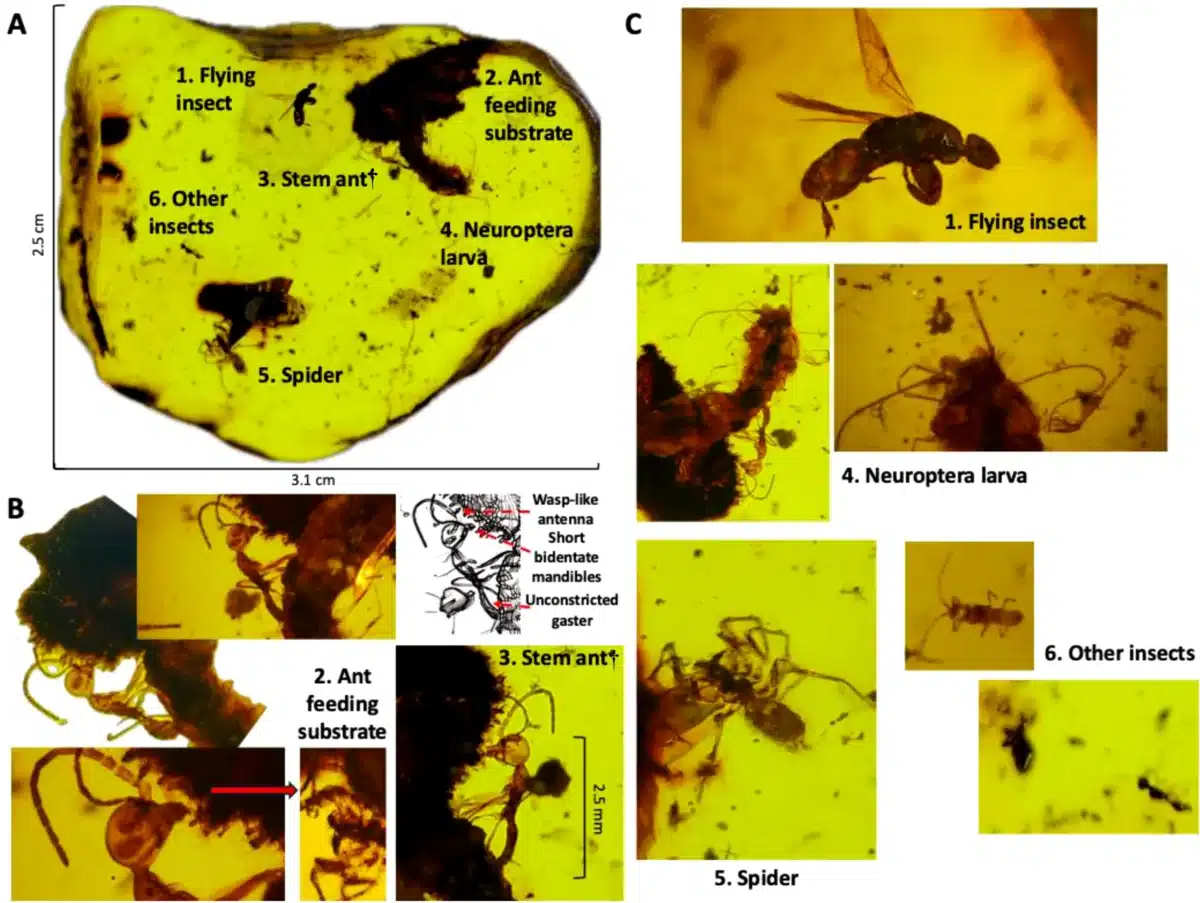
The most compelling specimen came from Burmese amber dated to roughly 99 million years ago. Inside, an early Stem ant was preserved with its body curved backward and mouthparts apparently pressed against a small object directly in front of its head. A larger worm-like insect larva, with what appears to be ruptured tissue, sat in physical contact with the ant’s body. A spider, a small parasitic wasp, and other insects were also present in the same piece.
The ant appears to have been feeding on a surface, possibly an organic mass or material directly in front of its head, while its body incidentally rested against the larger insect, with no clear evidence of a predatory interaction between the two. What makes this find so notable is not just what the ant was doing, but that it was doing anything at all. Catching an animal mid-behavior at the precise moment of entrapment is extraordinarily rare.
Ancient Ant Relationships Preserved in Fossil Amber
The other five specimens filled in a broader picture of ant life across deep time.
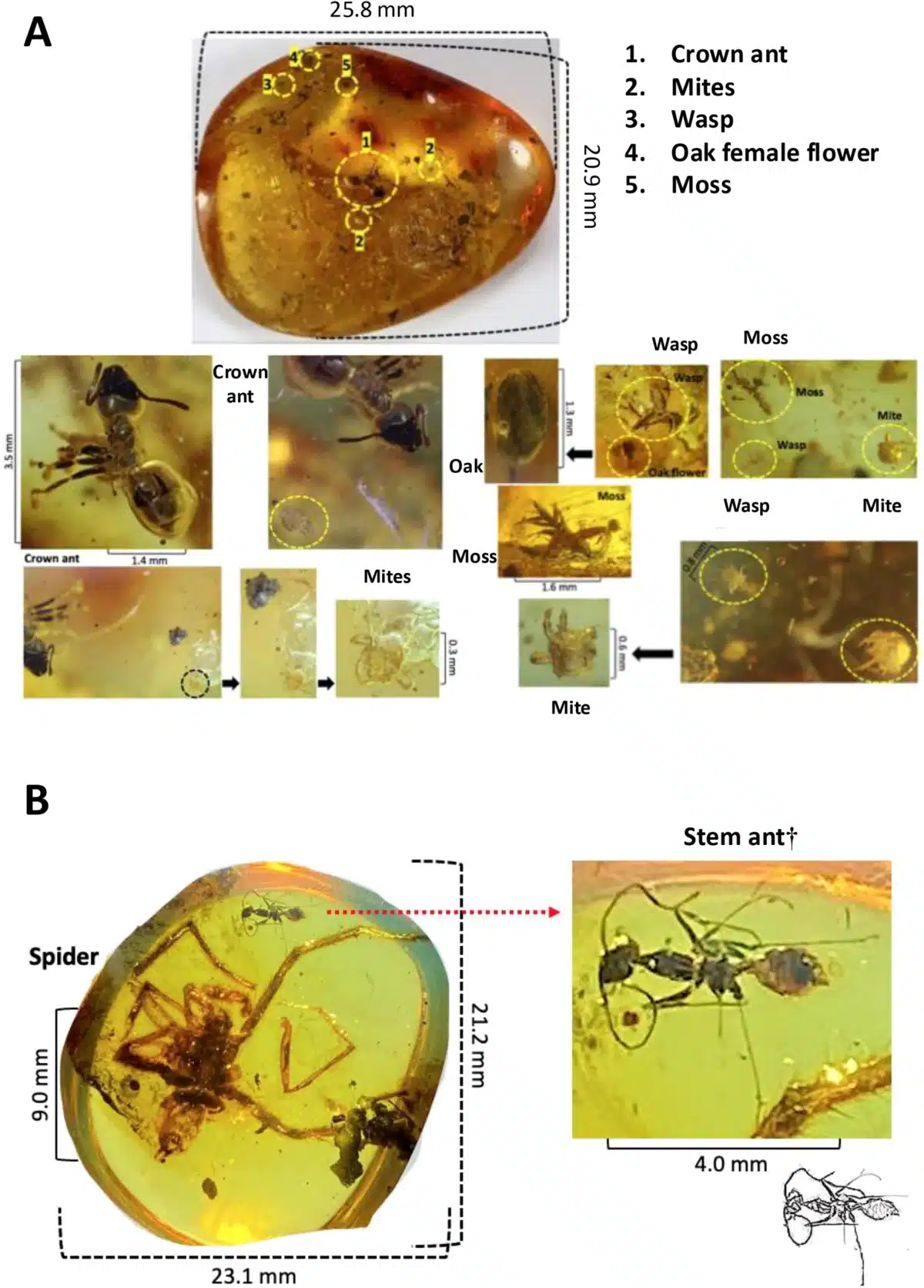
Mites turned up alongside ants in three separate pieces spanning all three geological periods studied. In modern ecosystems, certain mites are well-known hitchhikers, latching onto ants for free transport without harming their hosts. The Baltic specimen’s mites belong to a family associated with exactly this behavior. Finding them pressed close to an ant in resin 40 to 55 million years old suggests this relationship is far older than the modern ecosystems we know today.
The Dominican amber specimen told its own story. Three Crown ants and two termites were preserved together, with the ants sitting within roughly 4 to 6 millimeters of the termites. Ants and termites are fierce competitors today, with ants frequently raiding termite colonies. That combination in amber at least 23 million years old suggests that ant-termite ecological interactions may extend back at least that far.
A separate Burmese specimen placed a Stem ant alongside a spider from an extinct group. The authors note the two were found within about 5 millimeters of each other, and raise the possibility of an ecological association, though the nature of any interaction cannot be confirmed.
What the Fossils Can and Cannot Confirm
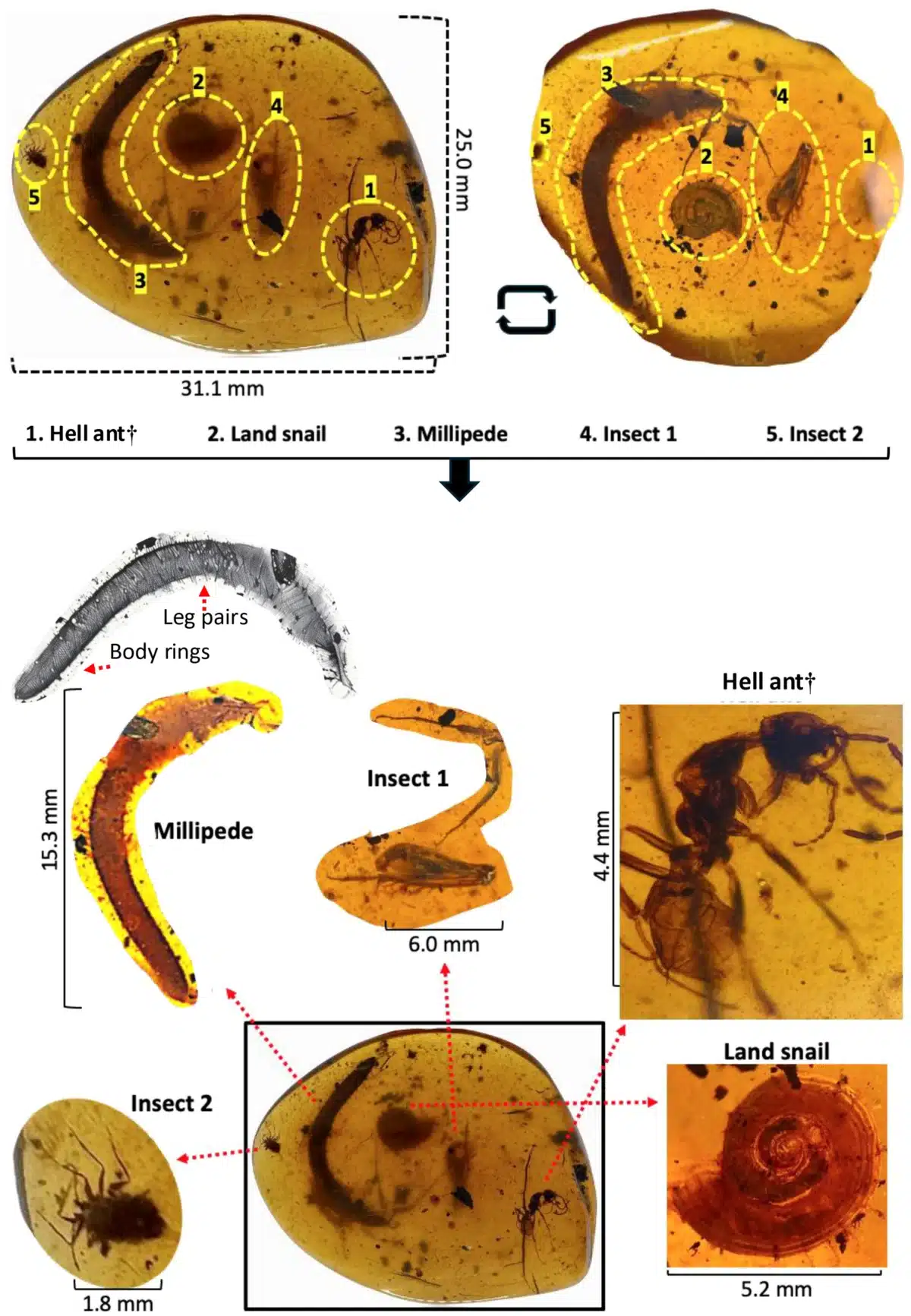
The researchers are careful about what counts as evidence and what counts as a reasonable guess. The feeding specimen stands on its own because physical contact between the ant’s mouthparts and a surface is visible. Most other cases rest on inference: organisms found close together whose known habits suggest they were interacting. A snail and millipede found alongside a Hell ant in another Burmese piece could reflect predation, since modern ants do prey on millipedes, or they could simply be creatures that wandered into the same resin at the same moment.
Amber distorts during fossilization, meaning distances between organisms can shift over millions of years. Proximity is a clue, not a verdict. The study points toward micro-CT scanning, a detailed imaging technique that maps the interior of amber in three dimensions without opening it, as the next step toward firmer conclusions.
What the six specimens establish, taken together, is that the social world of ants, the hitchhikers they carried, the rivals they faced, and the food they chased, was already well underway in the age of dinosaurs. One ant was mid-meal 99 million years ago when the resin fell. That meal is still there, unfinished, inside the amber.

Paper Notes
Limitations
The study is based on six amber specimens, a small sample that limits how broadly its conclusions can be applied. Several organisms were too poorly preserved to classify. Distances between organisms inside amber cannot definitively confirm biological interaction because fossilization can shift positions over millions of years. Criteria for inferring interaction, primarily proximity of approximately 5 millimeters or less combined with ecological context, are qualitative rather than quantitative. Advanced imaging such as micro-CT scanning and Z-stack imaging would be needed to confirm three-dimensional positioning and specific interaction types at the species level.
Funding and Disclosures
The study received partial financial support from the University of Castilla La Mancha through the 2025-AYUDA-38326 grant, associated with a project on vaccines for tick infestation control in sub-Saharan Africa. The authors declared no commercial or financial conflicts of interest and stated that generative AI was not used in the creation of the manuscript. Amber specimens are part of the KGJ Collection, Ciudad Real, Spain.
Publication Details
Authors: José de la Fuente (Instituto de Investigación en Recursos Cinegéticos, CSIC-UCLM-JCCM, Ciudad Real, Spain; Oklahoma State University, Stillwater, OK) and Agustín Estrada-Peña (Retired, Zaragoza, Spain). Title: “Description of fossil amber with ant syninclusions.” Journal: Frontiers in Ecology and Evolution, Volume 14, Article 1724595. Published: February 27, 2026. DOI: 10.3389/fevo.2026.1724595.


