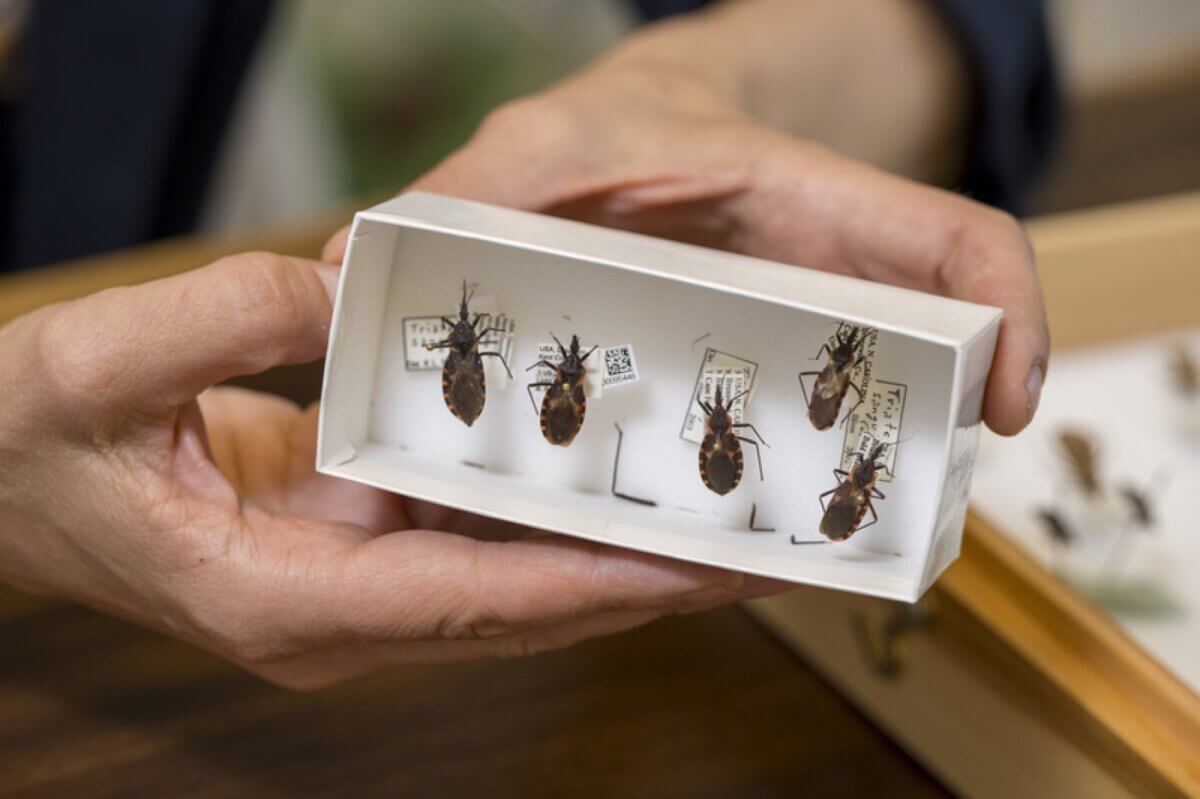
(Credit: University of Delaware)
In a Nutshell
- A live, blood-fed kissing bug native to the American Southwest was found in a Lisbon hotel room in August 2025, the first confirmed case of this kind of insect turning up alive anywhere in Europe.
- Genetic testing confirmed the species and ruled out the Chagas parasite in this particular bug, and blood tests on the couple who found it came back negative for infection.
- Researchers believe the insect accidentally hitched a ride across the Atlantic in luggage or cargo, a reminder that global travel and trade can quietly move disease-carrying insects between continents.
A couple traveling from the East Coast checked into a five-star hotel in Lisbon, spent one night in a comfortable room on the tenth floor, and woke up with a dark, unexplained streak on an arm and a finger. Hours later, they found the source: a blood-filled insect resting calmly on their headboard. When they caught it with a tissue, bright red blood oozed out from beneath its body.
According to a new report in the journal Parasites & Vectors, this was the first time a live kissing bug, an insect known for spreading Chagas disease, has ever been documented in Europe. The species, native to the deserts of the southwestern United States and northern Mexico, had somehow traveled thousands of miles to end up biting a sleeping tourist in a Lisbon hotel bed.
How the Kissing Bug Ended Up in a Lisbon Hotel
According to the report, the incident took place on the morning of August 26, 2025. The traveling couple, on a pre-cruise stopover in Lisbon, spotted the bug on their headboard and suspected it had bitten one of them overnight, based on a feces-like streak left on the skin. They reported it to hotel staff, who apologized and switched them to a different room for the rest of their stay. No further bugs turned up.
Once home in the United States, the couple grew worried about possible exposure to Chagas disease. Their primary care doctor reportedly brushed off the concern, so they turned to an infectious disease specialist and also reached out directly to an insect research lab at the University of Delaware, sending the specimen for identification. About six weeks after the bite, the couple was tested for antibodies to the Chagas parasite at a commercial lab. Neither test came back positive.
Meanwhile, scientists got to work figuring out exactly what the bug was. They first examined its body shape, size, and markings, features that matched Hospesneotomae protracta, a species also known by its older name, Triatoma protracta. To confirm the identification, researchers pulled DNA from the insect and compared it against a database of known species. The match was near-total, and the genetic results placed the Lisbon specimen firmly within that species.
Researchers also tested the bug itself for the Chagas parasite using a sensitive lab test designed to detect the parasite’s DNA. No trace of it turned up in this particular insect. That doesn’t mean the species is harmless in general. Past field studies of the same species collected in California found the parasite in roughly a third of bugs tested, and more recent surveys found infection rates in a similar range, showing that the parasite still circulates in wild populations of this bug back in its native range.
Why a Desert-Dwelling Kissing Bug Traveled to Europe
Researchers cannot say for certain how the insect made its journey, but they laid out a reasonable chain of events. The bug’s native range covers hot, dry parts of the southwestern United States and northern Mexico, including California and Texas, states that happen to rank among the top exporters of goods from the U.S. to Portugal. Portugal has also seen a steady rise in American tourism in recent years. Either route, tucked into a shipment of goods or packed accidentally into someone’s luggage, could explain how the insect crossed the Atlantic.
Certain traits of this bug may have helped it survive the trip. It’s built to endure the cool, dry conditions of desert winters, and past field research found that this species tends to move around most actively in July and August, the very month it turned up in Lisbon, when outdoor temperatures in its home range are similar to the temperature inside an airplane’s cargo hold. The species can also go weeks or even months without a blood meal, giving it plenty of time to survive a long flight and the wait for its next chance to feed once it arrived. When it finally does get access to a host, this species is an aggressive feeder, often beginning to feed within 30 to 60 seconds.
Researchers noted that only a handful of similar cases exist worldwide. A dead specimen of a different triatomine species was found in a commercial shipment in Spain in 2022, having apparently traveled from China. Decades earlier, two individuals of another triatomine species were intercepted at a Miami airport, hidden inside a plant shipment from Guatemala. Cases like these remain rare, but they show that these insects occasionally do make it across oceans.

What the Chagas Disease Risk Really Looks Like
Even though the species found in Lisbon can carry the Chagas parasite, the researchers were careful to explain that a single bite from an infected bug is unlikely to actually spread the disease. That’s because the parasite travels through the bug’s waste rather than its bite. The insect has to defecate on or near the bite site, and that waste then has to reach a wound, the eyes, or the mouth. Still, lab studies have found that more than a third of these bugs defecate within a minute of feeding, meaning transmission isn’t impossible under the right circumstances.
Chagas disease already exists in parts of Europe, the report noted, with an estimated 125,000 people in Western Europe currently infected, largely among people who immigrated from regions where the disease is common. In Portugal specifically, health officials don’t have solid numbers on how many people might be carrying the infection, and researchers cited estimates suggesting most cases likely go undiagnosed. Climate research cited in the study also suggested that some parts of Portugal and southern Europe have weather conditions that could theoretically support these insects if a population ever became established there.
No new bug population has set up shop in Europe. What happened in Lisbon was something more ordinary, and in its own way more unsettling: a blood-fed insect native to the deserts of the American Southwest, tucked into luggage or a cargo shipment, ending up in a five-star hotel bed thousands of miles from home, and biting a sleeping tourist before anyone realized it was there. Countless people and packages cross oceans every day, and disease-carrying insects can tag along without anyone noticing. Researchers who documented the case argue that the real lesson isn’t panic but attentiveness: catching and reporting these accidental arrivals before they have a chance to become something bigger.
Disclaimer: This article summarizes findings from a single published case report and is intended for general informational purposes only. It does not constitute medical advice. The parasite that causes Chagas disease was not detected in this specimen, and this case does not indicate an established population of kissing bugs in Europe. Anyone concerned about a possible insect bite or exposure to Chagas disease should consult a qualified healthcare professional.
Paper Notes
Limitations
This report describes a single case involving one insect specimen and does not indicate that this species has established a population in Europe. Researchers could not determine exactly where the bug originated within its native range or precisely how it was transported to Portugal. The parasite was not detected in this specimen, but that finding applies only to this individual bug and does not reflect infection rates across the species as a whole.
Funding and Disclosures
One author acknowledged financial support from the Coordination for the Improvement of Higher Education Personnel (CAPES) in Brazil. The authors stated they have no competing interests to declare.
Publication Details
Paper Title: “Live triatomine bug, vector of Trypanosoma cruzi, found engorged in Lisbon hotel room: A first for Portugal and for Europe”
Authors: Jennifer K. Peterson, Alexander R. Kelley, Trinity Antoszewski, Madeline Brown, Hanna Cortes, Peyton I. Easton, Grace Ferry, Thoburn Freeman, Cate Freiwald, Erik Hagen, Hunt Kinnaird, Luna Lewin, Malaki Lewis, Jessie McNulty, Natalie Moore, Erin Mullis, Stella Pettit, Luke Schultz, Sarah Sharp, William Stocker, Jillian Tunstall, and Jader de Oliveira
Journal: Parasites & Vectors, 2026 (volume 19, article 250)


