
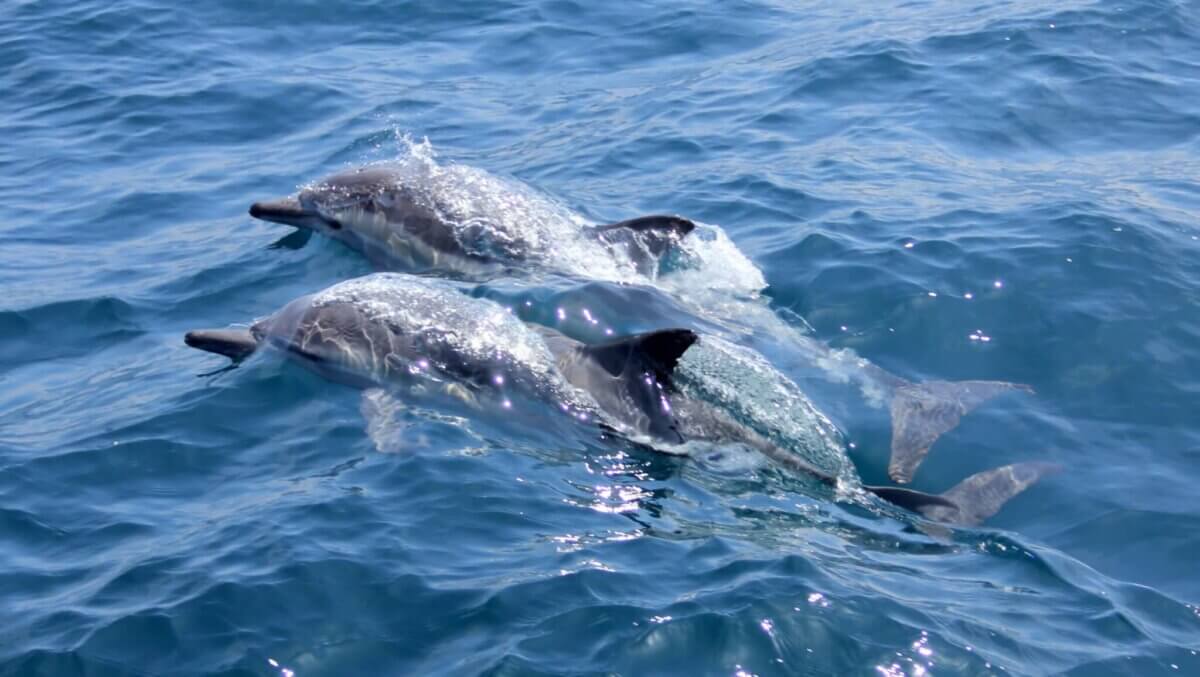
Bottlenose dolphins in Florida. (Credit: Wendy Noke Durden)
The fountain of youth may have been friendship all along.
In A Nutshell
- Male bottlenose dolphins with close friendships show younger biological ages than isolated peers, adding evidence that social bonds affect aging
- Quality beats quantity: Close bonds with a few allies were linked to slower aging, while hanging out in larger groups was tied to faster aging
- The findings mirror human research showing that social support and contact frequency correlate with lower biological ages in people over 50
- Scientists tracked dolphins for 40 years in Shark Bay, Australia, using DNA methylation patterns to measure biological age separately from chronological age
Friendship may be one of nature’s most powerful health tools. Male bottlenose dolphins with stronger social bonds show signs of aging more slowly at the cellular level than their less social peers, according to research that reveals how relationships may shape health and longevity.
Scientists studying wild Indo-Pacific bottlenose dolphins in Shark Bay, Western Australia, found that males with robust same-sex friendships had younger epigenetic ages (a molecular measure of biological wear and tear) compared to socially isolated dolphins of the same age. The study, published in Communications Biology, links dolphin social bonds to epigenetic aging, adding to mounting evidence that social connections shape health outcomes across mammalian species.
Male dolphins in this population form lasting alliances with other males, partnerships that can endure for decades as they cooperate to access mating opportunities. Some males invest heavily in these bonds, spending considerable time with close companions, while others remain more solitary. This natural variation created an opportunity to test whether friendship intensity relates to how quickly animals age biologically.
Bottlenose Dolphin Friendships and Epigenetic Aging
Researchers led by Livia Gerber from the University of New South Wales analyzed skin tissue samples from 38 male dolphins ranging from newborns to 29 years old. Rather than simply counting years, the team measured biological age using DNA methylation patterns—chemical tags that accumulate on DNA in predictable ways as cells age. Two dolphins of the same age can have different biological ages depending on their life experiences and health. A dolphin aging quickly might have the molecular profile of an animal several years older, while one aging slowly could appear biologically younger.
Scientists tracked which dolphins spent time together over four decades of observations, calculating how strong each male’s friendships were based on how often pairs were spotted together. Males that maintained stronger, more consistent companionships throughout their lives showed biological ages notably lower than expected for their actual age.
Among dolphins of the same age, those with stronger friendships appeared biologically younger by about 1.7 years for every standard deviation increase in social bond strength. The relationship held even after accounting for age and other factors, indicating that friendship quality is associated with differences in the molecular aging process.
Quality Over Quantity in Dolphin Social Bonds
The research uncovered a paradox about dolphin social life. While strong one-on-one bonds were tied to slower aging, spending time in larger male groups was associated with faster aging. Males observed in bigger assemblies showed higher biological ages than those in smaller circles.
This contrast reveals that quality appears more important than quantity in dolphin friendships. The benefits of close social bonds cannot be attributed simply to living in groups. Instead, the depth of individual relationships seems to matter more than the number of casual associates. The bigger-group finding wasn’t as consistent in follow-up analyses, so researchers treat it as suggestive rather than settled.
The pattern makes sense given the social pressures male dolphins face. Female dolphins in Shark Bay reproduce only about once every four years, creating fierce male competition for mating access. Males with more associates likely navigate greater relationship uncertainty and social tension, potentially triggering stress responses that accelerate cellular aging even as group living offers protection from tiger shark predators.
Males with strong bonds to a few trusted allies, by contrast, may experience less social stress. These tight-knit relationships could buffer against the wear and tear of competitive social environments, preserving cellular health over time.
Parallels Between Bottlenose Dolphins and Humans
The dolphin findings mirror patterns documented in people. Human studies show that social contact frequency and perceived social support correlate with lower biological ages in adults over 50. Paramedics with stronger social support networks showed younger biological ages both before and after traumatic exposures compared to colleagues with weaker support systems.
The convergence across evolutionarily distant mammals points to social bonds broadly influencing biological aging in highly social species. Male dolphins maintain one of the most complex social systems known outside humans, with multi-level alliances that form during adolescence and can persist for more than a decade.
Scientists hypothesize that social isolation increases stress in highly social species, triggering chronic inflammation and immune system changes that accelerate cellular aging. Male dolphins depend heavily on their allies for reproductive success, making social isolation a potent stressor with measurable physiological consequences.
Recent findings from the same dolphin population support this interpretation. Males who lost social network position were more likely to die soon afterward, while social instability has been shown to impair dolphin health in captive settings.
Strong friendships might slow aging by reducing stress and the physical toll it takes on the body. Alternatively, dolphins that age slowly for genetic reasons might simply be better positioned to invest in friendships. These explanations likely reinforce each other—friendship reduces stress and preserves health while good health enables continued social engagement.
The study cannot definitively prove causation since researchers observed naturally occurring variation rather than experimentally manipulating social bonds. However, the strength of the statistical relationships and consistency with findings from other species suggest friendship quality genuinely relates to aging trajectories.

What This Means for Aging Research
The study adds to growing evidence that social factors belong in the conversation about aging biology alongside genetics, diet, and exercise. Social isolation and loneliness are increasingly recognized as health risks in human populations, associated with elevated mortality rates comparable to smoking and obesity.
Understanding how social bonds protect against biological aging could inform public health strategies and clinical interventions. If friendship quality measurably affects cellular health, then social connection deserves the same attention as traditional health behaviors in promoting healthy aging.
The research also demonstrates the value of wild animal populations for aging research. The 40-year dataset from Shark Bay enabled researchers to capture dynamics impossible to observe in shorter studies, as social bonds between male dolphins develop gradually during adolescence and stabilize in adulthood.
Male bottlenose dolphins, with their complex alliances, long lifespans, and traceable social networks, provide a natural model for investigating fundamental questions about sociality, stress, and longevity. The Shark Bay population has already yielded insights into social cognition and cooperative behavior. Now it offers a window into how friendship may get under the skin, shaping biology at the molecular level.
Paper Notes
Study Limitations
The research focused exclusively on male dolphins and cannot determine whether similar patterns exist in females of the species. The sample size of 50 observations from 38 individual males, while substantial for long-term field research, limited statistical power for some analyses. Effects of group size on epigenetic age were not consistently replicated when restricting data to males with more precise age estimates or adult males only, likely reflecting reduced sample size rather than absence of a true effect. The observational study design cannot definitively establish causality—researchers cannot determine whether strong social bonds cause slower aging or whether slower aging enables individuals to better maintain friendships, though both processes could operate simultaneously. Behavioral observations excluded foraging surveys to avoid biasing association measures, which may have affected social network inference by removing certain aggregation contexts. The epigenetic clock was calibrated specifically for Indo-Pacific bottlenose dolphins and may not generalize to other dolphin species or marine mammals. The study measured biological age at single time points for most individuals rather than tracking aging rates longitudinally across repeated samples.
Funding and Disclosures
This research received financial support from the Swiss National Science Foundation (grant 31003A_149956 and Early Postdoc Mobility Grant P2ZHP3_200011), the Claraz Foundation, the A.H. Schultz Foundation, the University of New South Wales Scientia programme, the University of Zurich, the Australian Research Council (grants A19701144 and DP0346313), the Eppley Foundation for Research, the Seaworld Research and Rescue Foundation, and the W.V. Scott Foundation. The authors declared no competing financial or non-financial interests. Data collection was conducted under scientific permits from the Department of Biodiversity, Conservation and Attractions, Western Australia. Research protocols complied with animal ethics policies of the University of Zurich, University of Bristol, and University of Western Australia. Data collection took place on Gathaagudu, Malgana Sea Country, and the authors acknowledge the traditional custodians of the region.
Publication Details
Authors: Livia Gerber (Evolution & Ecology Research Centre, School of Biological, Earth and Environmental Sciences, University of New South Wales, Sydney, NSW, Australia; Australian National Wildlife Collection, National Research Collections Australia, CSIRO, Canberra, ACT, Australia), Katharina J. Peters (Marine Vertebrate Ecology Lab, Environmental Futures, School of Science, University of Wollongong, Wollongong, NSW, Australia; Securing Antarctica’s Environmental Future, University of Wollongong, Wollongong, NSW, Australia; Evolutionary Genetics Group, Institute of Evolutionary Anthropology, University of Zurich, Zurich, Switzerland), Stephanie L. King (School of Biological Sciences, University of Bristol, Bristol, UK; School of Biological Sciences, Oceans Institute, University of Western Australia, Crawley, WA, Australia), Simon J. Allen (Evolutionary Genetics Group, Institute of Evolutionary Anthropology, University of Zurich, Zurich, Switzerland; School of Biological Sciences, University of Bristol, Bristol, UK; School of Biological Sciences, Oceans Institute, University of Western Australia, Crawley, WA, Australia), Richard C. Connor (Biology Department, University of Massachusetts Dartmouth, North Dartmouth, MA, USA; Institute of Environment and Department of Biological Sciences, Florida International University, North Miami, FL, USA), Owen Forbes (National Research Collections Australia, CSIRO, Canberra, ACT, Australia), Kathryn G. Holmes (School of Biological Sciences, Oceans Institute, University of Western Australia, Crawley, WA, Australia; current address: Brookfield Zoo Chicago’s Sarasota Dolphin Research Program, c/o Mote Marine Laboratory, Sarasota, FL, USA), Anna M. Kearns (Australian National Wildlife Collection, National Research Collections Australia, CSIRO, Canberra, ACT, Australia), Erik P. Willems (Evolutionary Genetics Group, Institute of Evolutionary Anthropology, University of Zurich, Zurich, Switzerland), Michael Krützen (Evolutionary Genetics Group, Institute of Evolutionary Anthropology, University of Zurich, Zurich, Switzerland; School of Biological Sciences, Oceans Institute, University of Western Australia, Crawley, WA, Australia), Lee A. Rollins (Evolution & Ecology Research Centre, School of Biological, Earth and Environmental Sciences, University of New South Wales, Sydney, NSW, Australia)
Journal: Communications Biology (A Nature Portfolio journal) | Article Title: “Social bonds decrease epigenetic age in male bottlenose dolphins” | DOI: 10.1038/s42003-025-09227-w | Publication Date: 2025 | Volume and Article Number: Volume 8, Article 1765 | Data Availability: Epigenetic data available through the Mammalian Methylation Consortium (https://clockfoundation.org/MammalianMethylationConsortium) and Gene Expression Omnibus (dataset GSE223748)


