
(Credit: © Raquel - stock.adobe.com)
In A Nutshell
- The billions-per-cup number is real but narrow. It comes from a 2019 McGill University study of nylon and PET pyramid-style “silken” tea bags steeped near boiling, not from paper bags or loose-leaf tea.
- A German food safety agency disputes the counting method. The BfR called the study’s sample preparation “completely unsuitable for testing for microplastics” after its own testing pointed to possible contamination.
- The health question stays unanswered either way. The lead researcher told CBC News in 2019 that human health research on ingested microplastics is essentially absent.
- The bag’s material is the one variable science has pinned down. Paper bags and loose-leaf tea contain no plastic mesh, so they were never part of the finding that made headlines.
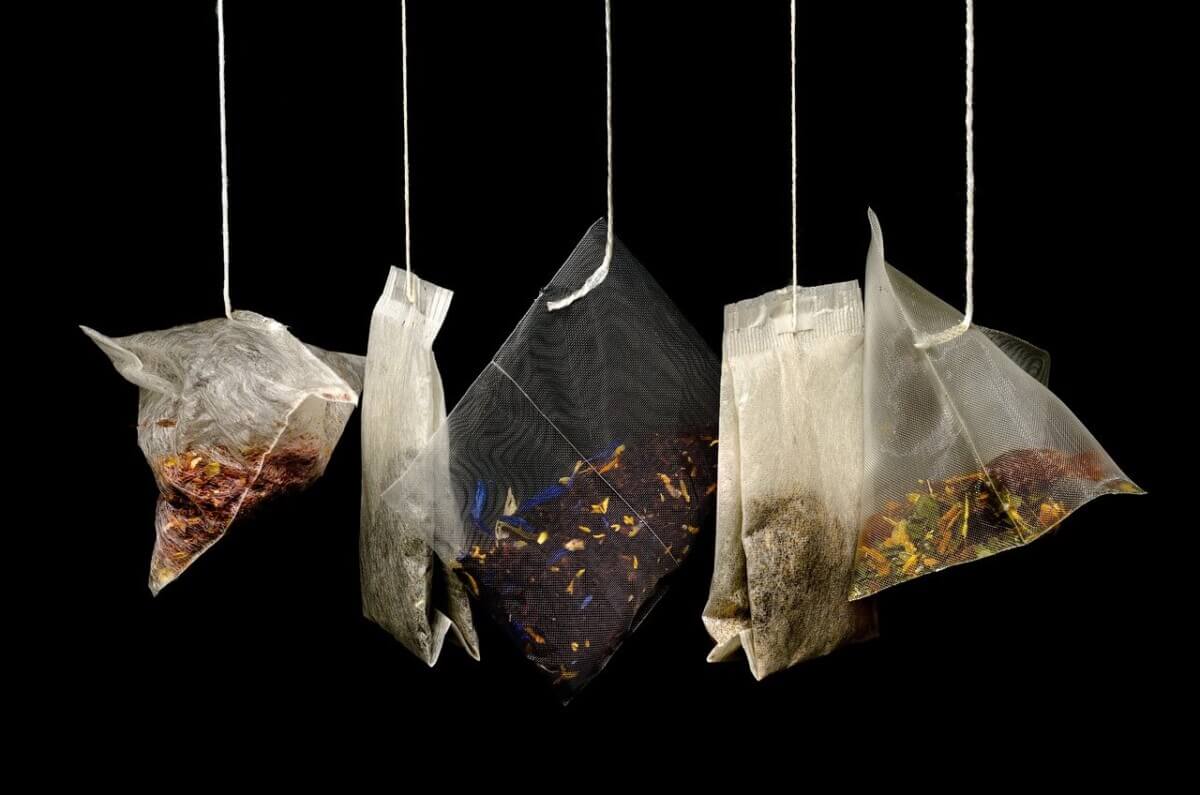
Steep a nylon or mesh pyramid tea bag in near-boiling water and, per McGill University researchers, a single cup can hold roughly 11.6 billion microplastic and 3.1 billion nanoplastic particles. Chemical engineer Nathalie Tufenkji and colleagues published it in 2019, behind years of alarming headlines. Read closely, though, it describes something narrower: one category of tea bag, brewed at a specific temperature, counted with a method other scientists have since challenged.
Which Tea Bags Actually Shed Plastic?
Not the kind in most kitchen cupboards. The McGill experiment, published in Environmental Science & Technology, focused on see-through pyramid sachets made from nylon or polyethylene terephthalate (PET), the heat-tolerant plastics used in food packaging. Steeping one at a brewing temperature of 95 degrees Celsius (100 Fahrenheit), released the billions of particles the study became known for.
Paper bags and loose-leaf tea were never part of that experiment, since they contain no plastic mesh for hot water to degrade.
A 2026 systematic review in Reviews on Environmental Health, pooling 22 studies, found a single plastic tea bag can shed from hundreds of thousands to billions of particles depending on polymer and measurement method, pointing to the bag’s material as what drives exposure.
How Reliable Is The Counting Method?
Social posts about tea tend to leave this part out. The McGill team used electron microscopy to count particles in small water samples, then extrapolated to totals per cup. That extrapolation is where the science gets contentious.
Germany’s Federal Institute for Risk Assessment, the BfR, reviewed the study in 2020 and ran its own extraction experiments, concluding that “the sample preparation methodology used in the study is completely unsuitable for testing for microplastics,” with most particles it counted likely reflecting contamination rather than shed bag material.
A separate comment raised similar concerns. None of this overturns the basic finding that plastic tea bags shed particles, but the precise scale of “billions per cup” carries more uncertainty than the number alone conveys.
What Do We Actually Know About Health Effects From Plastic In Tea Bags?
Very little, and that gap is the most consistent thread across every source. The McGill researchers exposed water fleas (Daphnia magna) to the shed material and observed dose-dependent behavioral changes and developmental malformations. The particles did not kill the organisms. The finding, of course, in a small aquatic invertebrate under lab conditions doesn’t provide great evidence about how they would affect people.
Tufenkji told CBC News in 2019 that “there’s really no research” on how microplastics affect human health. The BfR reported that the chemicals it measured coming off tea bags “do not pose a health risk in the (very small) amounts reported.” The two statements do not contradict each other: one concerns ingested microplastics broadly, the other specific chemicals at the levels the BfR measured. Whether swallowing billions of particles over years carries a cost is unanswered.
What’s The Practical Takeaway?
Nothing in the peer-reviewed record supports panic over a cup of tea, or dismissing the finding either. The evidence is narrower than either reaction: nylon and PET pyramid sachets, steeped hot, shed particles that paper bags and loose-leaf tea cannot, since those alternatives lack the plastic mesh that degraded in the McGill experiments.
Choosing loose-leaf tea or a plain paper bag removes the one variable the research has pinned down, while what billions of ingested particles mean over a lifetime stays open: as Tufenkji put it, that study has not been done.


