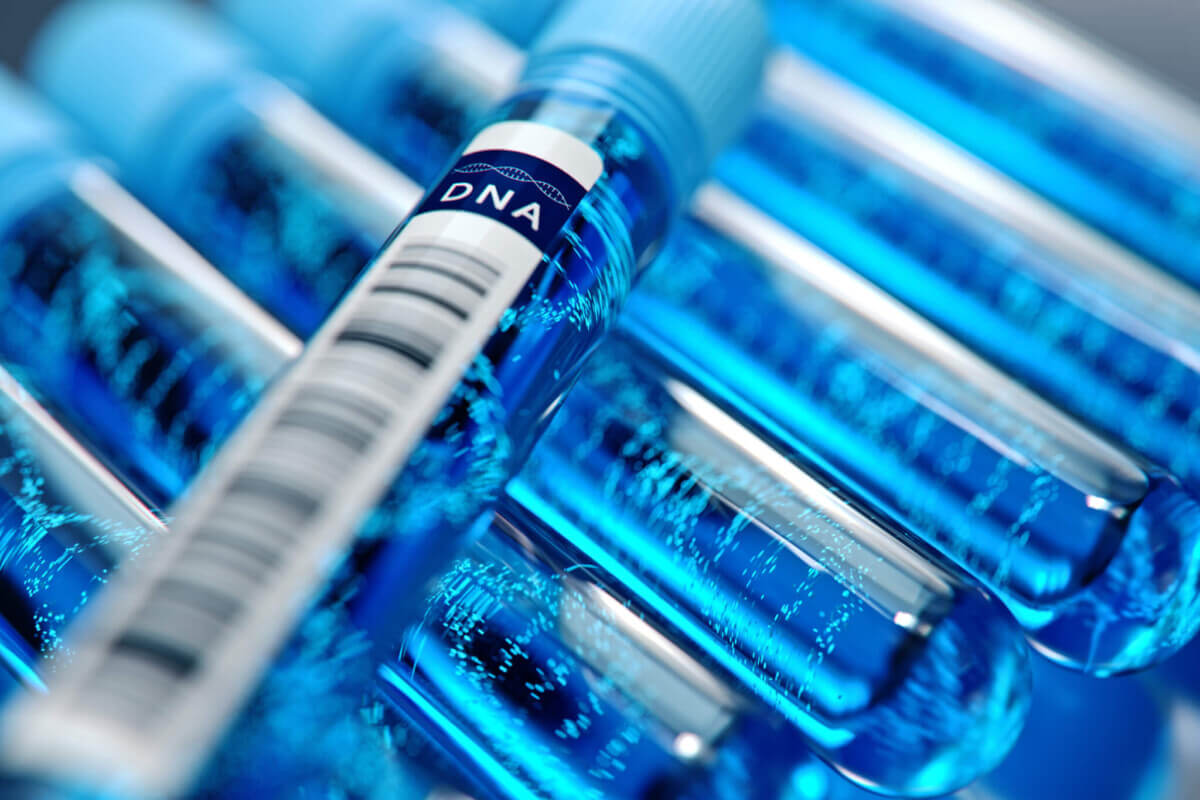
DNA test tube (© Connect world - stock.adobe.com)
The accessibility of at-home DNA testing means that practically anyone can send away for a kit and learn about their family history, genetic ancestry, and medical information. But some people get more information than they bargained for.
According to some reports, online DNA testing has revealed secret fathers, incest, and the use of donor (egg, sperm, and embryo) conception. These can all be emotional and distressing discoveries.
Our ongoing research explores how the increased accessibility of online DNA tests affects donor-conceived adults, their parents, and donors themselves.
We have found that the combination of secrecy around donor conception, the continued (albeit partial) legislative support for anonymity, and the rise of online DNA testing has led to growing numbers of people discovering they are donor conceived through late or shock discoveries.
UK law on assisted conception, the Human Fertilization and Embryology Act 1990, took effect in 1991 when there was a presumption that donation should be anonymous. Although attitudes have changed, the law still provides for donors to remain anonymous until any children born from their donation are adults.
But the act only regulates the disclosure of information by the fertility regulator, the Human Fertility and Embryology Authority (HFEA). Online DNA testing is a service marketed directly to consumers, and falls outside the HFEA’s remit – giving people a way to circumvent donor anonymity and search for information about genetic relatives.
In 2023, the HFEA consulted on modernizing UK fertility law, acknowledging the disruptive effect of online DNA testing. Noting that children benefit from being told at a young age that they are donor-conceived, the HFEA has proposed that the law should be changed so that donor anonymity is removed from the birth of any donor-conceived child, rather than when they are 18 (which is currently the case).
This proposal would be a significant change, and the HFEA has indicated that a gradual approach may be appropriate. For now at least, online DNA testing will remain the only possible route to the information for many people.
Why people want to know
As our research has found, for many people affected by donor conception, access to information about their genetic heritage is of great significance. People may be worried about hereditary medical conditions, or simply curious about their family history.
And, for many donor-conceived people, knowledge about their donor is fundamental to understanding their identity. Unexpectedly discovering that you are not, genetically, who you think you are can have profound implications.
One participant in our ongoing research said: “I couldn’t look at my face in the mirror…I could [only] think, ‘what the hell has happened?’. It felt like my whole childhood was a lie … Every single thing I believed about who I was and what I was.”
The legal protection of donor anonymity feels wrong for many donor-conceived people. As one person put it: “My family history’s been hidden from me my whole life. I’ve done nothing wrong. I’m just trying to find out who I am.” Some feel there is no option but to use a DNA test to search for that information, but are conscious about upsetting others.
The terms and conditions of online DNA testing providers vary but often require users to be adults. However, age verification is typically limited to customers stating their date of birth. Providers often allow parents to submit a child’s sample and manage their account.
While participants described easily being able to circumvent age restrictions, deciding when to do a DNA test for a child was sometimes experienced as a moral conundrum: “It’s still this balance of, does [child] turn round to me in 10 years, and [say], ‘Oh, you gave away my DNA,’ versus, ‘Oh, you could have done a DNA test and I could have found my genetic family earlier.’ … I feel the weight of that.”
What are you signing up for?
Often, simply by visiting an online DNA test website and browsing its pages, you agree to be legally bound by extensive terms and conditions. Many people don’t know what they have agreed to, or what the full implications might be.
For example, if you sign up for DNA services, your DNA sample might be stored in an overseas biobank (a large collection of human biological samples held predominantly for use in health and medical research). Your DNA data may be used for research or the development of commercial products, or shared with law enforcement agencies. In 2018, use of DNA databases helped solve the “Golden State Killer” case in California.
Some countries have tighter privacy laws than others, so what is permissible varies and changes over time. Under new data protection laws in the UK and Europe, for example, sharing DNA data with law enforcement agencies is more tightly regulated now than in the past.
Storing DNA data securely can also be difficult. 23andMe, one of the larger online DNA test providers, experienced a hack in 2023. Reports suggest that this data breach affected nearly 7 million customers, and an ongoing investigation is examining whether 23andMe had adequate safeguards in place to protect the highly sensitive information within its control.
There are also potential issues relating to the reliability of online DNA testing for health and well-being purposes. Results might be inaccurate or need interpreting to ascertain what the information means for the individual, sometimes causing stress and upset for no reason.
If you decide to use online DNA testing, you should consider reading the legal information offered. The Office of the Privacy Commissioner of Canada has published some guidance about what to look out for. Or, watch the following video produced by our colleague carrying out research in New Zealand:
Caroline A. B. Redhead is a research fellow at the Centre for Social Ethics and Policy at the University of Manchester, and Lucy Frith is a professor of Bioethics and Health Research at the University of Manchester.
This article is republished from The Conversation under a Creative Commons license. Read the original article.


