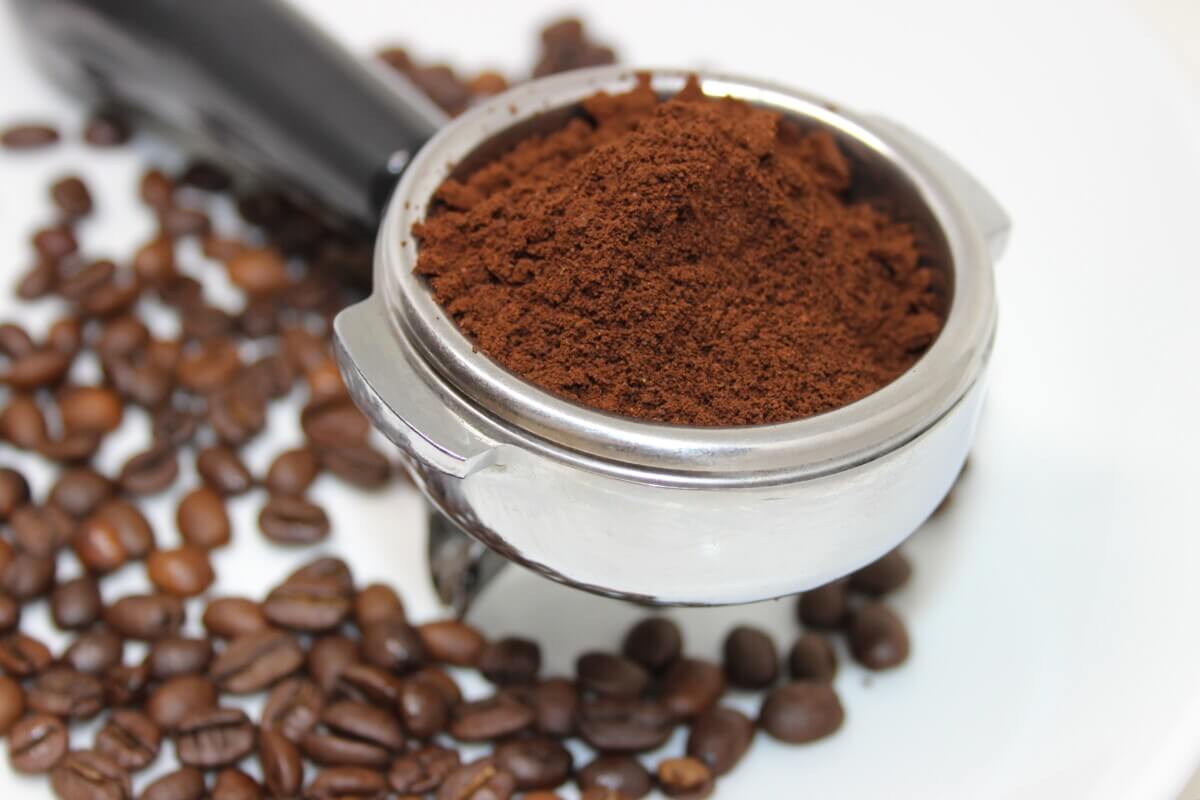
Billions of pounds of coffee grounds go to waste each year. (Photo by KATY TOMEI on Unsplash)
Coffee Waste Has Surprising Potential as a High-Grade Fuel, and Water Is the Secret
In A Nutshell
- Researchers converted wet coffee grounds into a high-energy biochar fuel in just 90 seconds using a superheated flame plasma jet, no drying required.
- The moisture in the grounds, normally a liability, actually drives the process by triggering a “popcorn effect” that creates a porous, carbon-rich material.
- At its best, the resulting biochar matched the heating-value range of anthracite coal, one of the highest grades of coal.
- The method is still at lab scale, and a full energy and cost analysis will be needed before it can be considered commercially viable.
Every day, billions of cups of coffee are brewed around the world, leaving behind mountains of soggy, used-up grounds. Most of it ends up discarded, in landfills or incinerators, wasting resources and pumping greenhouse gases into the atmosphere. Now, researchers have found a way to zap those wet coffee grounds into a high-quality fuel in less than two minutes, no drying required.
That last part matters more than it might seem. One of the biggest headaches in turning leftover plant matter into usable fuel has always been water. Wet materials don’t burn efficiently, and removing moisture beforehand takes enormous energy, often wiping out any environmental or economic benefit. A superheated jet of gas, it turns out, can sidestep that problem entirely, transforming sopping-wet coffee waste into biochar, a charcoal-like material made from organic matter, in the time it takes to microwave a bowl of soup.
The technique, described in the Chemical Engineering Journal, uses something called flame plasma, generated by burning liquefied petroleum gas mixed with compressed air. What’s surprising isn’t just the speed. It’s that the moisture everyone assumes is a problem turns out to be part of what makes the process work so well.
The ‘Popcorn Effect’ Driving the Flame Plasma Process
When the flame plasma, running at roughly 800 to 900 degrees Celsius, hits wet coffee grounds, it flash-evaporates the water trapped inside the material almost instantly. That sudden burst of steam creates enormous internal pressure, causing each particle to essentially explode from the inside out at a microscopic level. The researchers call this the “popcorn effect.” Just like a kernel of corn bursting under heat, the coffee grounds rupture and expand, creating a sponge-like structure riddled with tiny pores and channels.
That porous structure is extremely valuable. More surface area means the resulting biochar is better structured for burning. At the 90-second mark, which the team identified as the sweet spot, the surface area of the treated material peaked at 115.4 square meters per gram, compared to nearly zero before treatment. The structure may also make the biochar worth testing as a filtering or adsorbent material in other industrial settings.
Timing matters a great deal. Pushing the treatment to 110 seconds actually degraded the fuel quality, dropping the energy output and increasing the amount of non-combustible ash left behind. The extra heat was burning off the very carbon that made the biochar so energy-dense, and it caused the pore structure to collapse. Ninety seconds hit the ideal balance.

From Trash to Coal-Grade Fuel in Under Two Minutes
For the experiment, researchers used 30 grams of grounds collected straight from a cafeteria at the Korea Institute of Geoscience and Mineral Resources, wet and untreated, exactly as they came out of the coffee machine. All key measurements were repeated three times to confirm the results held up.
Starting with coffee grounds that were roughly 55% water by weight, basically the consistency of wet mud, the flame plasma process achieved a mass reduction of 83.3%. What remained was a dense, carbon-rich biochar with an energy output of 29.0 megajoules per kilogram. Anthracite coal, one of the highest-grade forms of coal, falls in the range of 25.1 to 29.3 megajoules per kilogram, according to figures cited in the paper. The coffee-ground biochar matched that heating-value range, though the paper notes that other fuel properties, including fixed carbon content and ash, differ from anthracite.
The process also dramatically reduced sulfur content. Raw coffee grounds contained a small amount of sulfur, and at the 90-second mark it had been substantially reduced. The authors report sulfur reached 0.0% after longer treatment. That suggests the fuel could produce less sulfur pollution when burned, though combustion emissions would still need to be measured directly.
Why Speed Changes Everything for Flame Plasma Technology
To understand why the timeline matters industrially, consider the alternatives. Conventional methods for turning high-moisture organic waste into solid fuel typically require drying the material first, an energy-intensive step that can take hours. Hydrothermal carbonization can handle wet material directly but requires high-pressure vessels and processing times of one to six hours. Traditional roasting-style treatments need more than 30 minutes and pre-dried material just to reach a comparable energy output.
The flame plasma approach skipped pre-drying entirely and completed the conversion in 90 seconds. The authors estimate process-energy figures, but say a full energy balance and scale-up testing are still needed before the method can be judged commercially competitive. They raise the possibility that recovering heat from exhaust gases in a scaled-up system might help reduce energy costs.
Over 10 million tons of spent coffee grounds are generated globally every year, according to the paper. Converting even a fraction of that into high-calorific biochar, without the energy penalty of drying, could shift how the world handles one of its most common forms of food waste, if the process scales.
A waste stream long dismissed as too wet and too inconvenient may actually be a high-grade fuel hiding in plain sight. The water that makes coffee grounds difficult to handle turns out, under the right conditions, to be exactly what drives the transformation.
Disclaimer: This article is based on a peer-reviewed study. The research was conducted at laboratory scale using a single batch size and moisture level. Findings have not yet been validated at commercial or industrial scale.
Paper Notes
Limitations
The authors note that this study was conducted using coffee grounds collected at a single moisture content of approximately 55% by weight, and that future research will need to test the process across a broader range of moisture levels to determine the optimal conditions for the “popcorn effect.” The experiments were performed in batch mode at laboratory scale with 30-gram samples, and the paper acknowledges that detailed energy balances and questions around industrial scaling, including continuous processing systems such as rotary kilns, require further investigation. The study also does not provide a full life-cycle analysis or comprehensive cost comparison with competing technologies at commercial scale.
Funding and Disclosures
This work was supported by the Technology Innovation Program funded by the Ministry of Trade Industry & Energy of Korea (Grant No. RS-2024-00448343), as well as the Basic Research Project (GP2025-031, 25-3222) of the Korea Institute of Geoscience and Mineral Resources (KIGAM), funded by the Ministry of Science, ICT, and Future Planning of Korea. The authors declared no competing financial interests or personal relationships that could have influenced the work.
Publication Details
Authors: Taejun Park, Gideok Park, Hyunseung Shin Institutions: Korea Institute of Geoscience & Mineral Resources; University of Science and Technology (Daejeon, Republic of Korea); Got tech co., Ltd. (Busan, Republic of Korea) Paper Title: ‘Rapid conversion of wet spent coffee grounds into high-calorific biochar via drying-free flame plasma pyrolysis for process intensification’ Journal: Chemical Engineering Journal, Vol. 537 (2026), Article 176452 DOI: https://doi.org/10.1016/j.cej.2026.176452 Published Online: April 19, 2026


