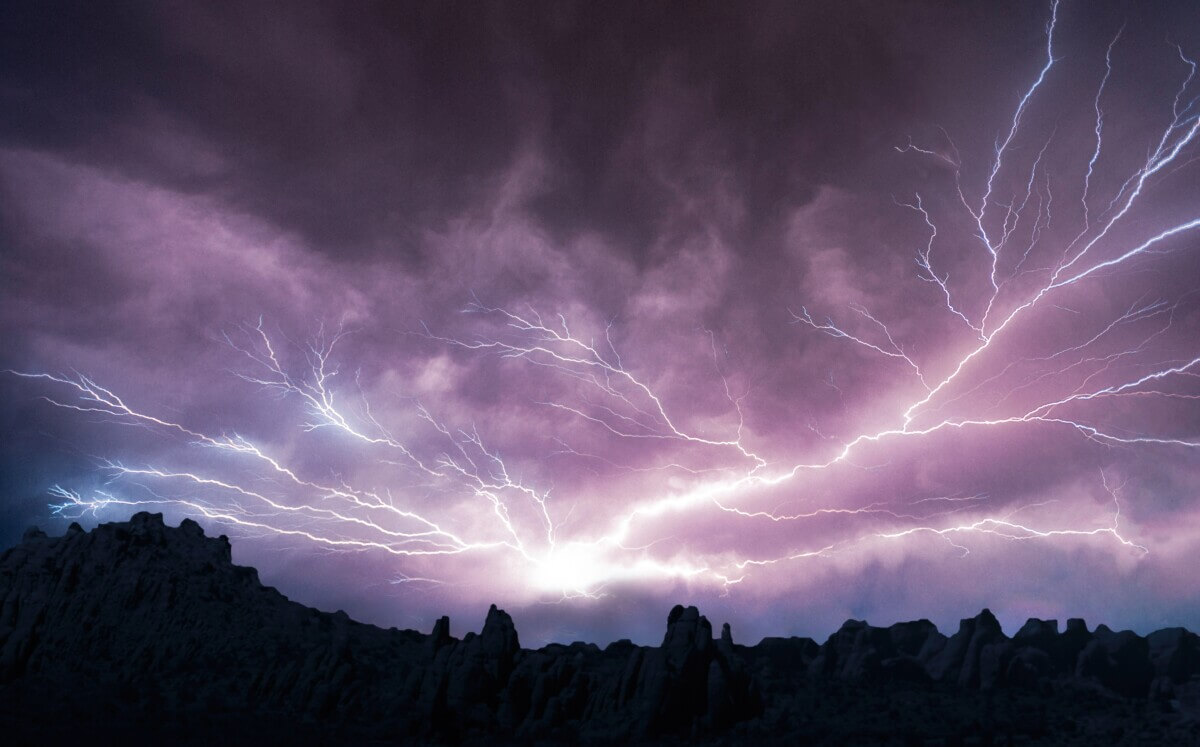
Stock image of lightning over mountains. (Photo by Micah Tindell on Unsplash)
INNSBRUCK, Austria — The climate crisis may be impacting our weather in more ways than we realize. Researchers in Austria are shedding light on the connection between global warming and lightning activity in the European Eastern Alps, and the findings are — pun intended — shocking.
A new study reveals that rising temperatures have led to a significant increase in thunderstorms and lightning strikes in the region. In fact, lightning activity doubled in the 2010s compared to the 1980s, particularly in the high-altitude areas of the Alps. Scientists say the lightning season also starts earlier and reaches a stronger peak, with a 50% increase in lightning during the day.
Similar signals along the southern and northern edges of the Alps are present but weaker, and flat areas around the Alps show no significant trend.
“Our analyses over this terrain have now shown that the rising temperatures due to climate change are causing the frequency of thunderstorms and thus lightning to increase even further. The fact that this trend is so clearly in line with global changes in the climate system also surprised us,” says atmospheric and statistical scientist Thorsten Simon in a university release.
Scientists gathered their data by reconstructing the lightning activity of cloud-to-ground lightning in the area of the European Eastern Alps for a period between 1980 and 2019. The technique showed unprecedented precision thanks to a special combination of extensive data sets.
“In this study, we link two sources of information, both available at a spatio-temporal resolution of 32 km x 32 km and one hour. From these datasets we obtain, on the one hand, information on lightning activity with seamless records over the last decade. On the other hand, we access analyses of atmospheric conditions – including cloud microphysics – at an hourly resolution over the past four decades,” explains Simon.
“By using machine learning, we were able to map the gapless lightning measurements from 2010-2019 with meteorological data. We then used machine learning and the meteorological data to reconstruct lightning frequencies further into the past, i.e. for a time when there were no such lightning measurements. And this even extends to variations in the diurnal cycle,” Simon adds.
Researchers say the findings are important so preventative measures can be developed to protect people and the environment from the potential damage caused by lightning strikes.
The study is published in the journal Climate Dynamics.


