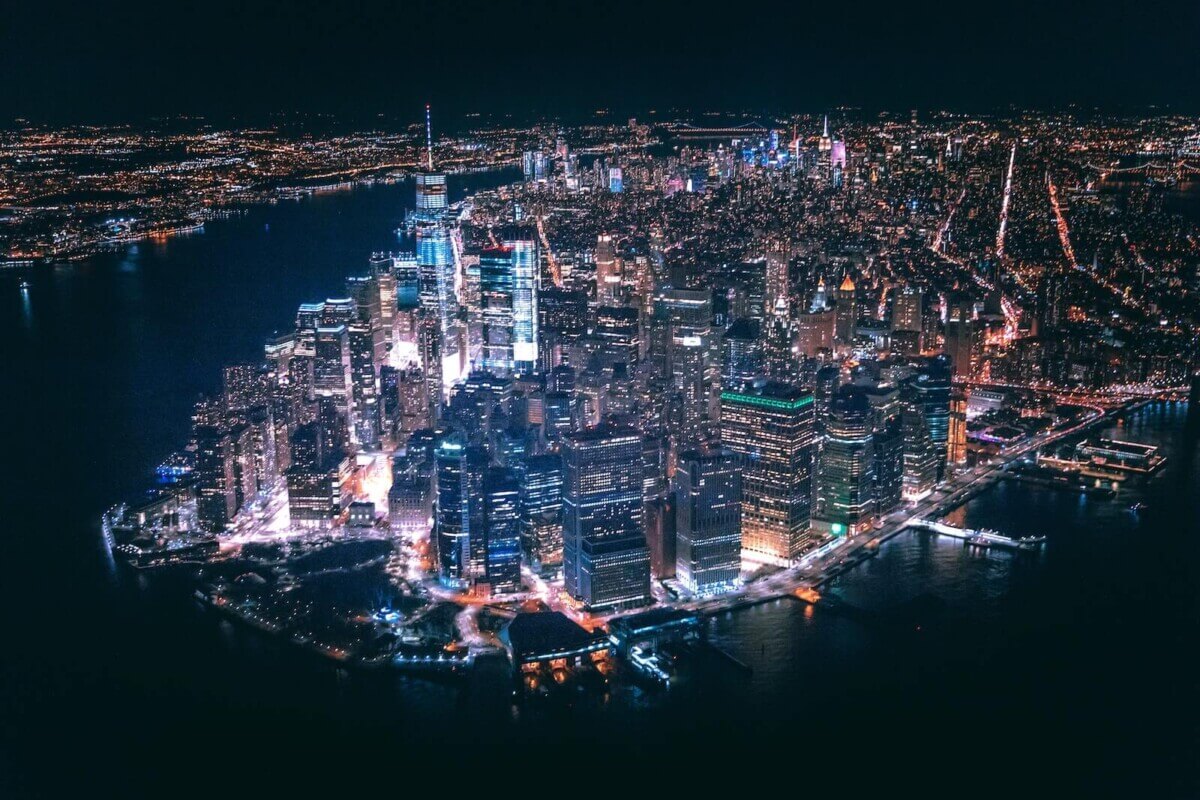
(Photo by Andre Benz on Unsplash)
NYC and D.C.’s Dimmer Streets Linked To Shifting Plant Growing Seasons
In A Nutshell
- A new satellite study found that New York City and Washington, D.C. cut nighttime light pollution after adopting lighting policies, while Newark and Philadelphia saw light levels rise.
- Blue light, the kind heavily emitted by LED streetlights, saw the biggest drop in the two policy cities, especially in D.C.
- Plant growing seasons in the policy cities shifted in ways that lined up with reduced light exposure, both in spring green-up and autumn’s end.
- Researchers call the plant findings exploratory, based on just one post-policy year and two city pairs, and are calling for broader studies before drawing firm conclusions.
When New York City and Washington, D.C., adopted measures to reduce nighttime lighting and light pollution, they may also have affected the seasonal rhythms of urban plants.
A new study published in PNAS Nexus compared nighttime light levels and plant seasonal timing in four northeastern U.S. cities, two with active light-reduction policies and two without. New York City and Washington, D.C. had enacted measures to reduce outdoor artificial light at night; Newark and Philadelphia had not. In the policy cities, nighttime glow dropped measurably from 2022 to 2023, and vegetation shifted in when the growing season started and ended. In the cities without policies, nighttime light actually increased.
A city ordinance about streetlights nudging when the neighborhood maple wakes up each spring sounds like a stretch. But scientists have spent years building a case that artificial light at night messes with plants’ internal clocks, pushing spring growth earlier and delaying when leaves change color and fall. This study asks a more pointed question: whether city governments can actually dial that disruption back by changing how they light their streets.
New Satellite Sensor Reveals City Light Pollution in Color, Not Just Brightness
To compare cities fairly, researchers needed a tool precise enough to catch not just how much light was shining at night, but what color it was. Older satellites could only capture a blurry, single-channel view of brightness. This study used imagery from the Sustainable Development Science Satellite 1, launched in late 2021, which reads light separately in red, green, and blue, sharp enough to tell one neighborhood from the next.
Each city pair, NYC with Newark and D.C. with Philadelphia, showed up in the same satellite image, making for a clean side-by-side comparison. Researchers checked 2022 against 2023, then confirmed the pattern held using a 2024 image and a separate NASA dataset. For plant timing, they used a NASA product that tracks greening and browning nationwide, comparing a 2004-through-2022 baseline against the 2023 post-policy year.

D.C.’s Blue-Light Cuts Outpaced NYC’s, While Newark and Philadelphia Saw Light Pollution Rise
Not all colors of light matter equally for plant biology. Blue wavelengths, heavy in modern LED streetlights, are especially good at disrupting plant seasonal cues, and the biggest light reductions in this study showed up in the blue band, especially in Washington, D.C.
D.C.’s Smart Street Lighting project, begun in spring 2022, converted 75,000 streetlights to LED technology built to minimize blue light, using warmer color temperatures of 2,700 or 3,000 Kelvin. Nighttime light in the blue range dropped measurably across much of the city. NYC also showed an overall decline, though parts of Manhattan, especially the downtown commercial core, actually got brighter, possibly tied to a rebound in commercial activity after pandemic slowdowns.
Newark and Philadelphia told a different story. Under the study’s classification method, Newark had very few areas showing a notable decrease in nighttime light. Philadelphia showed a patchwork of increases and decreases, which researchers say reflects uneven progress on the city’s own streetlight project, with LED trials producing localized decreases elsewhere.
Spring and Fall Growing-Season Timing Shifted After Cities Cut Nighttime Light
Before either city changed its lighting, NYC’s growing season started about 2.1 days earlier than Newark’s on average. After the policies kicked in, that gap closed and flipped: NYC started about 2.0 days later than Newark. In D.C. versus Philadelphia, the gap narrowed from about 8.8 days to 5.0 days.
Autumn told a similar story. NYC vegetation used to hang onto its leaves about 1.6 days longer than Newark’s each fall. After the lighting changes, that flipped: NYC’s growing season wrapped up about 8.0 days earlier than Newark’s, in line with the idea that less artificial light means less delay on autumn’s arrival. A similar reversal showed up in D.C. versus Philadelphia. City-wide plant tracking at this scale is a messy business, and the researchers call both the spring and autumn results exploratory rather than proven, though the pattern lined up the same way in both city pairs.
Only one post-policy year and two city pairs went into this analysis, so none of this proves cause and effect. Temperature, land management, and which plants grow where could all play a role too. Researchers want the same test run across more cities and years, with measurements taken on the ground.
Researchers Say Light Color, Not Just Brightness, Should Guide Future Light Pollution Policy
Researchers point out that policies should account for light color, not just brightness, since color matters for biological effects. Warmer lights, shielded fixtures, reduced brightness, and timers or dimmers are among the options the authors discuss, along with the possibility that cities could require sustainable lighting for new developments, similar to California’s solar mandate for new homes.
These findings are a first look, not a final word. The study is a proof of concept, and even its authors call the results indicative rather than conclusive. Whether city lighting policies can reliably reset plants’ seasonal clocks is a question this study raises far more than it answers.
Paper Notes
Limitations
Researchers are candid that this is a proof-of-concept study with meaningful constraints. Only two city pairs were examined, and post-policy comparisons relied on a single year of data, which makes it impossible to separate policy effects from normal year-to-year variation. Systematic uncertainties in nighttime light satellite measurements, including atmospheric conditions, sensor calibration differences, and the geometry of how light is captured, can affect results even when cities are paired within the same image. The satellite’s overpass time of approximately 9:00 PM Eastern time means it misses any light reductions that occur later at night, such as curfew-based restrictions. Plant seasonal timing is also influenced by temperature, precipitation, and species composition, none of which can be fully controlled at a citywide scale using this method. Researchers describe the phenology findings as exploratory and hypothesis-generating, and they call for future work across more cities, more years, additional satellite sensors, and field-based measurements before firm causal conclusions can be drawn.
Funding and Disclosures
According to the paper, this study was supported by the National Science Foundation’s Graduate Research Fellowship Program and the Evolutionary Studies Initiative Pilot Research Grant from Vanderbilt University. One co-author’s work was supported by NASA’s Suomi-National Polar-orbiting Partnership and Joint Polar Satellite System Program, grant number 80NSSC22K0199. Authors declared no competing interests.
Publication Details
Authors: Brandt Geist, Lin Meng, Travis Longcore, Zhuosen Wang, Franz Hölker, Huidong Li, Hao Yin, and Mahir Tajwar. Geist and Meng are affiliated with the Department of Earth and Environmental Sciences at Vanderbilt University. Longcore is with the Institute of the Environment and Sustainability at the University of California, Los Angeles. Wang is affiliated with the Earth System Science Interdisciplinary Center at the University of Maryland and NASA Goddard Space Flight Center. Hölker is with the Leibniz Institute of Freshwater Ecology and Inland Fisheries and the Institute of Biology at Freie Universität Berlin. Li, Yin, and Tajwar are also with Vanderbilt University. | Journal: PNAS Nexus, Volume 5, Issue 8 | Paper Title: Mitigating artificial light at night: effectiveness of policies and implications for plant phenology | DOI: https://doi.org/10.1093/pnasnexus/pgag237 | Published: August 4, 2026


