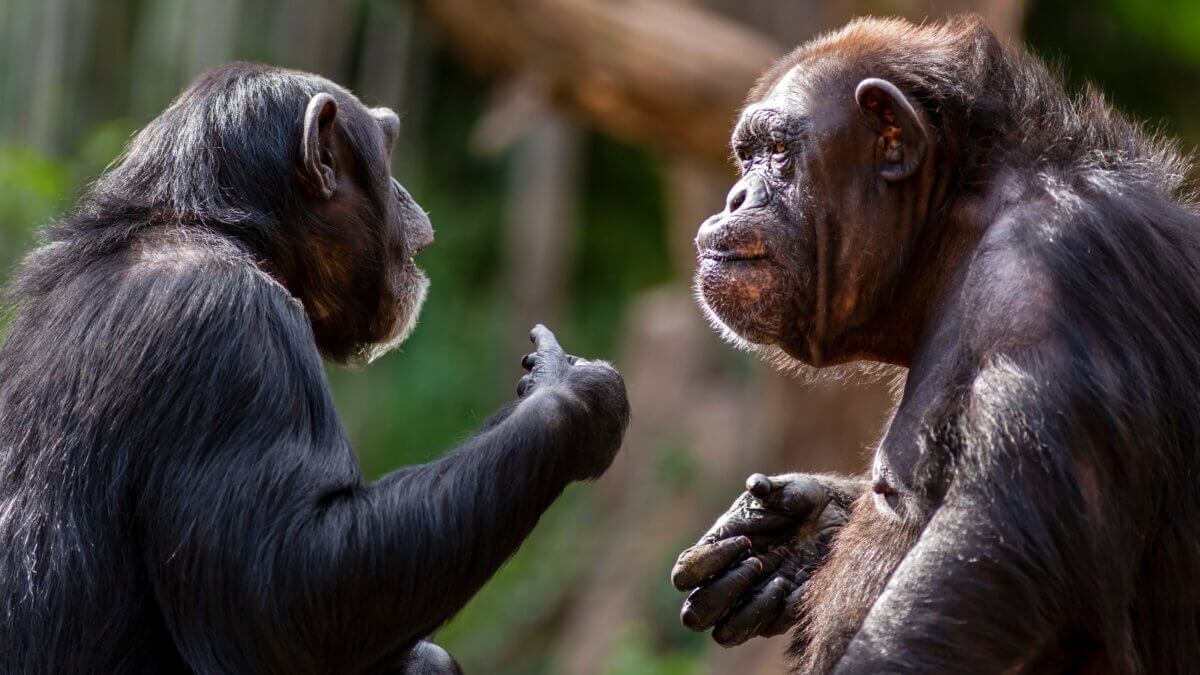
(Patrick Rolands/Shutterstock)
What Baby Chimp Grunts Reveal About the Roots of Human Speech
In A Nutshell
- Scientists recorded over 11,000 calls from 30 young chimpanzees at two sites in Africa, an orphanage in Zambia and a national park in Tanzania, and found that grunts and laughs already carried location-specific signatures in infancy, while distress calls stayed similar across both groups until later.
- As the chimps aged into their juvenile years, every call type became more reliably tied to where they lived, mirroring how human vocal patterns sharpen with development.
- Whimpers were correctly matched to their home site nearly 98% of the time overall, laughs almost 97%, and grunts close to 90%.
- The pattern points to social and environmental influences shaping chimp vocal development alongside possible genetic differences, hinting that the roots of human vocal flexibility may reach further back into evolutionary history than previously thought.
Two babies born on opposite sides of the world can end up babbling in noticeably different ways by the time they’re toddlers, one shaped by English, the other by Mandarin. Scientists have documented this in humans for decades. New research suggests something remarkably similar happens in chimpanzees, our closest living relatives, and it starts early in life.
A team of researchers studied young chimpanzees at two very different locations, an orphanage in Zambia and a national park in Tanzania, and found that infant chimps already produce grunts and laughs that sound different depending on where they live. As the chimps grew into their juvenile years, their vocal “accents” became sharper and easier to tell apart across every kind of call. That pattern mirrors how human speech develops, and it raises questions about where these differences come from: genes, environment, or the social world around a growing chimp.
This adds real weight to a long-running debate over why chimpanzee populations sound different. Some researchers argue it comes down to biology, while others think it’s shaped by social learning or environment, similar to how a person picks up a regional accent. Tracking how vocal differences unfold over time, this study offers evidence that social and environmental influences may help shape those differences alongside possible genetic effects.
Infant Chimps Already Sound Different, Depending Where They Live
Researchers focused on 30 young chimpanzees, split between infants and juveniles, at Chimfunshi Wildlife Orphanage in Zambia and Gombe National Park in Tanzania. The study, published in the journal PLOS One, compared Chimfunshi’s chimps, in open woodland, with Gombe’s, wild in dense rainforest. Twenty-one of the animals studied were infants, four years old or younger, and ten were juveniles, between four and ten, with one chimp appearing in both age groups as it grew.
Microphones near the animals captured an enormous amount of sound as the chimps went about their day. Just over 4,700 laughs, roughly 3,700 grunts, and close to 2,800 whimpers were recorded, adding up to more than 11,000 calls.
Once recordings were in hand, researchers measured specific sound features of each call, like pitch and rhythm, then fed that data into a computer program built to guess which location a chimp came from based on sound alone. They also made sure no single chatty chimp was skewing results, so what they were really testing for was a signature shared by an entire population, essentially a dialect.

Chimp Accents Sharpen From Infancy Into the Juvenile Years
Results left little doubt. Calls could be sorted by location far more accurately than chance would allow, with whimpers matched to their home site nearly 98% of the time overall, laughs almost 97% of the time, and grunts close to 90% of the time.
Breaking the data down by age told a more layered story. Among infants, grunts and laughs showed clear location-based patterns, but infant whimpers didn’t; the youngest chimps already sounded different when laughing and grunting, but their distress calls sounded pretty much the same no matter where they were raised.
That changed by the juvenile years. By then, whimpers also carried a location-based signature, and every call type got easier to place: grunts went from about 76% accurate in infancy to about 92% by the juvenile stage, laughs from about 93% to nearly 97%, and whimpers from about 77% to almost 85%.
Distress Calls Stay Consistent While Laughs and Grunts Diverge
Researchers offer a reasonable explanation for why whimpers behaved differently in infancy. Whimpers are distress calls, mostly directed at mothers, and if a baby’s cry for help sounded wildly different depending on random genetic quirks, that could make it harder for mothers to recognize and respond. That kind of pressure could keep distress calls consistent across populations early on.
Laughs and grunts may face different pressures. Laughing mostly happens during play with other young chimps, and grunts increasingly get directed toward specific individuals as chimps age, particularly higher-ranking group members. Both situations create repeated chances for social exposure, and potentially, for vocal habits to be shaped by the group around a growing chimp.
Habitat might matter too, the authors note. Gombe’s dense rainforest and Chimfunshi’s open woodland carry sound differently, and other primates, like baboons, adjust calls depending on whether they live in dense or open terrain.
Researchers also considered a simpler explanation: that recording equipment, which differed between sites, might be driving the result. But equipment differences should show up evenly across call types and ages, they argue, and the pattern instead was selective, which doesn’t line up with a technical glitch.
Chimpanzee Accents Point to Deep Roots for Human Vocal Flexibility
None of this proves genetics play no role. There is no migration between the two populations, so researchers say they likely differ genetically to some degree. But the fact that not all calls showed location-based differences in infancy, and that differences grew stronger with age, points toward learning and social environment as forces at work too, not biology alone.
That matters for understanding where human vocal flexibility came from. Humans stand out for how dramatically speech varies across cultures, and this pattern hints that some foundations of that flexibility may reach further back into the evolutionary tree than scientists thought. Chimpanzees, at least, appear to develop increasingly recognizable regional vocal signatures as they grow.
Paper Notes
Limitations
The study’s authors acknowledge that this was a retrospective analysis, meaning recordings from the two sites were originally collected using different equipment and protocols across different time periods, though all recordings were later measured and classified using the same standardized method. The researchers argue this is unlikely to explain their findings, since equipment or recording-quality issues would be expected to produce differences across all call types and age groups evenly, which is not what was observed. Sample size was also modest, with 30 individual chimpanzees total across both sites and age groups, and the youngest infants and juveniles were not evenly distributed by age due to a limited number of individuals at some specific ages.
Funding and Disclosures
According to the paper, the authors received no specific funding for this work, and the authors declared that no competing interests exist.
Publication Details
The study, titled “Ontogeny of dialects across chimpanzee vocalisations,” was authored by K. Giragosian, M. Davila-Ross, and D. Taylor. It was published in PLOS One, volume 21, issue 9 (2026), article e0355313. The paper can be accessed via DOI: https://doi.org/10.1371/journal.pone.0355313. The editor of record was Catalina I. Villamil of the University of Puerto Rico Medical Sciences Campus. The article was received on October 24, 2025, accepted July 20, 2026, and published September 2, 2026. It is distributed under a Creative Commons Attribution License.


