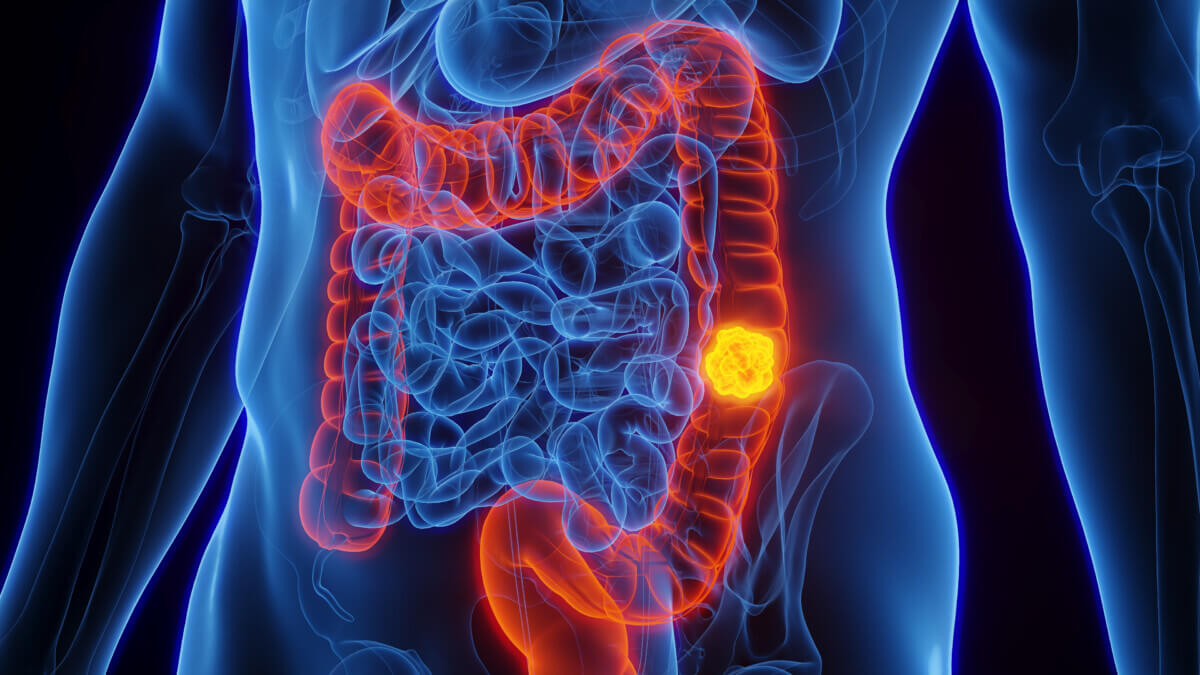
3D Rendered Medical Illustration of Male Anatomy showing Colorectal Cancer (Credit: © SciePro - stock.adobe.com)
In a Nutshell
- As colorectal cancer advances, essential amino acids make up a smaller share of the blood’s amino acid pool, while glycine makes up a larger share.
- Adding amino acid patterns to the CEA marker sorted patients with recurrence or metastasis more accurately than CEA alone within this study.
- Patients whose essential amino acids made up a smaller share before surgery had significantly worse survival.
Colorectal cancer ranks among the most survivable cancers when doctors catch it early and treat it hard. For many patients, though, the hardest stretch comes after surgery. The cancer returns, or it spreads, and by the time a scan or a symptom reveals it, the best window for treatment may already be closing. Any blood test that could help spot which patients face that danger sooner would change how doctors keep watch.
Researchers have taken a step in that direction. Scientists at the Korea Advanced Institute of Science and Technology (KAIST) and partner hospitals analyzed stored blood from colorectal cancer patients and found that the balance of certain protein building blocks, called amino acids, shifts in predictable ways as the disease advances. They then built a computer model around those shifts. When they added the amino acid information to CEA, the standard blood marker, the combined model sorted patients with recurrence or spread more accurately than CEA on its own. The work appears in the journal Advanced Science.
Colorectal cancer forms in the colon and rectum and remains one of the most commonly diagnosed cancers worldwide. Doctors currently track patients after treatment with surgery, imaging, and CEA, short for carcinoembryonic antigen, a protein that tends to climb when cancer is present. CEA has real blind spots, though. It misses cases, and it doesn’t capture everything happening inside the body at a molecular level. Amino acid patterns, this research indicates, might add information CEA leaves out.
How the Blood’s Chemistry Signals Colorectal Cancer
Amino acids are the raw materials the body uses to build proteins. Some, called essential amino acids, have to come from food because the body cannot make them. Others it can produce on its own. Cancer cells are known to be heavy consumers of certain amino acids, drawing on the body’s supply to fuel fast growth. This study set out to map those patterns and then test whether the map lined up with how patients fared.
Blood from 152 colorectal cancer patients, spanning early-stage to late-stage disease, went into the analysis. Using a chemistry method that tags amino acids with a fluorine marker and reads them with magnetic signals, the team measured 18 amino acids at once from a single sample. That approach was built to work with clinical blood samples, where differences between patients can otherwise blur the results.
Raw concentrations alone didn’t tell a consistent story. What stood out was each amino acid’s share of the total pool. Measured that way, essential amino acids such as valine and leucine made up a shrinking share of the blood as cancer stage advanced, while glycine, an amino acid the body can make itself, made up a growing share. The two trends moved in opposite directions in a clear, stage-by-stage pattern. A falling share of essential amino acids may reflect the tumor’s growing hunger for fuel, a drain linked to the physical wasting that often accompanies advanced cancer.
That shrinking share carried a warning of its own. Patients whose essential amino acids made up a smaller portion of the pool before surgery, measured against the group’s midpoint, went on to have significantly worse survival. That points to depleted essential amino acids as a possible red flag even before treatment begins.
Rising glycine tells a more layered story. Glycine feeds chemical processes that dividing cancer cells rely on to copy themselves. Rather than the tumor using less of it, the researchers believe the larger share in circulation may be the body compensating, with the liver, kidneys, and muscle ramping up production to match what the tumor consumes. A higher glycine share was also strongly tied to recurrence and spread.

How Amino Acids Talk to Each Other
One of the most original parts of this work looked past individual amino acid levels to the relationships among them. In early-stage colorectal cancer, many amino acid pairs in the blood moved together in coordinated patterns. As the disease advanced, that coordination fell apart.
Researchers mapped these connections as networks, linking each amino acid to the others it tends to move with. In early-stage disease, the networks were dense, with valine sitting at the center of many links. By the advanced stages, valine’s web of connections had collapsed, while glycine’s grew stronger and became the new hub.
That network information gave the prediction model its edge. Three machine-learning models were tested: one using only individual amino acid levels, one using only the network relationships, and one combining both along with CEA. On a 0-to-1 scale that measures how well a test separates higher-risk patients from lower-risk ones, the combined model scored about 0.81, compared with roughly 0.61 for CEA alone. Both scores came with wide margins of uncertainty, and CEA’s lower edge sat close to the point where a test performs no better than a coin flip. Notably, CEA wasn’t tossed out. It was the single most useful ingredient in the combined model. Amino acid data improved on it rather than replacing it.
A second cohort of 120 colorectal cancer patients and 50 healthy people from a different medical center showed similar shifts in essential amino acid proportions and several of the same amino acid relationships. That prediction model itself was not retested in that second group, so its performance still needs outside confirmation.
What a Colorectal Cancer Blood Test Could Mean for Patients
Beyond the model, the team ran lab experiments with colorectal cancer cells, watching how they changed the amino acid makeup of the fluid around them. Cancer cells reshaped their chemical surroundings more dramatically than normal colon cells did, more evidence that the shifts seen in patients’ blood come at least partly from the cancer itself.
Plenty of distance remains between this research and a test a patient would actually take. Because the study looked back at stored samples and existing records rather than following patients forward, it shows that the patterns line up with outcomes, not that a blood draw can forecast them in the clinic. The work also came from a single center, leaned toward late-stage disease, and could not read six of the standard amino acids because of measurement limits.
Even so, the core result matters. Read for the balance across a panel of amino acids, a blood sample may eventually add information about a patient’s progression risk beyond what CEA offers. Proving that will take forward-looking studies in new groups of patients. For a disease whose danger lies largely in relapses caught too late, even a modest head start would be worth chasing.
Disclaimer: This article summarizes peer-reviewed research for general information and is not medical advice. The study was retrospective, conducted at a single center, and has not been validated in forward-looking clinical trials, so the approach described is not yet available as a clinical test. Anyone with questions about colorectal cancer screening, monitoring, or treatment should consult a qualified healthcare professional.
Paper Notes
Limitations
The authors name several limits. Their fluorine-based method could not measure four amino acids (cysteine, aspartic acid, histidine, and proline), and a signal overlap between isoleucine and glutamate prevented reliable individual readings of those two, six in all. The analysis focused mainly on amino acids tied to a few cancer-related pathways rather than the body’s full chemistry. The study was retrospective and drew almost entirely from a single center, with a patient group weighted toward stage IV disease, which may limit how widely the results apply. Patients were sorted into broad stages rather than finer categories, and no formal calculation set the sample size, which was based on available data. The external cohort supported the reproducibility of amino acid patterns but was not used to train or test the prediction model. The researchers call for larger, forward-looking, multi-center studies with more balanced stages to confirm and extend the work.
Funding and Disclosures
The study was supported in part by the Samsung Research Funding & Incubation Center of Samsung Electronics (SRFC-MA2002-07); the National Research Foundation of Korea (RS-2024-00407383, RS-2025-25436925, RS-2025-02303891, RS-2025-15782968, and RS-2022-NR069827); a Faculty Research Grant (2024IF0030) from the Department of Surgery at Asan Medical Center; and grants (2025IP0041 and 2025IP0028) from the Asan Institute for Life Sciences, Asan Medical Center, Seoul, Korea. The authors declare no conflicts of interest. Editorial assistance was provided by Life Science Editors.
Publication Details
Authors: Ji-Yeon Lee, Jumi Kim, Taehan Yoon, So Hyun Kwon, Su Chan Park, Dohyun Chun, Dohyeong Kim, Eun Jung Park, Hyunwoo Kim, and Ji Min Lee. Ji-Yeon Lee and Jumi Kim contributed equally.
Affiliations: Graduate School of Medical Science and Engineering and Department of Chemistry, Korea Advanced Institute of Science and Technology (KAIST), Daejeon; Division of Colon and Rectal Surgery, Department of Surgery, Gangnam Severance Hospital, Yonsei University College of Medicine, Seoul; Division of Colon and Rectal Surgery, Department of Surgery, Asan Medical Center, University of Ulsan College of Medicine, Seoul, Republic of Korea.
Journal: Advanced Science (2026)
Paper Title: “Circulating Amino Acid Network Remodeling Reveals Systemic Metabolic Reprogramming Predictive of Colorectal Cancer Recurrence and Metastasis”
DOI: 10.1002/advs.76044


