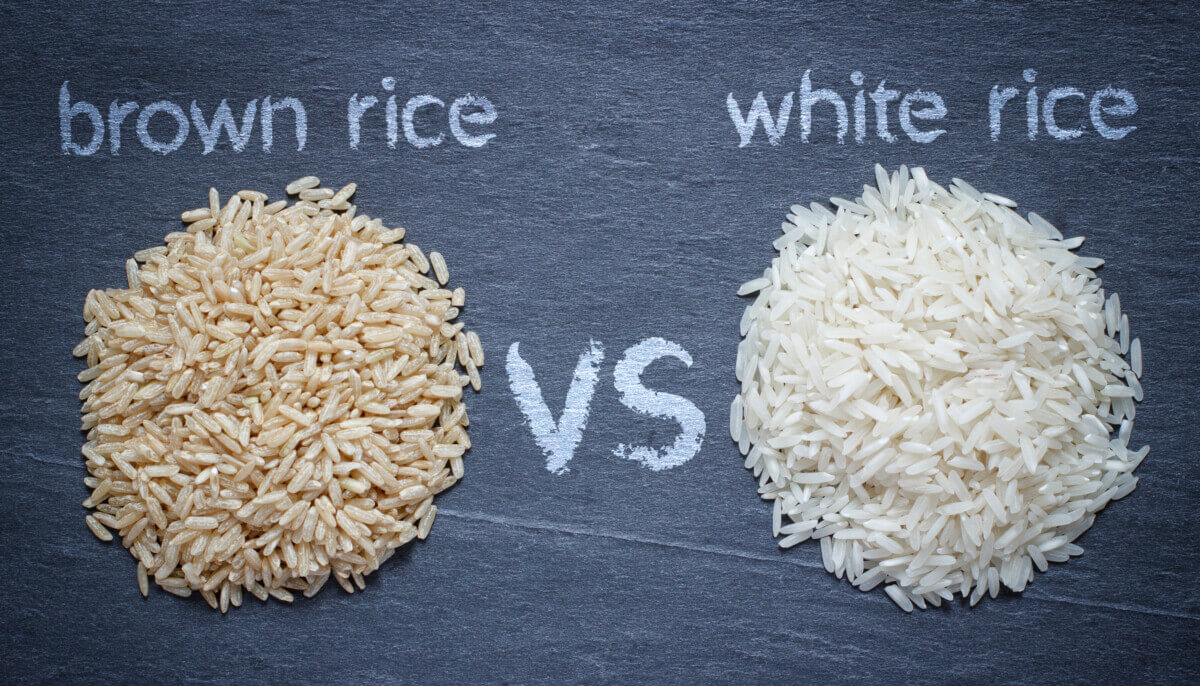
Brown rice vs white rice (© robsphoto - stock.adobe.com)
For centuries, rice has been a key component across several cultures in China, Japan, India, South Korea and other Asian nations for thousands of years. According to the Rice Association, there are over 40,000 rice variations that exist, but the exact number remains unknown. In recent years, modern-day diet culture has continued to promote the idea that brown rice is healthier than white rice.
So, is that really true? Let’s take a look at the facts.
What’s the difference between brown and white rice?
Brown rice is a whole grain while white rice is not. Brown rice has the bran and germ intact, while white rice has been refined to have these removed. Given the tough bran outer layer, it typically takes longer to cook and it yields a chewier texture. The nutrients in brown rice are better retained because they are found in the bran and germ, therefore there are significantly less nutrients in white rice.

Why do people say brown rice is healthier?
Across the board, it’s generally accepted than whole grain is preferable compared to white, refined grain. This goes for breads, cereals, etc. Since brown rice is considered a whole grain, it’s often immediately deemed healthier. Given that the bran is intact, there is slightly more fiber, vitamins, and minerals. Research also suggests that brown rice digests slower than white rice, having a positive impact on blood sugar stability.
Is it actually healthier?
Brown rice has a slight edge over white rice, but it isn’t significant in the grand scheme of things. Here’s why:
1. Fiber
On average, there is only about one gram of fiber per cup of brown rice, while there isn’t any in white rice. Recommended daily fiber intake is close to 25 grams, meaning brown rice isn’t making a significant difference in your fiber intake.
2. Arsenic
Arsenic, a heavy metal, is often found in much higher amounts in brown rice. In fact, it contains close to 80 percent more arsenic than white rice. While it isn’t a huge concern unless you eat a rice-based diet, it is something to be aware of. We are already exposed to arsenic and other heavy metals through water, and other environmental factors, so it doesn’t hurt to reduce exposure through food where possible.
3. Impaired nutrient absorption
Brown rice contains more magnesium, iron, selenium, and zinc. However, that doesn’t mean you’re getting them all. Brown rice is rich in phytic acid, much more so than white rice. Phytic acid is a carb molecule that has been shown to have antioxidant benefits, but it also binds to minerals like zinc and iron.
So, while brown rice may have more minerals, your body will not fully absorb them anyway due to the phytic acid content. Many other fruits, vegetables, meats, and seafood contain an abundance of minerals.
4. Blood sugar
Brown rice has been shown to digest slower and not induce steep blood sugar spikes. White rice digests quicker and may spike it. However, most of us don’t eat rice alone. Generally, it’s paired with a protein and some vegetables. After all, the classic gym bro meal is chicken, rice, and broccoli. When refined carbs are paired with protein, healthy fats, and fiber, your blood sugar responds much better than if you ate the carbs alone.
Bottom Line
Whether you eat brown or white rice will always be up to personal preference. Some people like brown rice, and that’s okay. If you are more of a white rice person, try to pair it with a protein, healthy fat, and fiber-rich vegetable to slow digestion and make the meal more satiating.
The main issue is how brown rice is viewed as significantly healthier than white rice, when things aren’t so cut and dry. Additionally, labeling white rice as a “bad” food continues to perpetuate the idea that healthy food must fit the standard Western mold. Cultures across the world have eaten white rice for centuries, and this should be recognized.


This article has facts, but the author leaves out relative facts. Such as origin of where rice is grown makes a difference in the amount of arsenic in the rice. You can find white rice with a higher count of arsenic. At the end of the day, brown rice is still better for you, even if it’s only a little bit. Do the homework people and find out for yourself. Shame on the author, the title is misleading, which makes the article misinformation.
Personally my fave is wild rice – which is actually a seed & a complete protejn by itself. It is SO good, with a lovely nutty & crunchy texture. Goes great with mushrooms & onions.
Can you post your credentials? Because I can mine ????.. I am reporting this story and any others your write as false and dangerous information
This feels revisionist. The eponymous prison and ship study (virtual prisons for the time period) should lay this to rest.
https://www.ncbi.nlm.nih.gov/pmc/articles/PMC3595404/#:~:text=It%20involved%20assigning%20inmates%20of,rice%20offered%20protection%20against%20beriberi.&text=As%20is%20often%20the%20case,a%20much%20more%20tortuous%20process.
Yes, white rice is ok with a reasonable diet supporting it. So are pastries and McDonald’s. One on one, white rice loses lives and brown rice keeps them.
“Significantly fewer nutrients” is correct English, not “significantly less nutrients.”
I have heard this information for 50 years. So, it is not Significantly “better” but it certainly tastes like you are eating a flavorful food, and not mushy white glue.
The Japanese eat rice daily and it is mostly white rice. They are the healthiest people on the planet.
Your article seems to emphasize the limited benefits of brown rice over white rice, but fails to apply the same scrutiny to its limitations. This appears to be a biased approach and could be seen as propagating a particular viewpoint rather than presenting a balanced analysis. A more rigorous evaluation grounded in empirical evidence would strengthen your argument. Additionally, the mere fact that a food has been consumed for millennia does not necessarily make it healthier; both scientific research and historical accounts have shown that this is not always the case.
Crapola…. I knew this all the way, almost all the healthy things they promote are just for the businesses!
Nobody ever heard of BERI BERI? All ignorants?
Having more arsenic in the brown rice is meaningless. If the amount is not significant compared to the toxicity levels. Having more fiber is significant even if it’s just one gram as most Americans diets are very low on fiber too low. The bottom line is brown. Rice is significantly healthier than white rice and I agree with one of the commenters that this is an article that got paid for by an association or a company that’s supplying a lot of white rice.
A lot of disclaimers . This was a click bait headline pure and simple, so you won this time. But not the next time.
“Brown rice is not healthier than white rice”
*Proceeds to write all the benefits brown rice has over white with a tiny “but” at the end…
Yet another click bait article, lazy journalism
Almost every point in this post demonstrates that brown Brice has the edge over white. So yes, buy and eat whatever you want. Just know this article shows brown rice with some advantages.
It so funny how they said white rice is refined rice lol
A cup of brown rice contains 3.5 grams of fiber, not 1 gram. A cup of white has 0.6 grams. That is a significant difference. 7 cups of brown give all the fiber you need for a day. It would take 41 cups of white rice to get that same amount.
I saw no reference to any study or data. This is strictly an option piece. And every argument presented seems to prove that brown IS healthier.
In my experience, your comment about brown rice being equivalent to white rice when combined when combined with vegetables and protein is incorrect. When I serve brown rice instead of white rice with stir fries or chili, my diabetic husband’s blood sugar is lower by at least 100 points after dinner than when I make white rice. Brown rice can make a significant difference in blood sugar levels.
Study by whom? Rice mill employee with 9 years school.
Click bate to get people to read or just stupid and don’t forget the processing chemicals used to make white rice besides the far healthier benefits of whole grain brown rice another article showing why Americas world leading obesity rate is increasing and most people line up for more horrible premade food …
This is a nonsense article. It states all the reasons brown rice is healthier than white rice, and then includes ‘but’ clauses to try and convince us the health effects aren’t that great. When most western diets are junk to begin with, every small improvement is important, especially with the impact on blood glucose, with insulin resistance on the rise.