
(Credit: © Tricky Shark - stock.adobe.com)
Museum Visitors Who Felt Overwhelmed or Underwhelmed Reported More Boredom
In A Nutshell
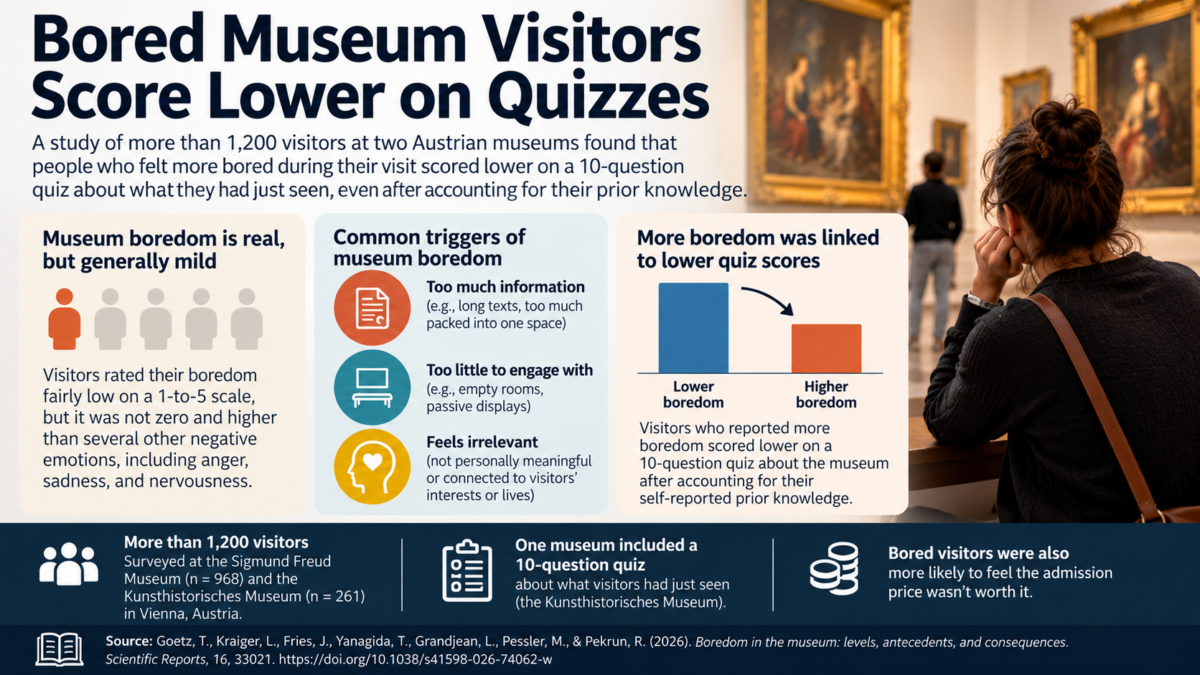
- Visitors at two Vienna museums reported low but real boredom, averaging about 1.7 on a 5-point scale.
- Feeling overwhelmed or underwhelmed went with more boredom, and so did seeing little personal importance in the visit.
- At the art museum, more bored visitors scored lower on a quiz about what they had just seen.
- Findings show a link, not cause, and only one museum gave the quiz.
Visitors who felt bored during a museum trip scored lower on a quiz about what they had just seen, even after researchers accounted for how much they already knew going in. The gap was modest, but a new study in Scientific Reports hints that a dull visit may send people home with less.
A team led by Thomas Goetz at the University of Vienna surveyed and interviewed more than 1,200 visitors at two different Austrian museums: the small Sigmund Freud Museum and the sprawling Kunsthistorisches Museum, which the paper calls “one of the most significant art museums in the world.” The researchers wanted to know how often boredom shows up, what goes with it, and whether it relates to anything beyond a flat day.
Museum boredom has rarely been studied, perhaps because visitors choose to go and can roam freely. It turned out to be mild overall, but visitors named specific complaints, from walls of text to blank rooms, that museums have the power to change.
Visitors Reported Low but Real Museum Boredom
Three studies ran between May 2023 and December 2024. Two were questionnaires handed to randomly approached visitors as they left, 968 at the Freud Museum and 261 at the art museum. Visitors rated 11 emotions, boredom among them, from 1 (not at all) to 5 (very strong). Ages ran from 18 to 91 and averaged about 40, with more women than men in both samples. Participants spoke German or English, and the researchers collected no data on race or ethnicity.
Interviews made up the third study, with 72 other Freud Museum visitors talking at a café table after their visit. Most lasted about 10 minutes, and the answers were sorted for recurring themes.
Boredom averaged 1.69 at the Freud Museum and 1.81 at the art museum, which the authors call low but above zero. Among seven negative emotions, boredom ranked third at the Freud Museum and second at the art museum, ahead of anger, nervousness, frustration, and disappointment in both. Despite the low average, some visitors rated their boredom at the maximum of 5.
Overwhelmed or Underwhelmed Visitors Reported More Museum Boredom
Visitors who said the visit was too challenging reported more boredom, and so did those who said it was not challenging enough. Researchers gauge links like these on a scale where 0 means no connection and 1 means a perfect match. Overall figures for these links, including the quiz and price results below, all landed between 0.18 and 0.35, which makes them modest.
On the overwhelmed side, nine of the 72 people mentioned having no set route through the museum, seven cited too much information, and six cited too much text. After an audio section, one visitor faced a large room with still more to read and said, “The boredom kept growing during my visit to the museum.” On the underwhelmed side, five mentioned bare design, five mentioned emptiness, and four mentioned videos where nothing else was happening. “The walls felt a bit barren, which made me somewhat underwhelmed,” said one.
Personal importance was part of the pattern too. Visitors who called the visit personally important reported less boredom. In the interviews, 15 cited a general interest in psychology or Freud, while seven said the visit held no personal value for them. One explained, “It just was sort of a recommendation.” Every link measured at both museums pointed the same direction, though several were stronger at the art museum.
Museum Boredom Tracked With Lower Quiz Scores at the Art Museum
Only the art museum survey tested learning. Visitors answered 10 multiple-choice questions about what they had just seen, such as which detail in the painting “The Tower of Babel” shows the building is unfinished (the unfinished floors). They also rated their own prior knowledge from 1 (very low) to 5 (very high).
Higher boredom went with lower quiz scores, and the link barely shrank after accounting for that self-rated prior knowledge. Bored visitors at both museums were also more likely to call the admission price too high.
This design cannot show which way the links run. Boredom may have led to poorer learning, disengaged visitors may have grown bored, or something else may have driven both. Visitors also often miss parts of an exhibition, so a wrong answer may reflect what a person never saw.
Goetz called museums “key venues for informal learning outside schools and universities” and said they “could cater more effectively to the diversity of their visitors,” using tools such as smartphone barcodes and routes of varying difficulty, from a short pocket tour to an in-depth one, without turning galleries into entertainment venues. None of those fixes was tested here.
A glazed look in front of a painting is not a character flaw. Many of the features tied to boredom are choices museums make, and the more bored visitors scored lower on the one quiz given. Museums that want people to leave knowing more have good reason to treat boredom as a design problem.
Disclaimer: This article summarizes published research for general informational purposes only. It is not medical, psychological, or professional advice, and the findings of a single study should not be treated as conclusive.
Paper Notes
Limitations
All boredom, challenge, and value ratings were self-reported, which can introduce bias. The design cannot establish which came first, boredom or the factors linked to it, so no cause and effect can be claimed. The knowledge quiz was used only at the Kunsthistorisches Museum, so the boredom and learning link was not independently repeated at a second site, and prior knowledge was a single self-rated question rather than a test. Visitors often do not see an entire exhibition, so a missed question may reflect limited exposure rather than missing knowledge. The pooled statistics combined just two surveys, which the authors describe as imprecise. Freud Museum visitors likely arrived with existing interest in Freud and psychoanalysis, which may limit how far results from that museum apply. Samples were German- and English-speaking, no race or ethnicity data were collected, and no one on a compulsory visit, such as a school group, took part; the authors say boredom may run substantially higher in those cases. The study did not examine broader sensory qualities of museum spaces, such as touch or spatial feel. The links between boredom and feeling overwhelmed, underwhelmed, and the general importance of museums varied between the two museums, and the authors caution against overgeneralizing across museums that differ in topic, size, and audience.
Funding and Disclosures
The authors state there was no funding for this work and declare no competing interests. One author, Monika Pessler, is affiliated with the Sigmund Freud Museum, where two of the three studies took place. All three studies were preregistered and approved by the institutional review board of the Department of Developmental and Educational Psychology at the University of Vienna. Participants gave written informed consent and received no compensation.
Publication Details
The paper, titled “Boredom in the museum: levels, antecedents, and consequences,” was written by Thomas Goetz, Lukas Kraiger, Jonathan Fries, Takuya Yanagida, and Louisa Grandjean of the Department of Developmental and Educational Psychology at the University of Vienna; Monika Pessler of the Sigmund Freud Museum in Vienna; and Reinhard Pekrun of the University of Essex, Australian Catholic University, and Ludwig-Maximilians-Universität München. Goetz is the corresponding author. It was published in Scientific Reports, volume 16, article number 33021 (2026), received March 4, 2026, accepted September 27, 2026, and published online October 27, 2026, as an open access article under a Creative Commons Attribution 4.0 license. DOI: https://doi.org/10.1038/s41598-026-74062-w


