
Astronomers have discovered a “black hole star,” an extremely bright red spot in the early universe that appears to be a new type of astrophysical object. It resembles an enormous star, but its energy production is closer to what a black hole might generate. (Credit: Jose-Luis Olivares, MIT)
Astronomers May Have Cracked ‘Little Red Dots’ Mystery With Discovery As Large As Our Solar System
In A Nutshell
- Astronomers have identified a brand-new type of object in the early universe, what they’re calling a “black hole star.” It’s a black hole wrapped in a cocoon of hydrogen so large it spans the width of our solar system.
- It shines about 100 billion times brighter than any star could through nuclear fusion, which is why the team concludes a black hole, not fusion, powers it.
- Its red color comes from dense gas rather than dust, and the researchers estimate a central black hole roughly 100,000 times the mass of the sun, far below what standard methods would suggest.
Astronomers have found something in the early universe that, by the ordinary rules of physics, should not exist. The object is about the size of our entire solar system, and glowing roughly 100 billion times brighter than any known star can physically produce. Its light carries the fingerprint of a star, yet no star could pump out that much energy. A black hole could.
A team at MIT and other institutions spotted the object, an intensely bright red dot, in images from NASA’s James Webb Space Telescope, dating to about 660 million years after the Big Bang. Their leading explanation is a mashup never seen before: a black hole cloaked inside a vast, dense envelope of hydrogen that behaves like the atmosphere of an enormous star. They call it a “black hole star.”
“Our picture of this object is evolving very rapidly,” says lead author Rohan Naidu, a NASA Hubble Fellow at MIT. “We think there is a central black hole that is 100,000 times as massive as the sun. And around this black hole, there would be this very extended envelope of gas that looks like a star the size of the solar system. It’s huge.”
Beyond its own strangeness, the object, cataloged as MoM-BH*-1, may crack one of the biggest puzzles of the Webb era: the “little red dots” that have turned up in nearly every deep-space image the telescope has taken. “These little red dots seem to be everywhere in the early universe but essentially disappear by the present day,” Naidu says. “What exactly these objects are has been one of the most debated topics of the JWST era.”
A Mirage, a Miracle, and the First Black Hole Star
Naidu and his colleagues were not hunting for a new kind of object. Their survey, playfully named “Mirage or Miracle,” set out to sort real early galaxies from impostors among the surprisingly bright sources Webb keeps finding in the young universe. “There’s been this puzzle of many bright galaxies showing up at extremely early times,” Naidu says. “What we found was that what looks like an extremely bright early galaxy, aka a ‘miracle,’ in some cases actually could be a ‘mirage.'”
One dot stood out as the reddest, brightest source in a patch of sky called the Ultra Deep Survey field. Its light was strong at longer infrared wavelengths but essentially vanished below a certain point, a sharp cliff astronomers call a Balmer break. That break normally signals dense gas soaking up light in the atmospheres of aging stars. In this object, it went far past anything a star could produce.
“The break we observed in this object is the deepest break we have ever observed in any object, ruling out ‘ordinary’ stars as the source,” Naidu says. Its light also carried almost no trace of heavier elements, only hydrogen and helium. “It was truly singular in so many ways,” Naidu says.

Gas, Not Dust, Behind the Red Glow
When astronomers see something very red in space, dust is usually the first suspect. “When we see something very red in the universe, we often assume that it is surrounded by dust, like soot or ash,” explains MIT co-author Robert Simcoe. “The same way that the wildfire smoke from Canada recently made the sky in Boston look bright red, astronomical objects can also appear redder than their intrinsic color when you see them through a veil of dust.”
But the light didn’t match what dust produces. Running close to a million simulations, the team found it could reproduce the strange red color with hydrogen alone. “We started to ask: Could you make something that red using just hydrogen, without any dust?” Simcoe says. “To our surprise, it turns out you can, if you have an extremely dense screen of hydrogen, so dense that it looks more like the surface of an enormous star than a wispy interstellar nebula.”
That distinction reaches well beyond one object. If the red glow of little red dots comes from gas rather than dust, the brightness corrections astronomers use to weigh their black holes could be off by a factor of 10 to 100 or more.
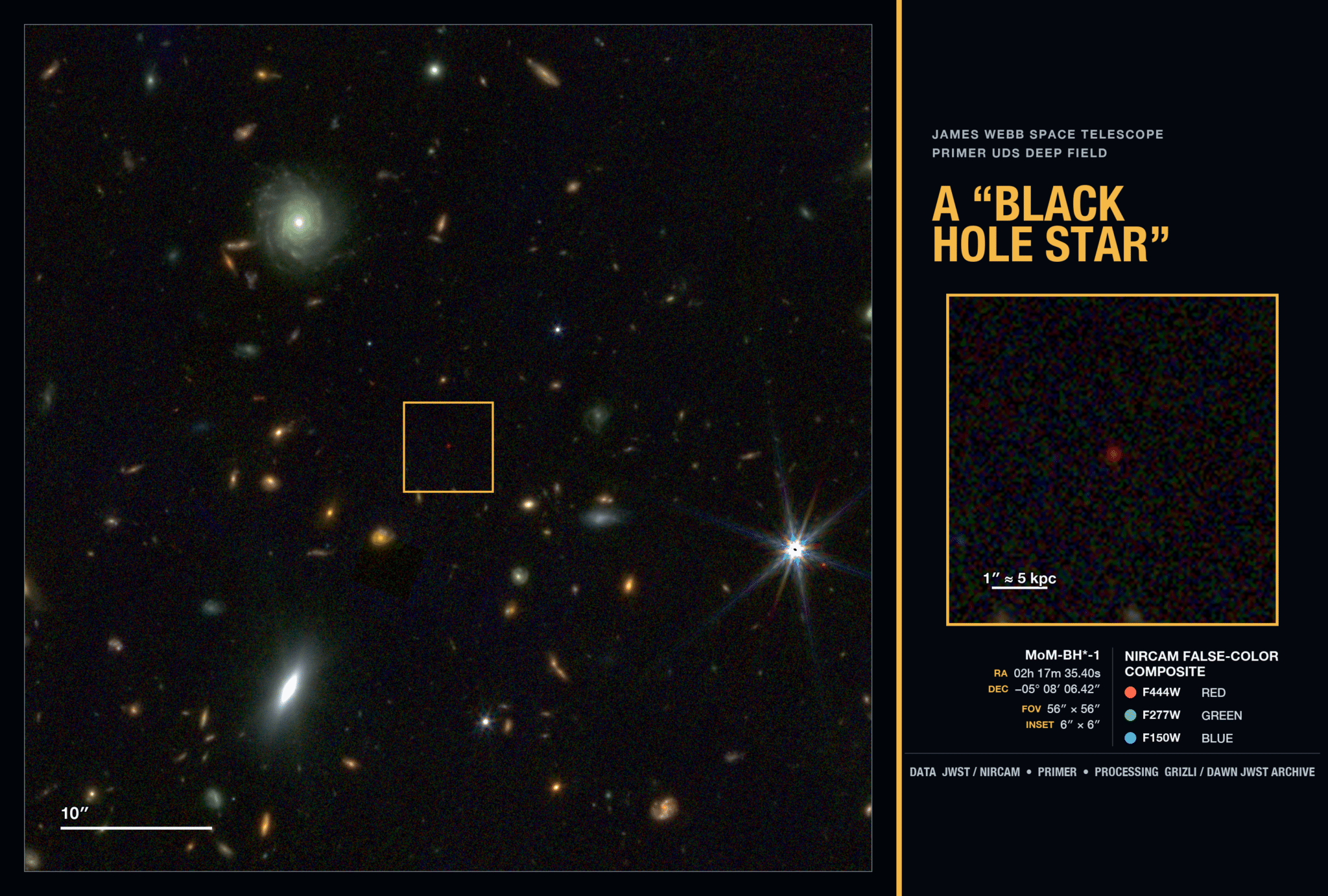
(Credits: Image: NASA, ESA, CSA, STScI, DAWN JWST Archive, PRIMER Survey (PI: James Dunlop); Visualization: Rohan Naidu (University of Hawai’i))
Weighing the Black Hole Star
One feature the hydrogen cocoon alone could not explain was the sheer output of light. “You have something that looks a bit like a star but is 100 billion times brighter,” Naidu says. “That means you can’t be powering this by nuclear fusion, which is the energy source that sits at the heart of all the stars we have.” Black holes, by contrast, routinely generate energy on that scale as they swallow surrounding material.
Weighing the black hole itself is where things get tricky, and that difficulty is telling. Standard methods gauge a black hole’s mass from the width of hydrogen emission lines, a stand-in for how fast gas whirls around it. In MoM-BH*-1, the team argues, that gas may not be orbiting the black hole at all; instead, light may be scattering repeatedly through the thick cocoon, artificially broadening the lines. Applied naively, the usual method would imply a black hole of a few hundred million suns. In the team’s favored model, the black hole comes out to roughly 100,000 times the sun’s mass, though the researchers stress that estimates like this are highly uncertain. As the paper puts it, “black hole masses of these sources may therefore be overestimated by orders of magnitude.”
Black Hole Stars and the Little Red Dot Mystery
MoM-BH*-1 sits near a larger galaxy at about the same cosmic distance, and the two are expected to merge in roughly 100 million years. When the team combined the light of both, the result looked very much like a little red dot. That match points to a tidy answer for what those dots are: a gas-enshrouded black hole, or black hole star, paired with an ordinary young galaxy, with the black hole dominating the red light. Long-standing quirks of little red dots, including their faintness in X-rays and the far infrared, fall into place under this reading.
What sets MoM-BH*-1 apart is how cleanly it can be seen. “Every little red dot is consistent with being a black hole star, embedded in a generic early galaxy,” Naidu says. “But what is special about MoM-BH*-1 is, the black hole star is essentially completely outshining its surrounding host galaxy, such that we’re seeing pure black hole star light.”
Whether MoM-BH*-1 is gorging on gas near the fastest rate physics allows or settling down from such a binge is still unknown, and much about black hole stars remains unsettled. What the object may offer is a rare look at the kind of environment theorists have proposed could help black holes balloon to enormous sizes in the early universe. If more of these red dots turn out to hide black hole stars, one of the Webb telescope’s most stubborn mysteries may finally have an answer.
Paper Notes
Limitations
By their own account, the researchers caution that their modeling is “highly simplistic” and that the relevant parameter space is “high-dimensional, degenerate and much remains unknown,” including the intrinsic light output of early black holes and the detailed internal structure of the gas envelope. Estimates of the black hole’s mass carry significant uncertainties, and the researchers present a wide range of possible values depending on which assumptions are used, explicitly cautioning that these should be seen as “order-of-magnitude estimates.” The tentative detection of variability was measured across three different observing modes with distinct calibration characteristics, which the researchers acknowledge is not ideal. The paper also notes that only one object has been studied, so it is not yet clear how representative MoM-BH*-1 is of the broader little red dot population.
Funding and Disclosures
This research was supported by NASA through the NASA Hubble Fellowship grant HST-HF2-51515.001-A. Funding was also provided by JWST programs GO-3516, GO-5224, and GO-1837. Additional support came from the European Union through ERC grants AGENTS (101076224), HEAVYMETAL (101071865), and RED CARDINAL (101076080). The Swiss State Secretariat for Education, Research and Innovation contributed support under contract number MB22.00072. Further funding came from the Swiss National Science Foundation through project grant 200020_207349, JSPS KAKENHI grant no. 23H00131, and the Danish National Research Foundation under grant DNRF140. Additional support for individual investigators came from the Gordon and Betty Moore Foundation and the John Templeton Foundation through the Black Hole Initiative at Harvard University, and from a UK Research and Innovation Future Leaders Fellowship (grant no. MR/V023381/1). The MIT press materials note additional support from the MIT Department of Physics and the Space Telescope Science Institute. The authors declare no competing interests.
Publication Details
Title: A gas-enshrouded and gas-reddened black hole at cosmic dawn | Authors: Rohan P. Naidu, Jorryt Matthee, Harley Katz, Anna de Graaff, Pascal A. Oesch, Aaron Smith, Jenny E. Greene, Gabriel Brammer, Andrea Weibel, Raphael Hviding, John Chisholm, Ivo Labbé, Robert A. Simcoe, Callum Witten, Wendy Q. Sun, and additional co-authors listed in the paper. | Journal: Nature, Vol. 656, published 13 August 2026, pp. 329–333. | DOI: 10.1038/s41586-026-10846-4 | Received: 20 March 2025 | Accepted: 24 June 2026 | Published online: 12 August 2026 | Quotes: Direct quotations from Rohan Naidu and Robert Simcoe are drawn from the MIT News release “Astronomers discover a brand-new type of astrophysical object: A black hole star” (written by Jennifer Chu, MIT News, 12 August 2026), distributed by MIT News.


