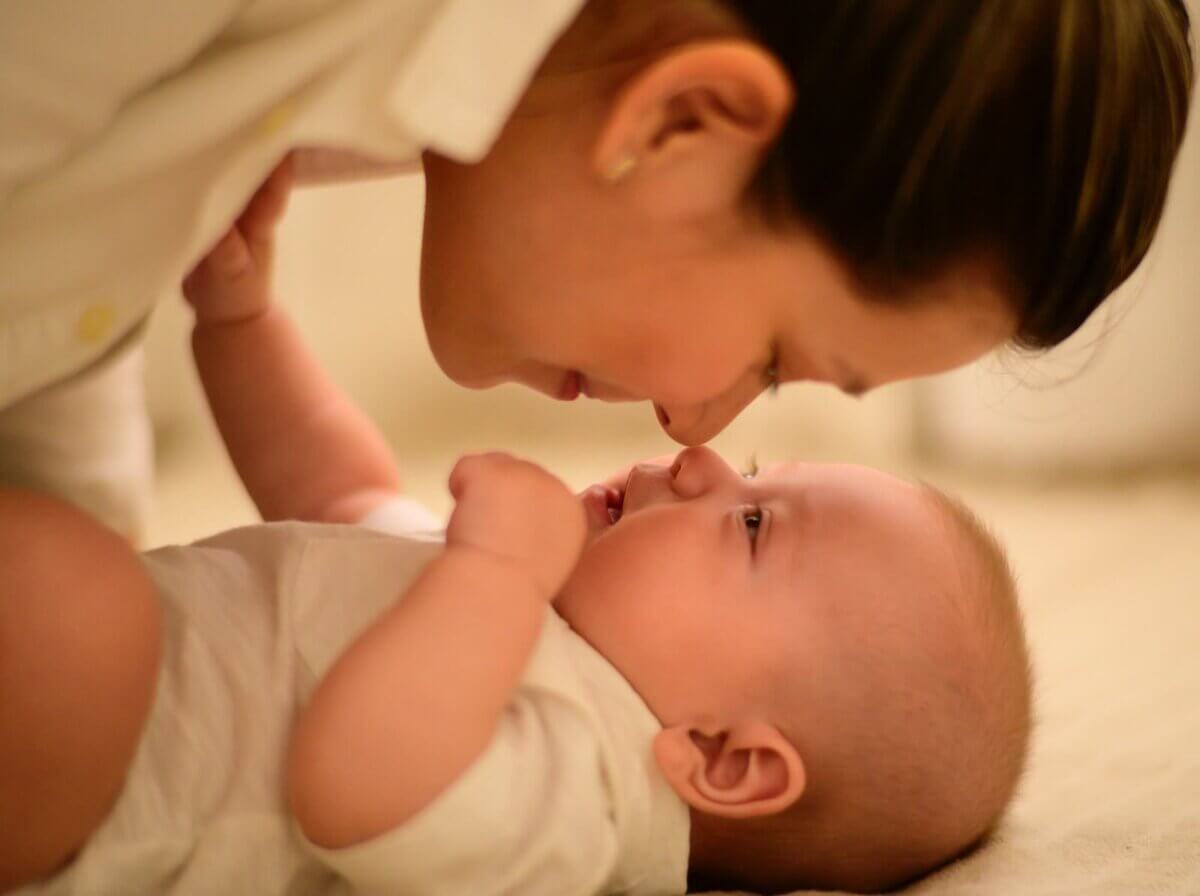
(Photo by Ana Tablas on Unsplash)
In A Nutshell
- Babies’ heart rate variability began rising several seconds before mom and baby shared a positively engaged moment.
- Positive moments from only mom or only baby did not bring the same rise.
- Mothers started 95% of shared positive moments during play, and those moments showed the clearest pattern.
- Authors call the work exploratory, so it shows an association, not cause and effect.
Several seconds before a mother and baby settle into a moment of shared delight, the baby’s heart rhythm has begun to shift. Researchers found that pattern in 974 four-month-olds, and it appeared only around moments when both mom and baby were positively engaged with each other at the same time.
Heart rate variability, which tracks how much the heart speeds up and slows down as a person breathes, is where the shift showed up. A heart that flexes easily generally signals a body that can calm down, focus, and adjust to what is happening around it. Researchers watch it in babies as an early clue to how well they manage their feelings.
Positive engagement covered more than smiles. Trained observers scored facial expressions, where each partner was looking, and sounds such as cooing, so a grin and a giggle could both count toward the same happy exchange. The study, published in Philosophical Transactions of the Royal Society B, is labeled exploratory by its authors. That means it maps a pattern rather than proving that a baby’s body predicts a happy moment or that such moments reshape a baby’s stress system.
Infant Heart Rate Variability Climbed Up to 10 Seconds Before Mutual Positive Moments
Families came from a research project at four U.S. universities. Four months is an age marked by intense expressions of joy during social interaction, which is why researchers focused on it. About 77% of the sample was Black. Many families had documented social risk factors: roughly 80% of mothers were single, and 82% received Medicaid, the public health insurance program for low-income Americans. About 42% of babies had been exposed to cocaine before birth, and more than half had been exposed to alcohol or tobacco. On average, babies arrived at about 36 weeks, slightly early, and weighed roughly 5 pounds, 12 ounces at birth.
Each pair completed a six-minute lab routine: two minutes of normal play, two minutes in which mom held a still, expressionless face, and two minutes of reunion play. Researchers use the routine to see how babies respond when a parent’s attention is switched off and then returns. Shared positive moments almost vanished during the blank-face stretch, leaving too few to analyze, which is unsurprising given that mothers were told to stay neutral. Sensors on the baby’s chest and abdomen tracked heartbeats while cameras filmed both faces. Observers then labeled every second of video, noting when mom and baby were both upbeat, when only one was, and when neither was. Each baby’s heart data from those moments were compared with an ordinary stretch from the same baby in the same part of the session.
Analyses covered 2,637 mutual positive moments during play and 1,658 during reunion. Heart rate variability ran higher during those moments than during neutral moments or moments when mom and baby were out of sync. During play, the elevation stretched from 10 seconds before a mutual moment began to 7 seconds after. During reunion, it ran from 8 seconds before to 4 seconds after. Because these moments were picked out after the fact, the data show when the rise began relative to each one, not whether a baby’s body can see joy coming.

Positive Moments From Mom or Baby Alone Did Not Raise Infant Heart Rate Variability
Moments when only one partner was positively engaged told a different story. A beaming mom whose baby stayed neutral, or a baby enjoying itself while mom did not join in, showed no reliable difference from ordinary moments at any second, in either play or reunion.
Mothers Led 95% of Mutual Positive Moments During Play
Next came the question of who started each shared moment. Mom went first 95% of the time during play and 75% of the time during reunion. Moments that mom started showed the clearest heart rhythm pattern, with elevated readings both before and after the moment began, in both parts of the session. Infant-started moments, just 114 in play and 360 in reunion, showed no reliable differences, though counts that small limit what can be concluded.
Neither social risk nor prenatal drug exposure changed how often shared moments happened. Babies with higher prenatal exposure risk did show a bigger heart rhythm difference during shared moments in the reunion period, especially mom-led ones, hinting that prenatal exposure may be related to how strongly infants respond physically during these exchanges.
Authors of the paper raise the possibility of a two-way loop in which a mother’s positive expressions support a rise in heart rate variability, which in turn helps the baby stay engaged in the moment, though the study cannot say which comes first. They also float a more speculative idea: that these shifts could put babies in a focused state that supports learning, which the study did not test. Longer studies with older children will have to show whether any of it lasts. If the loop holds up, a game of peekaboo may be doing more physical work inside a baby than it seems, with both people playing a part.
Disclaimer: This article summarizes one published study for general readers and is not medical or parenting advice. Findings describe associations in a specific group of infants and mothers and do not show that any behavior causes changes in a baby’s health.
Paper Notes
Limitations
Researchers used a 10-second window to estimate heart rate variability, shorter than the 30-second or longer windows common in earlier work. That allows finer timing, but changes inside the window may reflect activity from slightly before or after a given moment. The random comparison stretches were not controlled for what behavior they contained, so some may have overlapped with mutual positive moments. The authors say this may have worked against finding a result rather than inflating one. They also did not control for bouts that began within 10 seconds of each other, and they excluded bouts occurring in the first or last 10 seconds of an episode. The mother-led versus infant-led comparison was constrained by how few infant-led moments occurred, which reduced statistical power. Only mothers were studied, and the sample was made up of at-risk families, so whether the pattern holds in other families remains untested. The authors describe the analyses as exploratory and call for longer recording sessions in future research.
Funding and Disclosures
Funding came from the National Institute of Child Health and Human Development, along with the Administration on Children, Youth, and Families, the Center for Substance Abuse Treatment, and the National Institute on Drug Abuse. The authors declared no competing interests and stated that no AI-assisted technologies were used in creating the article.
Publication Details
Titled “Mutual positive engagement with mother is uniquely associated with increases in human infant heart rate variability,” the paper was written by Drew H. Abney (University of Georgia), Stephen J. Sheinkopf (University of Missouri), Samantha G. Mitsven (University of Miami), Ronald Seifer (University of North Carolina at Chapel Hill), Barry M. Lester (Brown University), Ed Z. Tronick (University of Massachusetts Boston), and Daniel S. Messinger (University of Miami). It was published in Philosophical Transactions of the Royal Society B, volume 381, article 20260004, as part of the theme issue “Mechanisms, development, phylogeny and functions of emotional expressions.” The paper was received January 26, 2026, and accepted June 29, 2026. DOI: 10.1098/rstb.2026.0004.


