
Photo by Zachary Kadolph on Unsplash
NEW YORK — We’re seeing a lot of research these days emphasizing how more of America’s young adults still rely on their parents financially well into their 20s. Yet according to a new poll of 2,000 adults, Americans believe the average person should be able to afford their “dream home” — by age 33! And if you think that’s wild, the age at which people think retirement becomes attainable is two decades earlier than the standard.
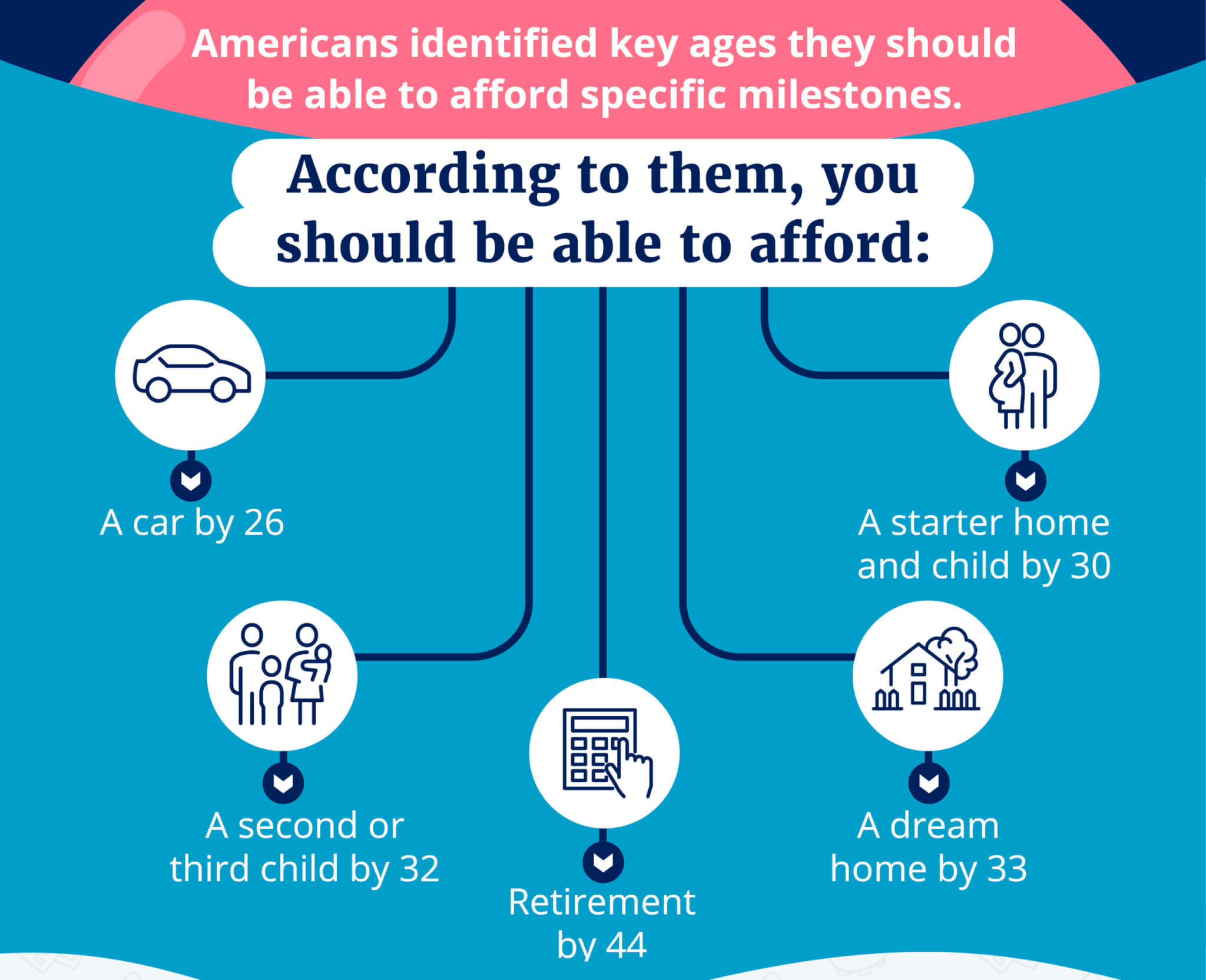
The surprising results reveal that, aside from their ideal house, the average person should also be able to afford a car by age 26, along with a starter home and a child by age 30. After that, Americans should have enough money to have a second or third kid by age 32, and, shockingly, retire by age 44!
Many are making moves toward that goal, as more than half (51%) of those polled say retirement is their top savings goal.
Do you have financial goals?
The study by financial services company Empower, and conducted by OnePoll, finds an overall 56% of people have financial goals— and 92% of those believe their goals are feasible at certain life stages. Additionally, 56% have a budget set aside purely for savings, with individual amounts for both long-term and short-term savings goals.
For short-term goals, defined as attainable within five years of saving, people say they stash an average of $1,539. Savers say they’ve set aside an average of $2,335 for longer-term goals that are five years or more away.
People are more inclined to set aside money for their long-term goals than short-term ones (41%, compared to 24%) which include saving for a home (50%), student loans (46%), medical expenses (45%), and cars (41%).
Long-term savings are also more impactful on peoples’ financial health than short-term savings (78%, compared to 65%).
“Most people believe in the positive impact setting aside money for later can have on their lives,” says spokesperson Courtney Burrell, financial professional at Empower, in a statement. “Whether it be for retirement, a home, or Taylor Swift concert tickets, having a plan — and sticking to it – can help you reach your financial goals, both big and small.”
What’s your money persona?
The study also aims to categorize Americans into four major “money personas”: explorers, builders, mentors, and givers.
Explorers (38%) defined themselves as “learning about the world around them,” builders (37%) are focused on “growing their lives,” mentors (16%) like to “share what they have learned” and givers (7%) believe in “revisiting past aspirations.”
Aligned with their preference to “get the most out of life” by enjoying the here and now (50%), explorers favor saving for material things (83%), whereas builders, mentors and givers prefer saving for experiences (80%, 87% and 83%, respectively).
Nearly half of builders (47%) defined it as “planning for a secure, prosperous future.” And 46% of givers simply says it’s defined by “having nice things.”
“Understanding your financial ‘persona’ and what you value in life can help you make more informed money decisions throughout each stage of your life,” says Burrell.
Survey methodology:
This random double-opt-in survey of 2,000 general population Americans was commissioned by Empower between October 27 and October 28, 2023. It was fielded by market research company OnePoll, whose team members are members of the Market Research Society and have corporate membership to the American Association for Public Opinion Research (AAPOR) and the European Society for Opinion and Marketing Research (ESOMAR).


