(Credit: Vitalii Vodolazskyi/Shutterstock)
Aphantasia Doesn’t Stop Abstract Thought, and That’s a Bigger Deal for Philosophy Than It Sounds
In A Nutshell
- About 1% of people have severe aphantasia, meaning they cannot form mental images at all, even when asked to visualize something simple like an apple.
- Philosopher David Hume argued that all abstract thought depends on mentally picturing things, which would mean people with aphantasia should not be able to think abstractly.
- Aphantasics clearly do reason and think abstractly, which two philosophers argue exposes a real flaw in Hume’s centuries-old theory of the mind.
- The researchers tested four possible defenses of Hume’s theory and concluded none of them hold up.
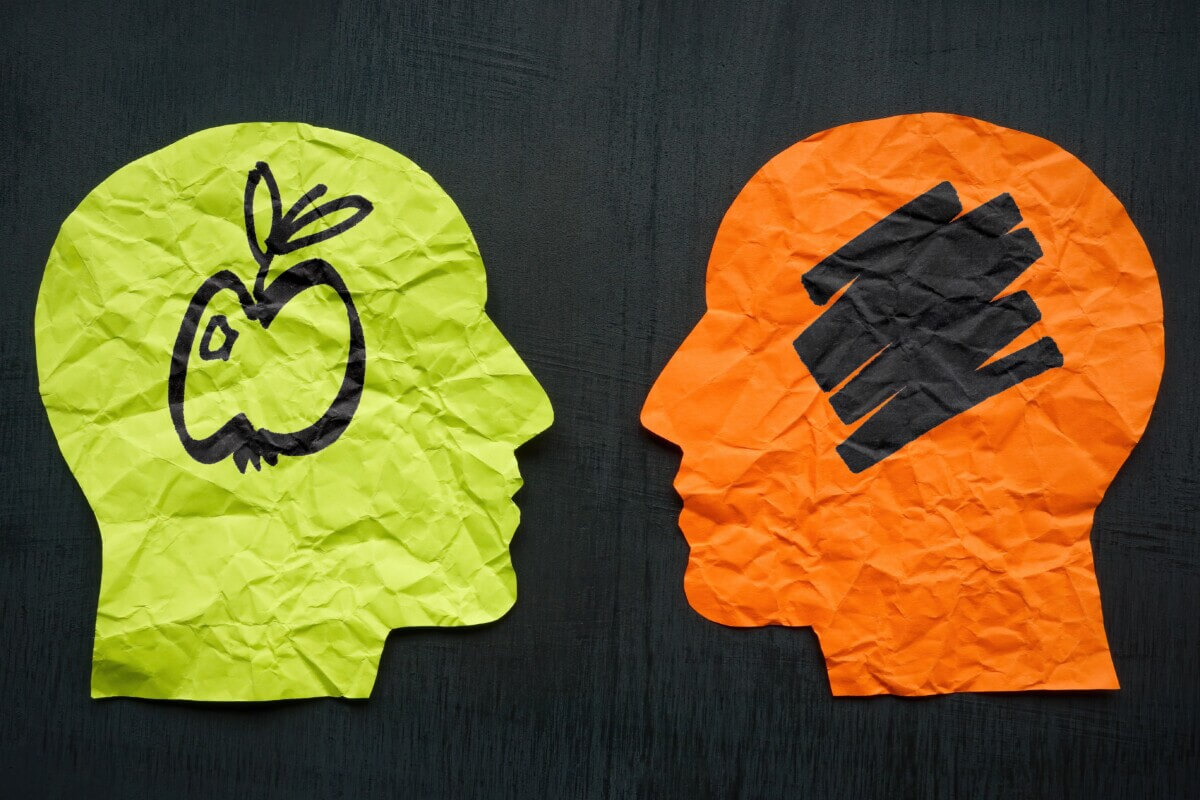
A small but real portion of the population has no mind’s eye. Ask them to picture a red apple, and nothing appears. No colors or shapes. This condition, called aphantasia, might seem like a quirk. But a philosophical analysis in Neuropsychologia argues it exposes a serious flaw in one of the most celebrated theories of the mind ever written.
That theory belongs to David Hume, the 18th century Scottish philosopher who argued that all thinking is rooted in sensory experience, and that even the mind’s most abstract ideas are built from faint copies of what the senses have encountered. Even “justice” or “triangle” depend, for Hume, on the mind’s ability to conjure and manipulate those copies through imagination. If that’s right, abstract thought needs mental imagery. But severe aphantasics, who report being unable to generate mental images, seem to think about abstract concepts just fine.
Philosophers Uku Tooming and Roomet Jakapi, at the University of Tartu, argue this gap is no minor footnote. It challenges the “imagistic conception of thought,” the idea that thinking is a form of mental picturing, and may extend to modern theories that treat concepts as grounded in internal sensory simulations.
What David Hume Actually Argued About Mental Images and Thought
To understand why aphantasia is such a problem, it helps to know what Hume was actually claiming. In A Treatise of Human Nature, published in 1739 and 1740, Hume built his theory of the mind on one idea: everything in human thought comes from sensory experience. A person who sees a bright red color or smells fresh bread keeps a mental trace of it, a faint copy the mind can work with later. Hume called these copies “ideas.” Even thinking about “triangle in general” requires pulling up a specific mental image of a triangle and using it as a stand in for all triangles.
Tooming and Jakapi call this “projective imagination,” the ability to picture something and use it to represent a category. Picture one triangle clearly enough, and the mind treats it as a stand in for every triangle out there, without needing to picture them all.

How Aphantasia Challenges That Argument
Aphantasia, a term first used in a 2015 study, describes people who, when asked to visualize something, report that nothing happens. Some describe discovering, well into adulthood, that other people’s talk of “picturing something in their mind” was literal. Some data suggest about 4% of people fall on the aphantasic end of the imagery spectrum, while lifelong severe aphantasia is estimated at roughly 1%. The condition often extends across senses, not just sight. Researchers still debate whether it means a complete absence of mental imagery, an absence of conscious imagery only, or something subtler in how people notice their own inner experience. Whatever the exact mechanism, aphantasics clearly reason through complex problems and hold their own in conversations about abstract matters, which is exactly what puts pressure on Hume’s account.
Four Escape Routes, All Contested
Tooming and Jakapi work through four ways a defender of Hume might rescue the theory, arguing each falls short. Some aphantasics might rely on mental images that pop up unbidden, but that doesn’t work, since Hume’s imagination needs at least some control from the person. Maybe they lean on memory, but memory only replays experiences in order, while abstraction needs the freedom to mix and rearrange. Maybe they use imagery from touch or sound instead of sight. But aphantasia often affects several senses at once, and one study found a group of aphantasics who leaned on verbal strategies while showing weak imagery across the board, not just in vision.
A fourth option is simpler: treat aphantasia as a rare exception and let Hume’s theory keep working for everyone else. Hume made a similar move himself, allowing that someone who has seen every shade of blue but one might still imagine the missing shade. Tooming and Jakapi say the comparison doesn’t hold up. The missing shade is a curiosity with no real stakes for the mind in general, while abstract thought is baked into nearly everything the mind does. Treating aphantasia as a footnote would mean writing off a huge share of human cognition, not one strange edge case. And if Hume refused to budge, he’d be stuck saying severe aphantasics cannot think abstractly at all, a claim the authors call close to offensive.
Why This Goes Beyond a Debate About a Dead Philosopher
Several modern theories of how the brain builds concepts, including Barsalou’s grounded cognition framework and Jesse Prinz’s proxytype theory, assume that thinking about categories requires internally simulating sensory experience. Aphantasics, who form abstract concepts without that ability, put pressure on those theories too. Some brain scans have picked up imagery related activity in aphantasics’ brains, and one study proposed calling it “imageless imagery,” a label the authors treat cautiously since it rests on one study. The real question isn’t whether a faint signal shows up on a scan, but whether it can do the job Hume’s theory needs, and that remains unproven.
Hume built his system on the idea that picturing the world and thinking about it are inseparable. Roughly 1% of people with lifelong severe aphantasia suggest otherwise.
Disclaimer: This article summarizes and interprets a peer-reviewed philosophy paper. It does not provide medical or psychological advice about aphantasia or any other condition.
Paper Notes
Study Limitations
The authors acknowledge several important limitations. Their argument is philosophical in nature and relies on existing empirical research on aphantasia rather than original experimental data. The empirical literature on aphantasia itself contains significant debate: researchers disagree about whether aphantasics lack all mental imagery, only conscious imagery, or whether their self-reports accurately reflect their inner experience. The authors also note that much aphantasia research relies heavily on subjective self-report measures, which have known weaknesses. The paper focuses specifically on severe aphantasia and is careful not to overgeneralize its conclusions to moderate aphantasia or to the full spectrum of imagery abilities. Additionally, the authors acknowledge that citing individual studies, such as a single EEG study on neural processing differences, is insufficient to definitively prove claims about aphantasics’ cognitive capacities, and they frame some of their conclusions as invitations for further empirical research rather than settled findings.
Funding and Disclosures
According to the paper, this research was funded by the Estonian Research Council, grant number PRG2721. The authors declare that they used ChatGPT 5 during the preparation of the manuscript to occasionally check grammar and style, and state that they reviewed and edited all content produced with that tool and take full responsibility for the published article.
Publication Details
Paper Title: Aphantasia as a challenge for Humean abstraction Authors: Uku Tooming and Roomet Jakapi, Institute of Philosophy and Semiotics, University of Tartu, Tartu, Estonia Journal: Neuropsychologia, Volume 227 (2026), Article 109465 DOI: https://doi.org/10.1016/j.neuropsychologia.2026.109465 Published online: April 20, 2026 Access: Open access under CC BY license


