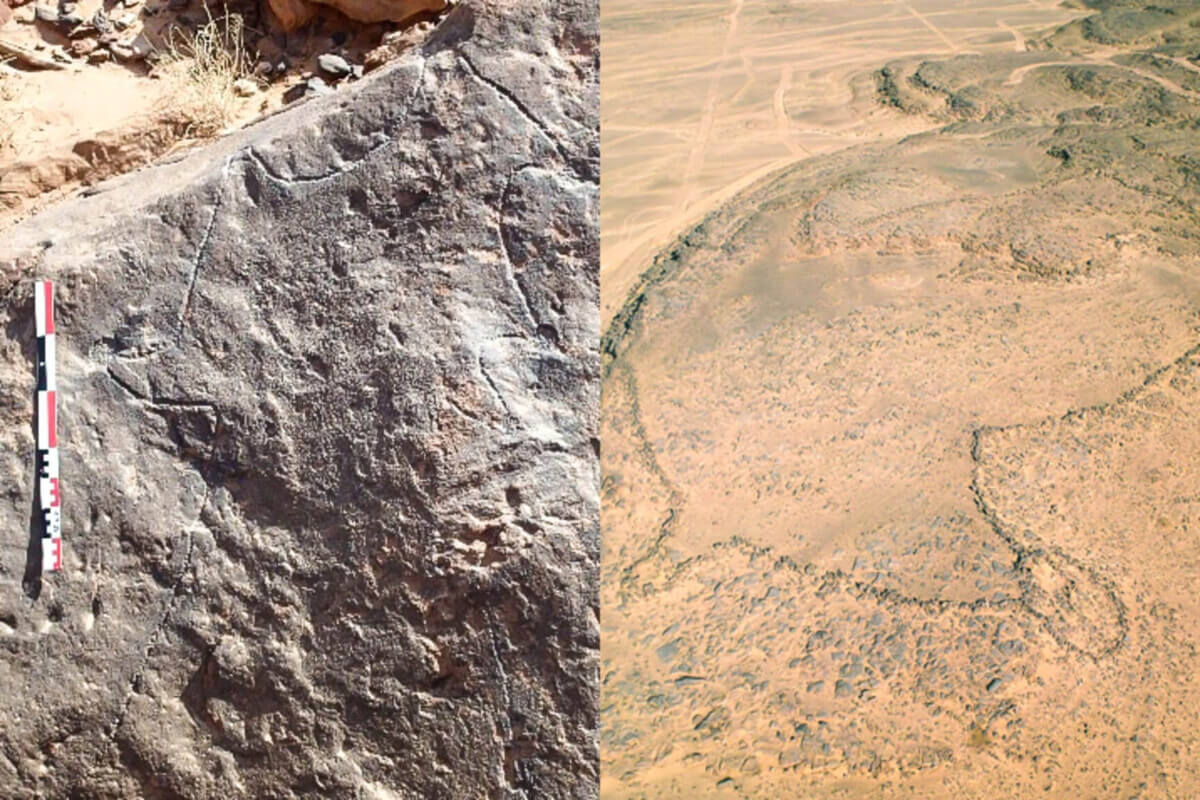
The dimensions of desert dragons only become apparent from the air: at Jebel az-Zilliyat in Saudi Arabia, the true-to-scale engraving depicts nearby desert dragons. (Credit: Oliver Barge, CNRS)
PARIS — Archaeologists have uncovered the earliest known architectural plans to scale, dating back thousands of years. The engravings, which are estimated to be between 8,000 and 9,000 years old, depict desert kites—large structures built to trap animals.
According to researchers, the ability to represent expansive space on a small, two-dimensional surface marks a significant point in the evolution of intelligent behavior, enhancing our understanding of how these kites were designed and constructed.
“Even though human constructions have been altering natural landscapes for millennia, few plans or maps predate the literate civilizations of Mesopotamia and Ancient Egypt. These findings represent the oldest known scale plans in human history,” says Dr. Rémy Crassard from the Centre National de la Recherche Scientifique (CNRS) in France, in a media release.
The international team, which included scientists from France, Israel, Germany, Saudi Arabia, and Jordan, noted that desert kites were first discovered by aerial reconnaissance in the 1920s.
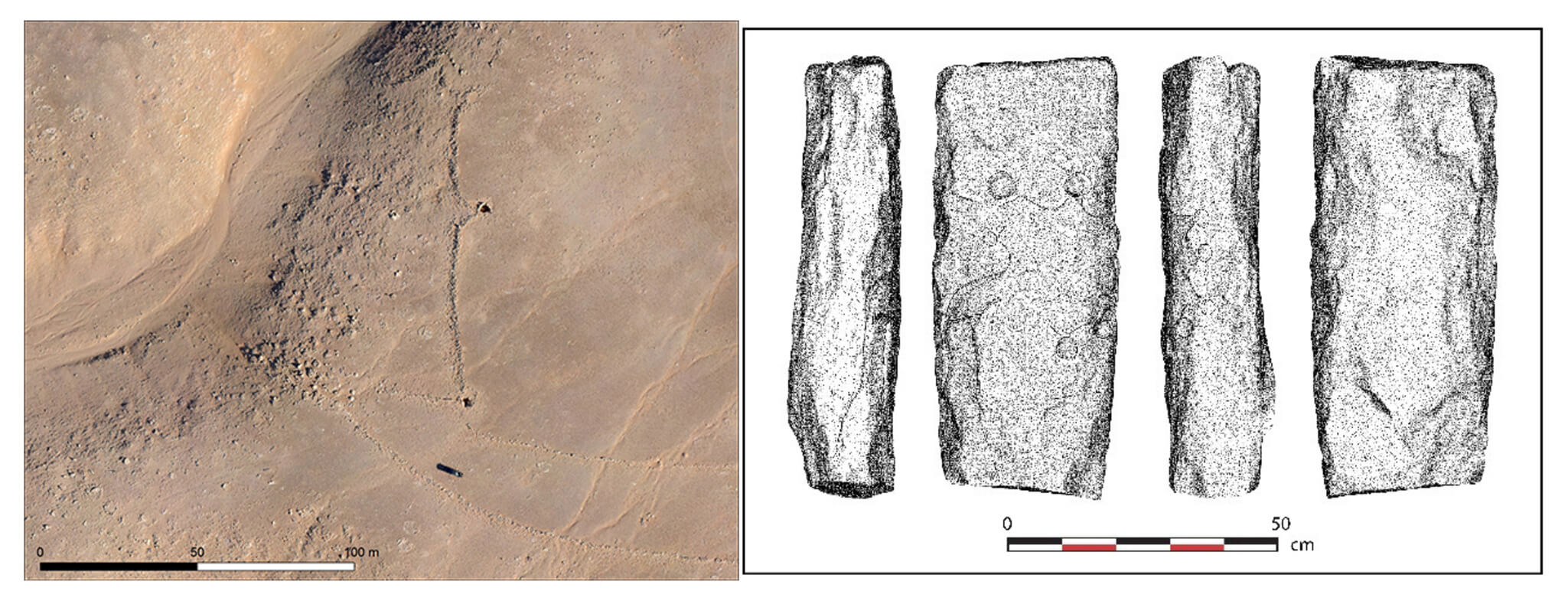
“The engravings illustrate desert kites—sophisticated archaeological structures composed of walls that are up to five kilometers long converging in an enclosure to trap animals. These structures, bordered by pits, can only be fully seen from the air. The necessity for this type of spatial representation was unprecedented,” explains Dr. Crassard.
The researchers discovered two engravings representing kites in Jordan and Saudi Arabia. In the Jibal al-Khasabiyeh area of Jordan, which is home to eight kites, a carved stone depiction was found nearby and has been dated to around 7,000 years ago. In Saudi Arabia’s Zebel az-Zilliyat area, where two pairs of visible kites are located 3.5 kilometers apart, a to-scale engraving was discovered and dated to around 8,000 years ago.
“These kinds of plans would have been essential to the builders, as the complete layout of the structures cannot be comprehended without an aerial view,” says Dr. Crassard. “Previous evidence for the plans of large structures were rough representations, but these designs are extremely precise.”
The findings are published in the journal PLOS One.
South West News Service writer Stephen Beech contributed to this report.


