
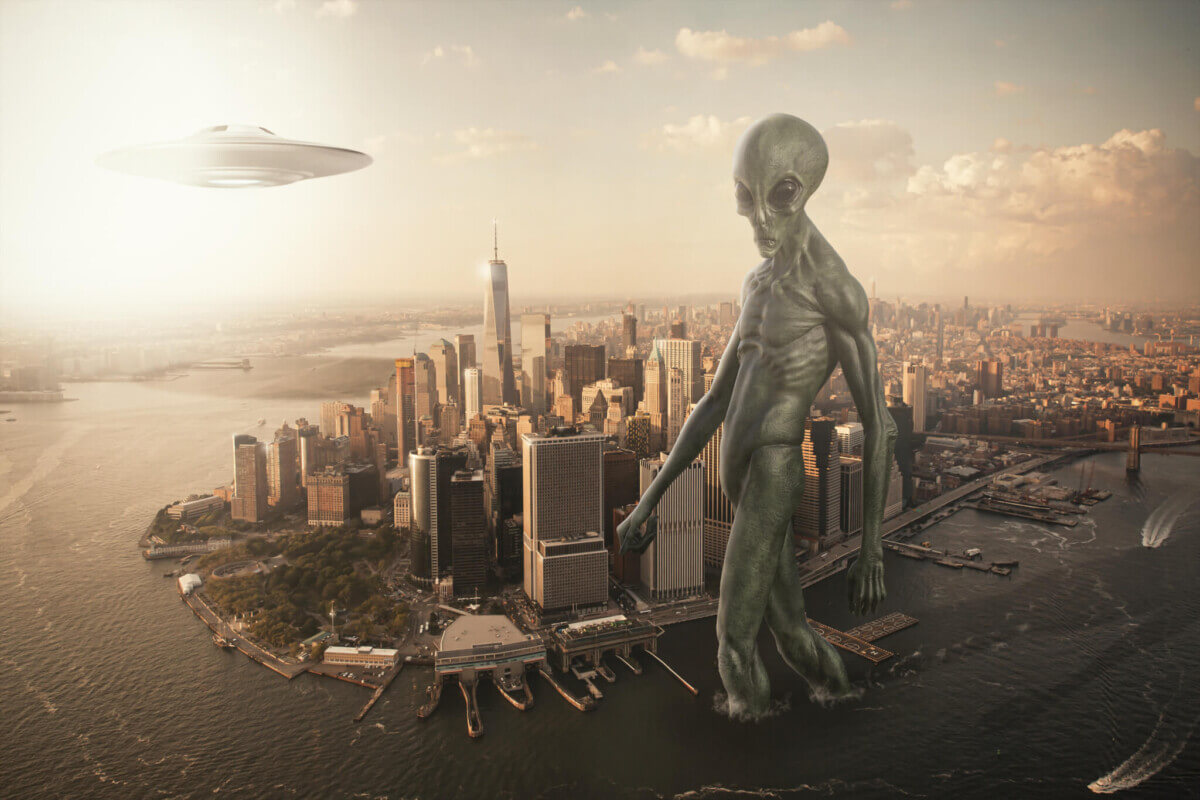
(Photo by Su San Lee on Unsplash)
In A Nutshell
- Space is so vast that even nearby stars are unimaginably far away, making alien visits extremely unlikely.
- Interstellar travel would demand immense energy and expose travelers to dangerous radiation and physical damage.
- Earth’s unique atmosphere and biosphere may make our planet a poor target for alien visitors, even if intelligent life exists elsewhere
The United States government’s recent release of hundreds of previously classified Unidentified Anomalous Phenomena (UAPs) cases spanning the 1940s to the present, along with the new Steven Spielberg movie, Disclosure Day, about extraterrestrial life, has fuelled the idea that aliens are visiting Earth.
In fact, polls in Australia, the U.S. and elsewhere indicate around a third of the public believes aliens are here.
However, while what we know about the universe suggests aliens may exist, there are three compelling reasons why they probably aren’t visiting us.
Space is Big – Very Big
To begin with, space is vast – beyond our imagination.
Proxima Centauri, the nearest star to our Sun, is about 40 trillion kilometers away, 268,000 times farther than the Sun is from Earth. That’s 4.3 light years as astronomers measure it. A light year is the distance light travels in one year at 300,000km per second.
We can only travel across space at a fraction of the speed of light with current technology. Even our fastest spacecraft, the Parker Solar Probe, travels at a top speed of roughly 191 kilometers per second – 0.064% the speed of light.
At that speed, it would take about 6,650 years to reach Proxima Centauri, and that’s just in our local stellar neighborhood. So interstellar travel within human lifespans would require much higher velocities.
Let’s assume we did have the means to travel close to the speed of light. That introduces the first problem with traveling at that velocity. Albert Einstein demonstrated that time is relative; the rate of time flow is not the same everywhere in the universe. The faster a spaceship travels from Earth, the slower time will pass for its passengers. This is called time dilation.
For example, when NASA astronaut Scott Kelly arrived back on Earth from a year on the International Space Station, he was milliseconds younger than his identical twin because time moves more slowly for objects in motion, and the International Space Station travels at roughly 28,150 kilometers per hour.
This difference was negligible for the Kelly twins. But for any aliens cartwheeling through our skies, it would be significantly more because of the journey to Earth and back from a distant star system at a necessarily higher speed. They would go home to a planet much older than the one they left – perhaps by a century or more. They would be time exiles.

Unimaginably high energy requirements
Then there’s the unimaginably high energy requirement for interstellar travel.
The mass of the spaceship increases with velocity, so an increasing amount of energy is required to accelerate it.
At the speed of light, the ship becomes infinitely massive, requiring an infinite amount of energy. This is clearly impossible.
Another significant issue is that space is a vacuum – but not completely. There are just enough particles to worry about. They can potentially cause fatal radiation for passengers and the instruments of a high-velocity spacecraft, or destroy it. Sparsely spread hydrogen atoms turn into intense radiation at near light speed, and the heat that is generated would ablate and eventually destroy the hull.
Faster-than-light travel, according to physicist Miguel Alcubierre, is possible, but it comes with its own set of issues and a currently impossible energy requirement.
That raises the question of why spend all this energy to travel to Earth? Anything we have, an advanced civilisation (as they would have to be to get here) would be able to make on their planet.
A Unique Biosphere
Yet another issue is our biosphere, unique to Earth as far as scientists know.
Life and the planet co-evolved. Complex life would not exist on Earth if cyanobacteria, a type of single-celled microbe, had not pumped oxygen into our mostly nitrogen atmosphere 2.4 billion years ago.
It’s therefore not toxic for us, but oxygen is reactive and could be highly corrosive for aliens. And while they could wear protective suits like humans do when going to inhospitable environments, reports of visiting aliens do not include any descriptions of spacesuits.
So, Are Aliens Out There?
If aliens are not here, are they out there? It’s an interesting question, scientifically and philosophically. Scientists do not have enough information yet, but they are working on the question.
About 6,200 exoplanets have been found in more than 4,700 solar systems, though none are like Earth or our Solar System.
Most stars could have at least one planet, and there are more than 100 billion stars in our galaxy alone. The number of planets is therefore astronomical, and some may be habitable.
Closer to home, there are worlds with potential for microbial life either past or present – Mars, Europa (a moon of Jupiter), and Enceladus and Titan (moons of Saturn). If we discover life began twice in our Solar System, that will increase the odds of life elsewhere.
Since 1960, we’ve had the capability to look for intelligence elsewhere, piggybacking on normal radio astronomy. The biggest search for alien life projects are carried out by the SETI Institute in California and the Breakthrough Listen project based at Oxford University in the United Kingdom.
Nothing has been found across all the searches made. Finding intelligence in our time frame – about a hundred years – in the 13.8-billion-year history of the universe is challenging.
However, as a 1959 Nature paper noted, while it’s difficult to estimate the chance of success, if we don’t search, the chance drops to zero.
Carol Oliver, Professor in Science Communication and Astrobiology, UNSW Sydney
This article is republished from The Conversation under a Creative Commons license. Read the original article.


