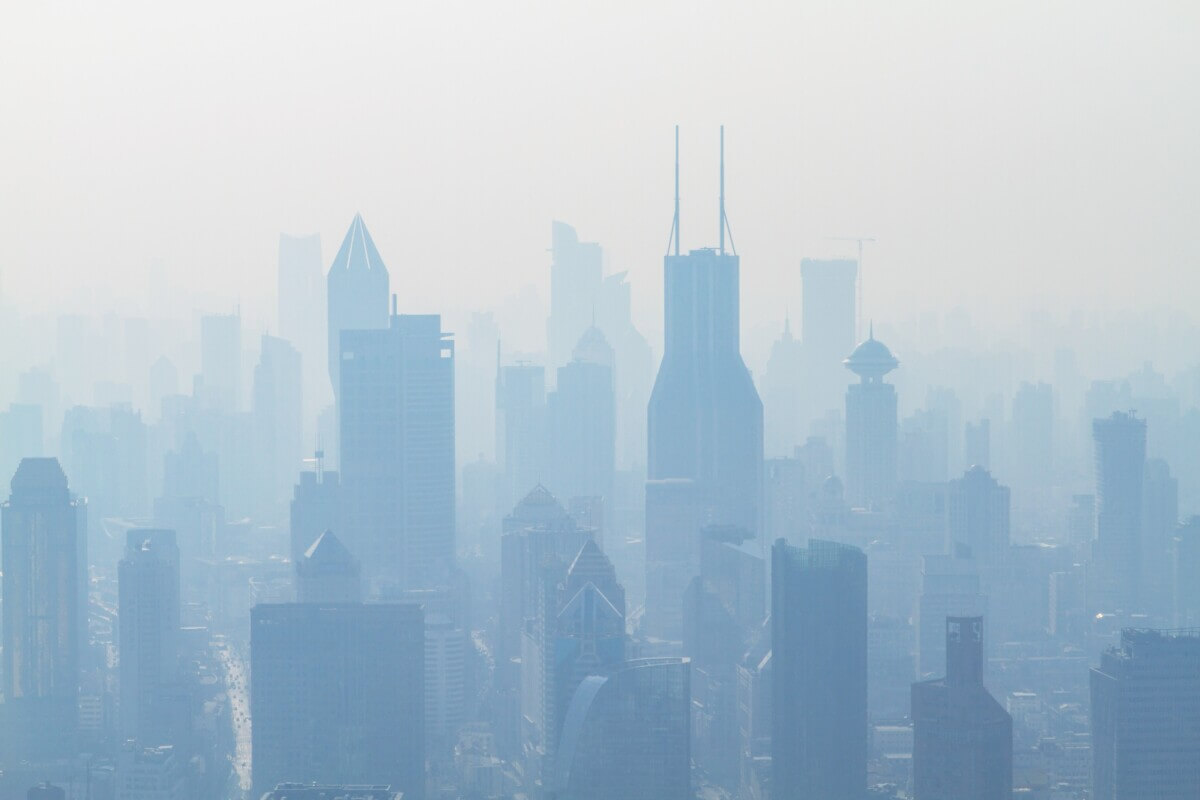
New research shows air pollution is linked to increased hospital admissions for heart attack and stroke. (Photo by Holger Link on Unsplash)
NEW HAVEN, Conn. — Air pollution levels have decreased across the U.S. in recent years, but not all Americans are benefiting equally. That’s especially the case when it comes to fine particulate matter known as PM2.5, according to a recent Yale-led study. The research indicates that racial and ethnic minorities, particularly Black Americans, still face “disproportionately high rates of cardiovascular disease-related deaths” due to exposure to this type of air pollution.
PM2.5, or fine particulate matter, consists of tiny particles less than 2.5 micrometers in diameter. For context, these particles are “30 times smaller than the width of a human hair,” researchers say. Despite their microscopic size, this type of pollution can lead to major health problems.
“When you inhale such small particles, they can get into your lungs and some smaller particles can even get into the blood stream and circulate around the body. That can impact your heart, which leads to a lot of the cardiovascular disease we see today,” explains senior author Kai Chen, assistant professor of epidemiology at Yale’s School of Public Health, in a statement.
For the research, data on cardiovascular disease deaths and monthly PM2.5 concentrations were gathered from 3,103 counties in the contiguous U.S. from 2001 to 2016. The study aimed to evaluate “whether there was a link between increases in PM2.5 levels and changes in cardiovascular disease-related deaths.”
The researchers found that an increase of one microgram per square meter in PM2.5 levels correlated with “2.01 additional cardiovascular disease-related deaths per 1 million people.” However, this average obscures racial and ethnic disparities. Specifically, the same PM2.5 increase was linked to “1.76 additional deaths per 1 million White people, 2.66 additional deaths per 1 million Hispanic people, and 7.16 additional deaths per 1 million Black people.”
The study also showed that while cardiovascular disease-related deaths due to long-term PM2.5 exposure declined by “more than 34%” from 2001 to 2016, the relative rates between racial groups remained almost unchanged.
“Air pollution reduced and that reduced exposure for everyone, which is very good news. But Black people still experience a higher burden because they are more vulnerable and at higher risk of mortality,” says Chen.
The study’s findings suggest that the health impact of air pollution is distributed unequally among racial and ethnic groups. This has implications for future policy-making, underscoring that “the public health burden of air pollution differs across racial groups” and that high-vulnerability groups should be particularly considered in policy design.
“Poor air quality imposes a substantial burden on Black Americans, with greater exposures and greater vulnerability,” said co-author Harlan Krumholz, the Harold H. Hines, Jr. Professor of Medicine at Yale School of Medicine.
Chen and his team plan to delve deeper into this issue through a new project funded by a Yale Planetary Solutions Project seed grant. They aim to “assess PM2.5 exposure, cardiovascular disease risk, and morbidity burden at the neighborhood level and design location-specific strategies to address inequalities.”
The study is published in the scientific journal Nature Human Behavior.


