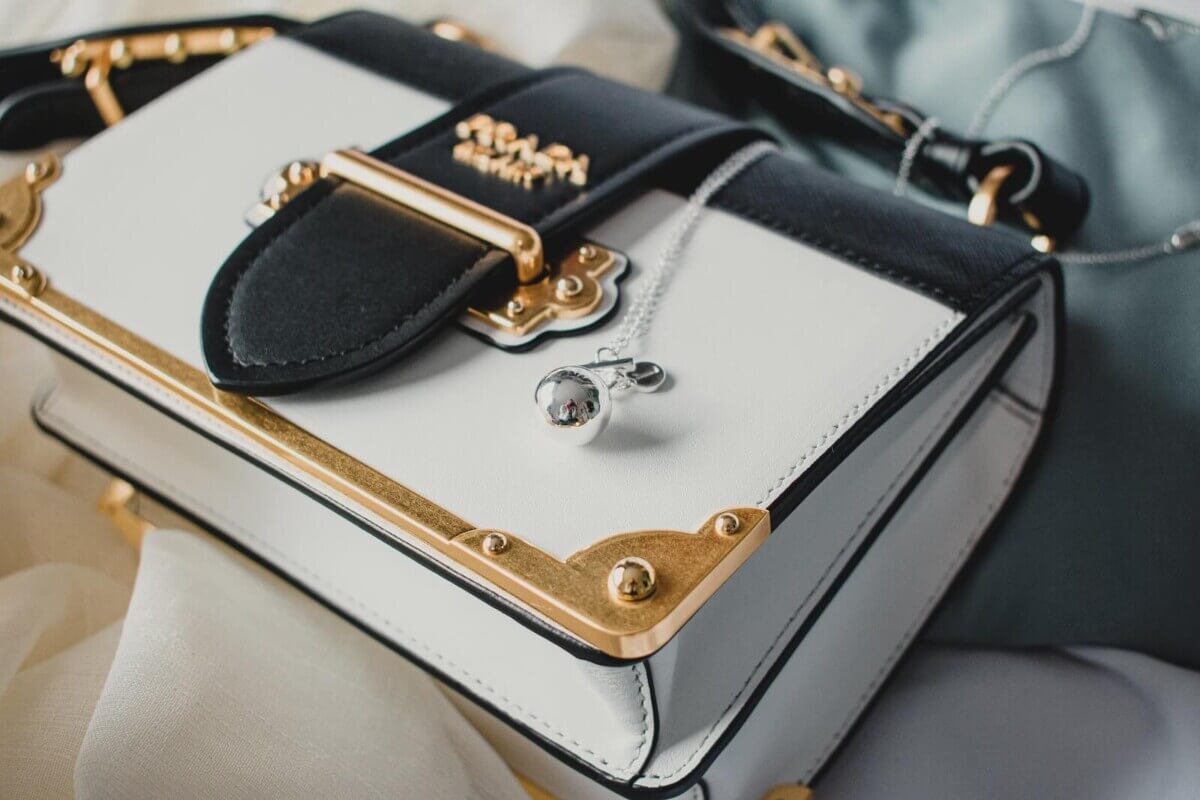
(Photo by Harper Sunday on Unsplash)
Why Women’s Interest in Designer Logos May Shift Near Ovulation
In A Nutshell
- A study of hundreds of women found that interest in logo-heavy luxury items rose near ovulation, when fertility peaks.
- The effect only showed up for items that would be seen in public, not for luxury kept at home.
- When women were told men don’t really notice designer brands, the fertility effect disappeared.
- Researchers argue the pattern points to a mating-related motive to be noticed, not just a general taste for luxury.
Two designer handbags might look almost the same, but one broadcasts its brand with a large logo while the other keeps things subtle. New research suggests which bag a woman wants most may depend on where she is in her monthly cycle, and on whether she thinks anyone will actually notice.
A study published in PLoS One found that women near ovulation, the point in the cycle when fertility peaks, showed a stronger preference for conspicuous, easily recognized luxury items. The researchers say the usual explanation, that people buy designer goods mainly to show off wealth or status, doesn’t fully explain what they saw. They propose that hormonal changes around ovulation may strengthen the motive to be seen by potential partners.
Something interesting happened when the chance of being seen disappeared. Interest in high-end brands dropped when a product wasn’t visible to others, and it also faded when women were told that men generally don’t pay attention to designer clothes. The shift in luxury preference during peak fertility, the researchers argue, wasn’t simply about owning something expensive. It was about being noticed.
Three Studies Tracked Fertility and Luxury Preferences
Three separate studies made up this research, using different ways to check where a woman stood in her cycle.
In the first study, 70 female college students who weren’t using hormonal birth control took urine tests that detect a hormone surge signaling ovulation is about a day or two away. Each woman was tested twice, once near her fertile window and once during a low-fertility stretch, so she served as her own point of comparison. During each visit, participants drew luxury brand logos, choosing from Gucci, Chanel, and Louis Vuitton, onto pictures of handbags and shoes, half the time for items they’d keep for themselves and half for items meant for another woman. Researchers then measured how big each logo turned out.
A second study recruited 1,486 women through Prolific and analyzed responses from 332 who met strict screening rules, including no hormonal birth control and clear certainty about their cycle dates. Instead of urine tests, this study estimated fertility using a standard method based on the timing of reported period dates. Participants rated how much they wanted to buy a T-shirt from either luxury brands, like Chanel, Prada, and Burberry, or nonluxury brands, like Gap, Target, and Walmart, imagining they’d wear it either out in public or only at home, alone.
A third study recruited 966 women through Amazon’s Mechanical Turk, with 358 remaining in the final analysis after preregistered screening. This one added a real-world twist: instead of just rating preferences, women chose between a $100 gift card to a luxury brand, Polo Ralph Lauren, or a nonluxury brand, Old Navy. Before choosing, participants read one of two short articles: a neutral piece about galaxies in the universe, or one suggesting that men notice things like a woman’s smile and the way she walks rather than the brand of clothes she wears. This tested whether believing men actually notice luxury brands mattered.

Desire for Luxury Rose With Fertility, But Only in Public
Results lined up across all three studies. In the logo-drawing study, women drew noticeably bigger logos for themselves during their fertile window compared to their low-fertility phase. But when drawing logos meant for another woman, the pattern flipped, and women drew smaller logos during high fertility, hinting that they may not want to help other women stand out during that window.
In the purchase-intention study, fertility boosted interest in buying luxury brands, but only for items meant to be worn in public. For luxury items meant to stay at home and unseen, women estimated to be at higher fertility actually reported less interest. Interest in nonluxury brands stayed flat no matter where a woman was in her cycle, suggesting the effect was tied specifically to luxury as a way of standing out rather than a general shopping mood.
Perhaps the clearest test of the theory came from the gift card study. Among women who read the neutral galaxies article, fertility pushed choices toward the luxury brand: those near peak fertility picked Polo Ralph Lauren over Old Navy noticeably more often than women in their low-fertility phase did. Among women who had just read that men don’t really notice designer clothes, that pattern vanished entirely.

A Strategy to Attract a Wide Pool of Potential Partners
This research pushes back on an idea that had gained traction in earlier studies: that women use luxury goods mainly to be picky, signaling high standards to scare off less desirable suitors. The authors argue instead that there are two different phases in how women approach finding a partner. First comes a broad attraction phase, where the goal is simply getting noticed by as many potential partners as possible. Selectiveness comes later, once there’s a pool of interested men to choose from. Conspicuous luxury, meaning brand-name goods that are easy to spot from a distance, fits squarely into that first phase, and the effect held only when hormones were surging.
As the authors put it: “What we found most interesting is that the effect of ovulation on luxury desire is not simply a general increase in preference for expensive products. Rather, it appears to be socially strategic: the effect becomes stronger when luxury consumption is visible and personally relevant but disappears when women believe that men do not pay attention to such signals.”
Disclaimer: This article is based on findings from a peer-reviewed study and reflects the interpretations of its authors. It is intended for general informational purposes and is not a substitute for professional medical or psychological advice.
Paper Notes
Limitations
Study authors note that participants were a convenience sample of women who volunteered, rather than a broad, representative slice of the population, and future research would benefit from testing whether the findings hold up more generally. A large number of participants across the studies were excluded for not meeting screening criteria or for being unsure about their menstrual cycle dates, which the authors acknowledge is a resource-intensive but standard practice in this type of research. The authors also point out that the research focused specifically on logo size and luxury brand preference, so the findings may not extend to every context where women might try to attract a partner’s attention. Finally, they note that Study 1 compared each woman to herself across two visits rather than randomly assigning her to a group, meaning fertility status was observed as it naturally occurred rather than controlled by the researchers. That limits how strongly the study can support cause-and-effect claims compared with a fully controlled experiment.
Funding and Disclosures
According to the paper, the authors received no specific funding for this work, and they declared no competing interests.
Publication Details
The study, titled “Fertility increases women’s desire for conspicuous luxury,” was authored by A. Kim, K.M. Durante, J. Laran, L. Nikiforidis, and V. Griskevicius. It was published in PLoS One, volume 21, issue 9 (2026), article e0354126. The paper can be accessed via DOI: https://doi.org/10.1371/journal.pone.0354126. Data for all studies is available at https://osf.io/c3v49/.


