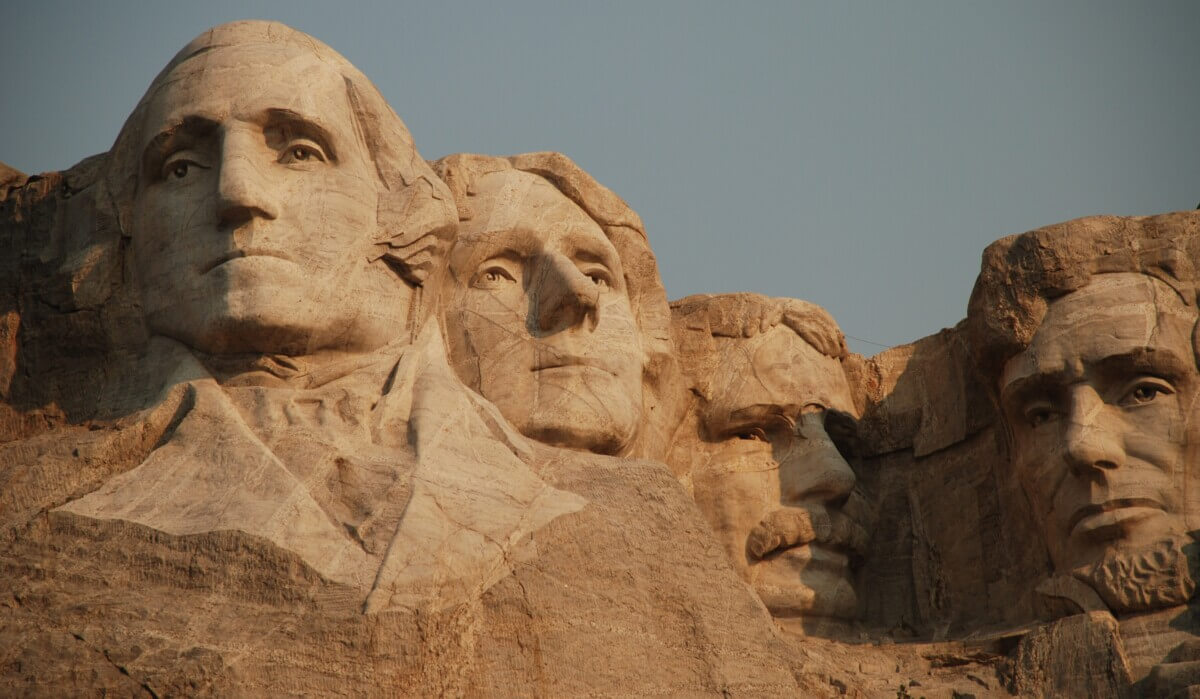
Mount Rushmore (Photo by Ronda Darby on Unsplash)
EXETER, United Kingdom — The word “hero” means different things to different people, but researchers from the University of Exeter have found a high number of American and British individuals habitually overlook both women and people of color when choosing their heroes. Study authors say these demographics and their inspirational achievements remain “invisible” to citizens of the U.K. and U.S., as most people continue to list White men as their heroes.
The majority of people surveyed for this study listed their family and friends, or the people closest to them, as their heroes. Such “everyday” heroes accounted for one in three choices in the United Kingdom and 41 percent in the United States.
Meanwhile, both countries show an affinity for politicians. Common hero choices included Ronald Reagan, Abraham Lincoln, and Barack Obama, as well as British Prime Ministers like Winston Churchill and Margaret Thatcher. Notably, human rights activists (MLK Jr., Malcolm X, Nelson Mandela, Malala Yousafzai) ranked as the sixth most popular hero category across both nations.
Crucially, however, there were also numerous striking differences between the two countries. Brits chose celebrities, actors, and TV presenters as their heroes quite often, while close to no one across the pond picked a religious figure (1.2%). In the United States, though, religious figures came in as the second most popular type of hero (close to 7% of all reported heroes). When they did pick a religious figure, U.K. citizens tended to choose living religious leaders like the Pope, while Americans went for Biblical figures more often.
Women living in both countries are more likely than men to have female heroes. Both American and British men were roughly four times less likely to have a woman hero than women (9-34% in the U.S., 9-40% in the U.K.). All in all, just one in four Britons and one in five Americans reported having a heroine.
This analysis was put together by Ekaterina Kolpinskaya from the University of Exeter and Nataliya Danilova from the University of Aberdeen and was based on YouGov surveys encompassing 1,686 U.K. adults and 1,000 Americans.
“The allure of heroes is enduring. We have found people’s gender and ethnicity has an impact on who their hero is. There is a persistent gap between the publicly prominent white male hero-figure and a perpetually ‘invisible’, and ‘forgotten’ heroine. People’s choice of hero reflects their own sex and race and ethnicity,” Dr. Kolpinskaya says in a media release.

When researchers excluded family members from the responses, just 11 percent of Americans chose a female public figure hero, while one in five Britons did the same. Young Americans (under 25 years-old) were also more likely to have a female hero than older Americans, but the rate of female heroines among Britons remained largely the same regardless of age.
When it comes to politics, Britons supporting the Conservative Party had a larger probability of having a woman hero, 27 percent in comparison to 13 percent for Labour party supporters, 22 percent for Liberal Democrats, and 14 percent for UKIP. Study authors say this is due to the “Thatcher effect,” which refers to U.K. PM Margaret Thatcher making up 18 percent of all female heroines listed by Conservative supporters specifically.
American Republicans, on the other hand, were much less likely to choose a female hero (13% percent chance compared to 25% for U.S. Democrats). While study authors say racial prejudice is declining in the United Kingdom, non-White minority heroes account for a mere 15 percent of all U.K. heroes compared to 31 percent in the United States (including 21% for females).
Ethnic minority hero figures tended to feature non-British political activists such as Nelson Mandela, Martin Luther King Jr., Malala Yousafzai, Mahatma Gandhi, and Muhammad Ali. Only three Britons made it on that list: boxer Lennox Lewis, Formula 1 driver Lewis Hamilton, and Victoria Cross recipient Johnson Beharry. The study authors say there is an urgent need for greater public recognition of ethnic minorities across the fabric of British society.
“In both countries, ethnic minorities belong to another group of ‘invisible’, and often overlooked heroes. But there was a much wider presence of non-white Americans in the ‘pool’ of the US heroes. This included prominent public figures such as Barack Obama and Martin Luther King Jr.,” Dr. Danilova explains.
“As in Britain, American women are disproportionately – and statistically significantly – more likely to have ethnic minority heroes with one in three women declaring an ethnic minority figures among their family and friends.”
It’s also important to note African Americans (88%), Hispanics (70%), and Americans belonging to other ethnic minority groups (89%) displayed a strikingly higher probability of having a non-White hero when compared to Caucasian Americans (6.5%).
The study is published in the International Journal of Politics Culture and Society.


