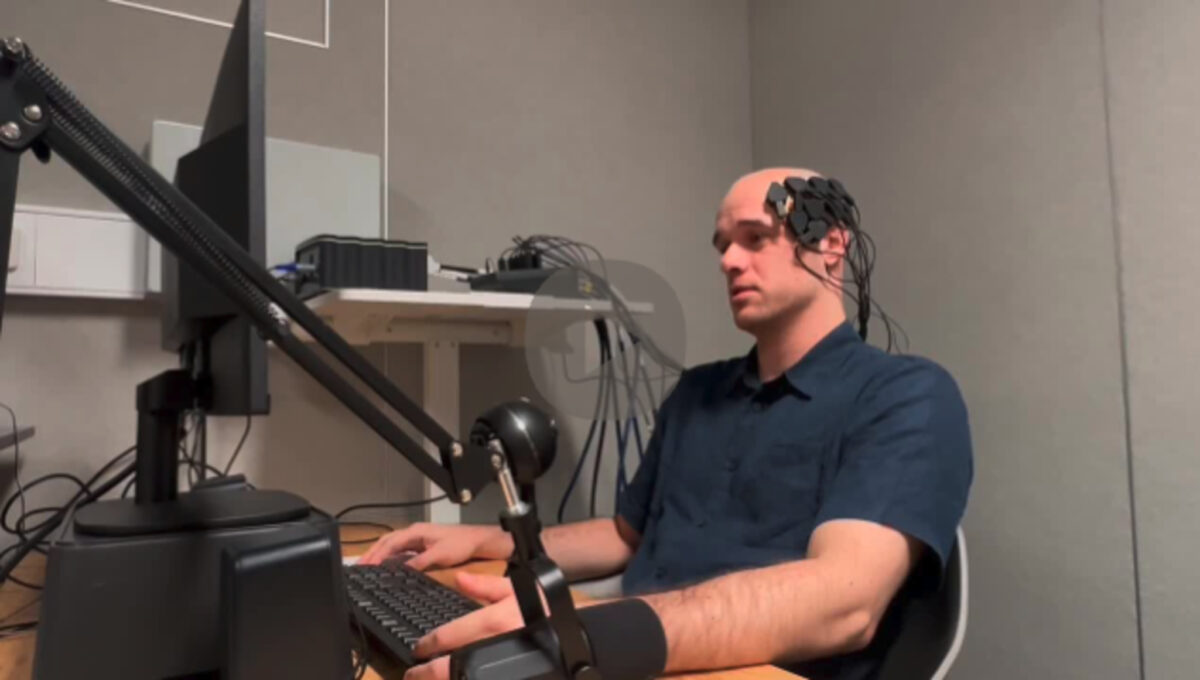
A University of Melbourne startup is developing a brain computer interface, designed to help people with impaired speech communicate simply by using their thoughts. (Credit: The University of Melbourne)
Many Australians living with neurological disorders, such as motor neuron disease and multiple sclerosis, experience speech difficulties and may lose their ability to speak.
There are limited technological devices available to help these patients communicate, with many relying on communication boards or charts requiring the user to select letters or words on a screen through touch or eye movements.
While there have been rapid advancements in brain-computer interfaces in recent years, current prototypes involve invasive and costly surgery.
Fluent, a University of Melbourne spinout company, is developing a low-risk brain-computer interface that can be inserted under the scalp but outside of the skull.
Fluent Co-founder and biomedical engineer, Dr. Tim Mahoney, said: “Our device will be positioned above an area of the brain called the motor cortex which controls speech muscles.
“If you think of electrical signals as QR codes: when a person speaks, every individual mouth and jaw movement produces different ‘QR codes’ in their motor cortex.
“These ‘QR codes’ also occur when a person with impaired speech is attempting to speak. Our device can capture these codes in a sequence, which tells us what someone is trying to say.”
Researchers are in the process of building a machine learning model that can convert recorded brain activity into text or audio, enabling people who are non-verbal to communicate without needing to say a word or push a button.
Through his PhD in accessible brain-computer interfacing, Dr. Mahoney demonstrated that the quality of electrical signals captured with this device is comparable whether it’s placed beneath or outside the scalp.
This means that the team can develop the technology rapidly without requiring complex surgeries.
The technology has been validated through preliminary human testing in electromagnetically shielded lab rooms at the new Aikenhead Centre for Medical Discovery in St Vincent’s Hospital Melbourne.
“Participants had 144 electrodes placed on their scalp and the electrodes recorded brain activity occurring in their motor cortex while they spoke, mimed and imagined saying different phrases,” Dr. Mahoney said.
“After building the largest English dataset of its kind, we partnered with a Japanese team leveraging an even larger dataset. This collaboration proved that a model can accurately isolate the correct phrase from a pool of 128 options with 96 percent accuracy.”
Clinical studies of Fluent’s insertable electrodes are scheduled later this year.
“Until now, this technological capability was only thought possible using highly invasive electrodes implanted inside the skull,” Dr. Mahoney said.
“With a safety profile that’s even better than a routine cochlear implant, the technology will be more accessible to the broader population.”
University of Melbourne Deputy Vice-Chancellor (Research) Professor Mark Cassidy AM said Fluent is an example of the extraordinary work being undertaken by University-affiliated startups advancing technologies in the treatment of neurological conditions.
“Fluent was born out of the University’s innovation ecosystem with its researchers securing Proof of Concept funding, nurtured by the Melbourne Entrepreneurial Centre’s accelerator program and now securing investment to develop human clinical trials,” Professor Cassidy said.
“This startup is working to improve the independence of people living with constraining illnesses and transforming lives as a result.”
Fluent has raised over $2M in funding from investors, including University of Melbourne Genesis Pre-Seed Fund, Galileo Ventures, Multiple Sclerosis Western Australia (MSWA), Professor David Graydon (University of Melbourne), and internationally from Jumpspace Ventures (New York), Founder’s Factory (London) and Pacific Channel (Auckland).
Press Release by The University of Melbourne
Media contact: [email protected], +61 3 8344 4123


