Photo by Ava Tyler from Unsplash
WASHINGTON — If you’ve ever visited a Jersey Shore boardwalk, you’ve probably encountered those storefronts selling salt water taffy – colorful, sticky candies that evoke memories of summer vacations. For most of us, the allure of taffy is its sweet taste and chewy texture. For researcher San To Chan, however, upon receiving salt water taffy in honor of their thesis defense, it posed a fascinating scientific question — why does it have that strange texture?
In collaboration with researchers from the Okinawa Institute of Science and Technology and the Massachusetts Institute of Technology, Chan delved into what gives taffy this distinct texture. The findings reveal the intriguing science behind the popular treat.
“Taffy is a viscoelastic material — it has properties between a viscous liquid and an elastic solid,” says Chan, the study’s author, in a media release. “Comparing the deformation behavior of commercial taffy to those of different lab-made sugar syrups and lab-made taffies allowed us to identify the most important taffy ingredient (and material structure) that governs taffy rheology.”
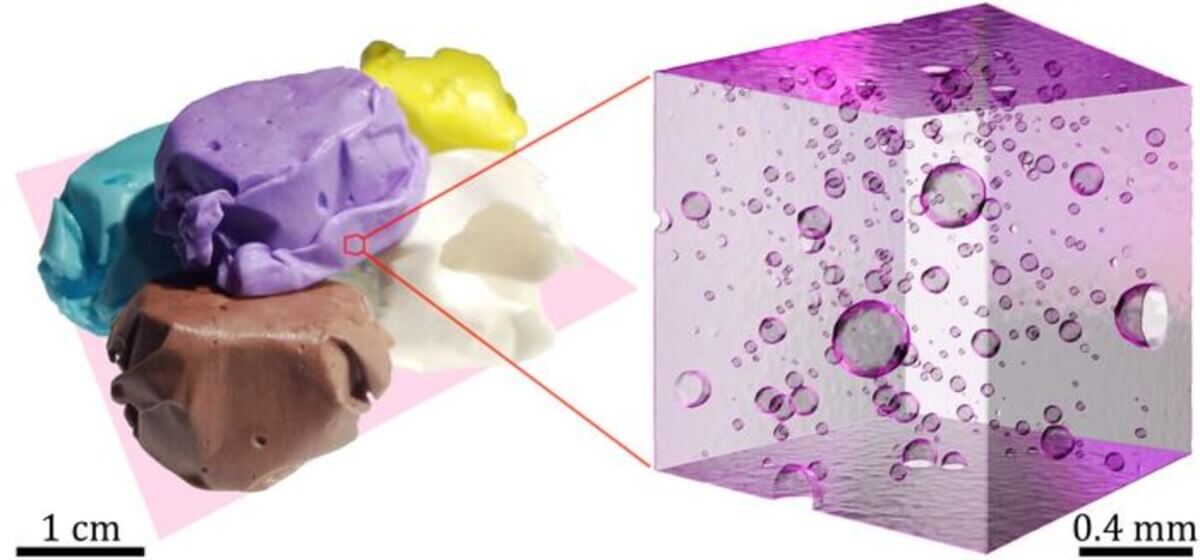
Contrary to its name, salt water taffy doesn’t actually contain any saltwater. It’s traditionally crafted using table sugar, water, oil, and corn syrup, with added flavors and colors for a delightful appearance and taste. The concoction is boiled until it reaches a specific consistency, and upon cooling, it’s pulled, either manually or mechanically. This pulling process introduces tiny air bubbles and disperses oil droplets throughout the candy, giving it its characteristic chewiness.
“Taffy is composed of oil droplets and air bubbles of various sizes dispersed in a viscoelastic matrix (sugar syrup),” explains Chan. “In some sense, oil droplets and air bubbles are like rubber balls. When deformed in the taffy, they tend to return to their original, spherical shape because of surface tension. In other words, emulsification and aeration make taffy more elastic, hence, chewier.”
The study identified that the presence of these oil droplets and air bubbles plays a pivotal role in taffy’s unique rheological, or flow-related, properties. Emulsifiers, like lecithin, can enhance the candy’s texture, making it chewier and ensuring its flavors last longer in the mouth.
Through their research, the team aims to equip candy makers with insights to create new versions of this treat, blending innovative flavors and textures while preserving the age-old craft of candy-making.
“Because of the larger amount of soy lecithin compared to commercial taffy, the lab-made taffy has a strong soy milk-like flavor, which I like,” adds Chan.
The study is published in the journal Physics of Fluids.


