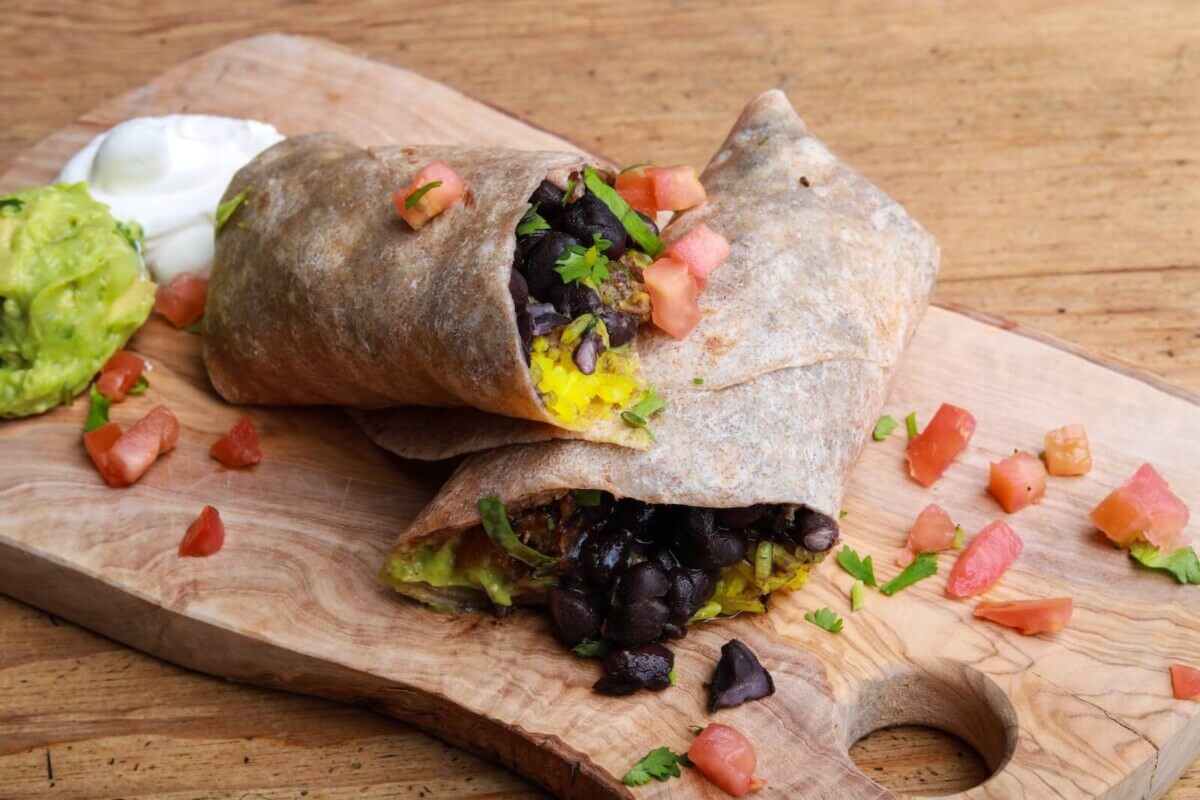
Bean burrito (Photo by Creative Headline on Unsplash)
Plant-Based Protein Pairing Falls Short After Exercise in Small Study Comparing Beans, Rice, and Pork
In A Nutshell
- A small study found that beans and rice did not build muscle protein more effectively after exercise than a nutrient-matched powder with the same macronutrients.
- In an exploratory comparison using separate trial data, lean ground pork at the same protein dose produced roughly double the muscle protein-building response of either plant-based option.
- Getting 20 grams of protein from beans and rice requires eating a very high amount of carbohydrates, which may have limited how quickly amino acids reached the muscles, though this was not directly confirmed.
- Results reflect a single post-workout meal in a small group of mostly young men and do not speak to long-term plant-based diets or higher protein doses.
For anyone who has ever swapped a burger for a bean burrito hoping to get the same post-gym benefit, a new study has some sobering news.
When young, active adults ate a meal of rice and black beans, a classic protein combo nutritionists have long praised, their muscles did not build protein any more effectively than when they consumed a stripped-down powder matched for the same measured nutrients. And in an exploratory comparison using data from a separate published trial, both plant-based conditions appeared to produce a smaller short-term muscle protein-building response than lean ground pork at the same protein dose.
For years, nutritionists have pointed to complementary protein pairing as a smart workaround for plant-based eaters: combine two incomplete plant proteins, like beans and rice, and together they fill in each other’s amino acid gaps. Amino acids are the building blocks the body uses to repair and grow muscle. Beans lack one key amino acid; rice lacks another. Together, the thinking goes, they cover each other. A study in The American Journal of Clinical Nutrition put that logic to the test with a single 20-gram protein dose after a resistance workout, and the beans-and-rice meal did not outperform a nutrient powder matched for the same macronutrients.
Participants Got an IV Line, a Leg Workout, and a Meal
Researchers at the University of Illinois Urbana-Champaign recruited 11 physically active young adults, 10 men and 1 woman averaging about 24 years old, for a controlled crossover trial in which each participant tried both conditions on separate occasions.
On each trial day, participants arrived at the lab after fasting overnight. An IV line delivered a specially labeled amino acid that acted as a tracer, a harmless chemical tag that let scientists track in real time how quickly the body was building new muscle protein. Participants then performed a standardized leg workout before consuming one of two test meals immediately after.
One meal was cooked jasmine rice and canned black beans, delivering 20 grams of protein and 114 grams of carbohydrates for a total of 548 calories. The other was a dissolved powder engineered to match the beans-and-rice meal gram for gram in protein, carbohydrates, fat, and fiber. Blood and muscle tissue samples from the thigh were collected at rest and over the five hours following each meal to measure muscle protein synthesis rates and how amino acids moved through the bloodstream.

Beans and Rice Produced No Edge Over a Powder, and Fell Short of Pork
Both meals raised muscle protein building above resting levels after exercise. But the rates for beans and rice versus the isolated nutrient powder showed no meaningful statistical difference. Turning beans and rice into a complementary protein pairing did not deliver a muscle protein-building edge over the same nutrients in powder form.
Worth noting: the biological signals that tell muscle cells to start building did activate in both plant-based conditions after exercise. Muscle is not simply indifferent to plant protein. Those signals did not translate into a measurable difference in actual muscle protein construction between the two meals, however, and the overall response remained modest.
More telling was what happened to amino acids in the bloodstream. After eating the powder, participants showed a quick but short-lived spike in blood amino acid levels before those levels dropped below baseline. Beans and rice did not even produce a spike; amino acid levels simply declined throughout recovery. Muscle tissue needs a sustained supply of amino acids circulating in the blood to keep building new protein, and neither meal delivered that supply effectively.
In an exploratory comparison using data from a separate published trial, lean ground pork at the same 20-gram protein dose produced a muscle protein-building rate roughly double that of either plant-based condition. Because those conditions were not part of the same randomized experiment and differed in total calories and carbohydrate content, the researchers described the result as “hypothesis generating” rather than definitive. In that same benchmark, a carbohydrate-only drink with no protein at all also did not clearly separate from the two plant-protein conditions on the short-term muscle protein-building measure.

Getting to 20 Grams of Plant Protein Comes With a Lot of Carbohydrates
To get 20 grams of protein from beans and rice, a person ends up eating a meal that comes packaged with 114 grams of carbohydrates, a very large amount. One possible explanation for the weaker muscle protein-building response is that this heavy carbohydrate load, along with the fiber and structural properties of whole plant foods that slow digestion, may have limited how quickly amino acids entered the bloodstream. The researchers noted these mechanisms were not directly measured, so carbohydrates cannot be named the definitive cause.
Rice and beans remain a nutritious meal, and this study only captured a single post-workout snapshot in a small group of mostly young men. Other research has suggested that larger plant protein doses, generally 30 grams or more, may close the gap with animal protein more effectively. But for anyone relying on whole plant foods to hit a standard 20-gram post-workout protein target, the biology may not cooperate the same way it does with a piece of meat, no matter how well those plants are combined.
Disclaimer: This article is based on a single peer-reviewed study and is intended for informational purposes only. It is not a substitute for professional medical or nutritional advice. Results from a small, short-term study may not apply to all populations or dietary patterns.
Paper Notes
Limitations
The study enrolled only 11 participants, and just 10 completed both arms of the trial, making the sample size small. The group was predominantly male, with only one female participant, limiting how broadly the results can be applied across sexes. Muscle protein building was measured over a single five-hour window after one meal, which does not reflect long-term dietary patterns or repeated protein intake. In two instances, muscle samples could not be collected due to participant discomfort. The cross-trial comparisons involving ground pork and the carbohydrate-only drink were exploratory, not part of the same randomized design, and the conditions differed in total energy and carbohydrate content. Several potential biological mechanisms, including increased amino acid extraction by the gut and liver with plant protein intake and exercise-induced gut effects, were not directly measured.
Funding and Disclosures
This work was supported by the Hatch Act of 1887 (project award number 7007302) from the USDA’s National Institute of Food and Agriculture and The Pork Checkoff (PR-005301). Sponsors were involved only in financial support and had no role in design, data collection, analysis, or interpretation. Lead author Nicholas A. Burd has received research grants and travel compensation from organizations including the National Dairy Council, Alliance for Potato Research and Education, and Pork Board. Co-author Luc J.C. van Loon has received research grants, consulting fees, and speaking honoraria related to exercise and nutrition research on muscle metabolism. All other authors reported no conflicts of interest.
Publication Details
Paper Title: Complementary plant protein pairing does not further increase postexercise myofibrillar protein synthesis after a 20 g protein dose within a high-carbohydrate whole-food matrix in young adults: a randomized controlled trial | Authors: Žan Zupančič, Takeshi M Barnes, Max T Deutz, Gena L Irwin, Joshua E Zimring, Calvin Chen, Andrew T Askow, Alexander V Ulanov, Jared W Willard, Luc JC van Loon, Nicholas A Burd | Journal: The American Journal of Clinical Nutrition, Volume 124 (2026), Article 101380 | DOI: https://doi.org/10.1016/j.ajcnut.2026.101380 | Clinical Trial Registration: NCT06781723 (clinicaltrials.gov) | Published Online: May 28, 2026


