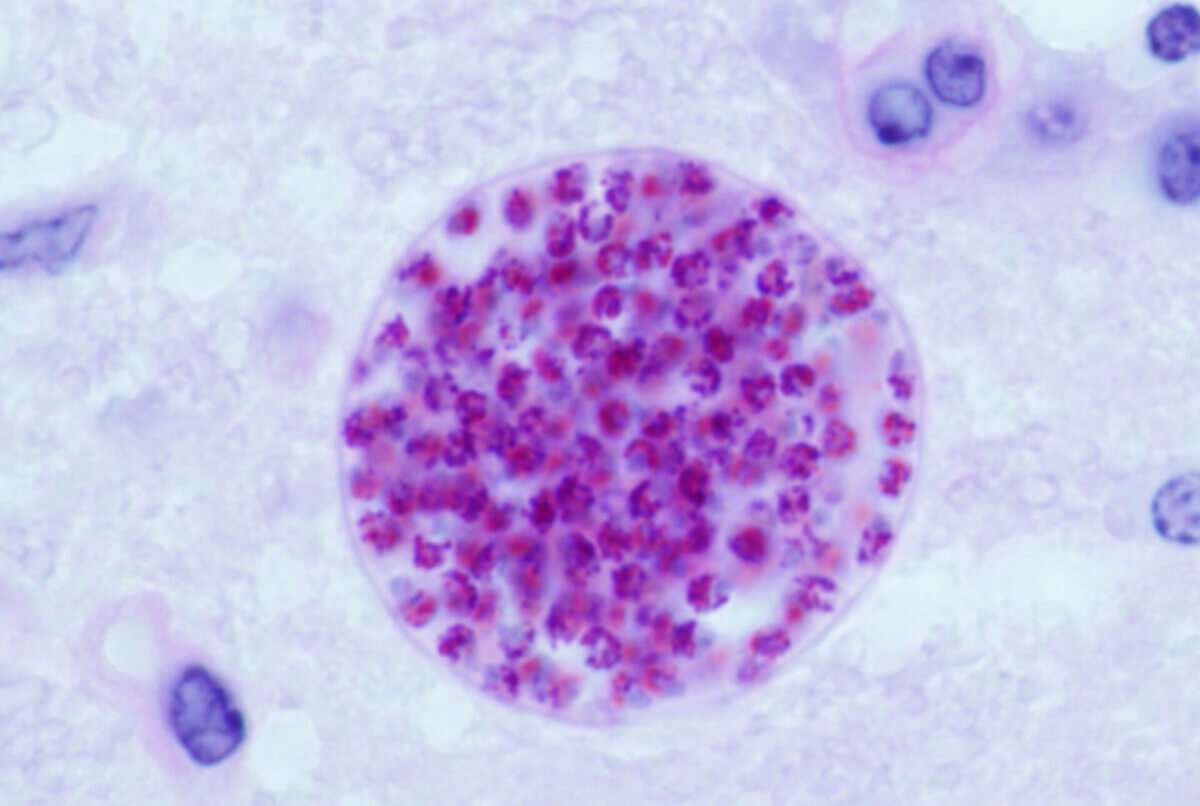
Microscopic cysts containing Toxoplasma gondii develop in the tissues of many vertebrates. Here, in mouse brain tissue, thousands of resting parasites (stained red) are enveloped by a thin parasite cyst wall. Photo by Jitender P. Dubey. (Credit: ars.usda.gov)
TURKU, Finland — A sexually-transmitted parasite that up to 50 percent of the population carries may actually make people look more attractive to the opposite sex. Researchers in Finland say Toxoplasma gondii may be responsible for a number of different neurological disorders, including schizophrenia and psychotic episodes. However, its strangest effect may be altering the way others view people carrying the infection.
Study authors found that both men and women infected with T. gondii were rated as being more attractive and healthier-looking than uninfected individuals. The team says this strange connection could have its roots in evolution, theorizing that changes which benefit the host (an animal or human) also benefit the parasite. This symbiotic relationship would help the parasite spread through carriers having more sex.
“In one study, Toxoplasma-infected male rats were perceived as more sexually attractive and were preferred as sexual partners by non-infected females,” study first author Javier Borráz-León from the University of Turku and his team write in the journal PeerJ.
The parasite may actually change how your face looks
While previous studies on T. gondii suggest that the parasite leads to higher testosterone levels in men, others suspect that the parasite manipulates chemicals in a host’s body — including neurotransmitters and hormones.
Manipulating a host’s “phenotype,” Borráz-León says, can lead to far-reaching changing — including how a person actually looks physically.
“Some sexually transmitted parasites, such as T. gondii, may produce changes in the appearance and behavior of the human host, either as a by-product of the infection or as the result of the manipulation of the parasite to increase its spread to new hosts,” the researchers write in their study.
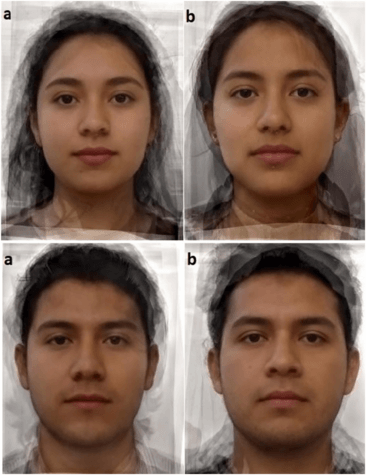
In an experiment including 35 college students (22 men, 13 women) infected with T. gondii and 178 students not carrying the parasite, researchers looked at how symmetrical their facial features were. The team explains that fluctuating asymmetry is a measure of how different the features in your face are. Studies have linked having more symmetry in your face (lowers levels of asymmetry) to better health, stronger genes, and being more attractive to others.
Results show that Toxoplasma-infected participants had lower levels of fluctuating asymmetry than healthy college students. Additionally, young women carrying the parasite had a lower body mass index than their peers. These women also rated themselves as more attractive and reported that they had more sexual partners.
“It is possible that the apparently non-pathological and potentially beneficial interactions between T. gondii and some of its intermediate hosts, such as rats and humans are the result of co-evolutionary strategies that benefit, or at least do not harm, the fitness of both the parasite and the host,” study authors conclude.


