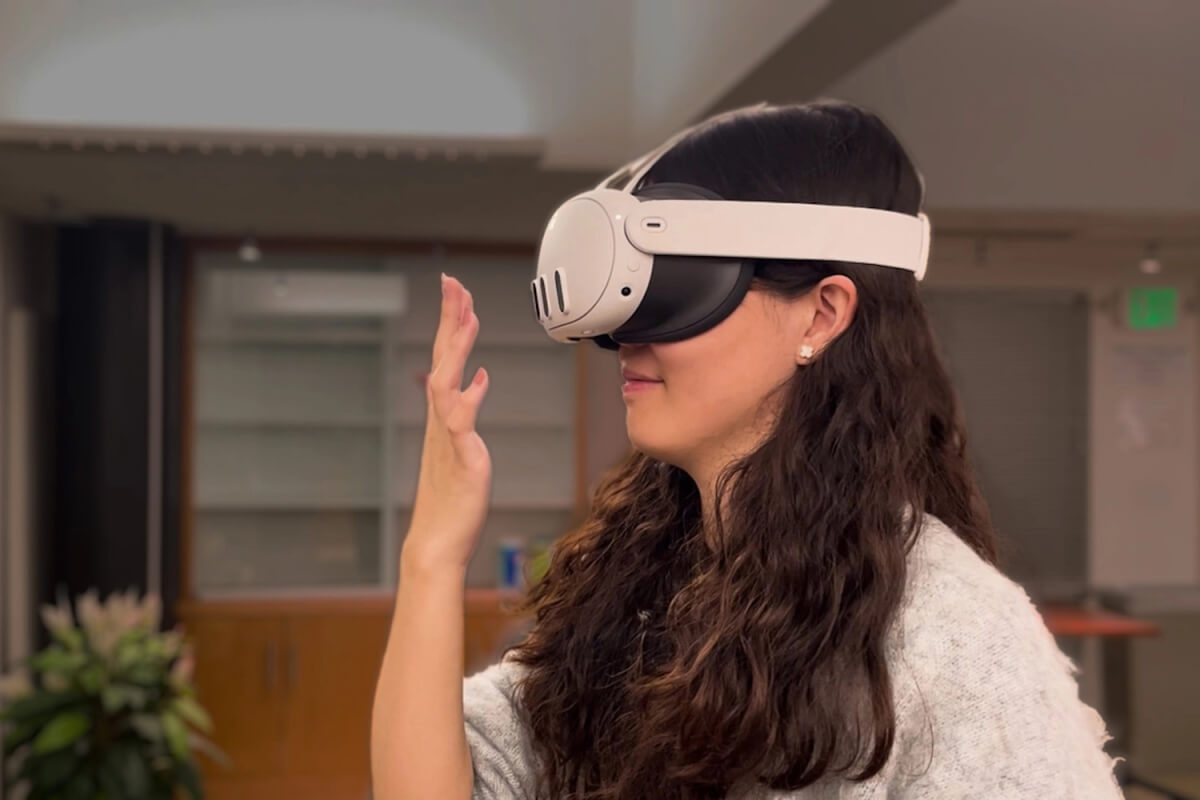
The “Pinocchio Test” is used to study near-eye distance underestimation. Participants point to where they think the tip of their nose should be based on passthrough vision and are surprised to find their nose has “grown” due to the spatial distortion of passthrough. (Image credit: Virtual Human Interaction Lab)
STANFORD, Calif. — Mixed reality headsets are becoming all the rage. These cutting-edge devices, which overlay digital content onto the real world through passthrough video technology, could revolutionize our daily lives, yet they come with a set of challenges that might hinder widespread adoption for continuous use. Stanford University researchers have uncovered unsettling effects while studying these headsets, including “dangerous” aftereffects.
Mixed reality, also known as spatial computing, is among the most talked-about consumer technologies today. It promises an immersive experience that combines the physical environment with digital enhancements, allowing users to interact with both realms simultaneously. The technology relies heavily on passthrough video, which captures the external world through cameras mounted on the headset, projecting it onto internal screens in real time. This innovation enables wearers to engage with digital applications while navigating their physical surroundings, a concept that has piqued the interest of tech enthusiasts and companies alike.
A team from Stanford conducted field tests to investigate the psychological and behavioral impacts of prolonged passthrough video headset use. Their findings highlight a mix of experiences that could shape the future of human-computer interaction.
“Given how far headsets with passthrough video have come, it’s time to dedicate serious academic thought to the psychological and behavioral effects of this technology,” says study author Jeremy Bailenson, the Thomas More Storke Professor in the Stanford School of Humanities and Sciences and founding director of the Virtual Human Interaction Lab (VHIL), in a university release. “We want to understand the implications of living in a life in which we rely on passthrough for hours every day to see the world around us.”

Participants engaged in various activities, from walking around campus to buying coffee, all under the watchful eyes of a chaperone to ensure safety. Despite the initial thrill, researchers quickly encountered drawbacks, including visual distortions, feelings of social disconnection, and motion sickness, which raised concerns about the technology’s practicality for extended daily use.
Mixed Reality Headsets Can Cause ‘Funhouse Mirror’ Effect
The study detailed how passthrough video could alter perception, limiting peripheral vision and presenting a “funhouse mirror” effect that distorts reality. Users reported difficulties with simple tasks like giving high fives or eating, as the technology’s limitations led to misjudgments in distance and object size.
“Even though the world you are looking at is real, it certainly has a video-game-like ‘otherness’ to it,” notes study co-author James Brown, a master’s student in Stanford’s Symbolic Systems Program.
These visual inaccuracies, combined with a delay in the video feed, not only challenged users’ interactions with the environment but also sparked a phenomenon the researchers termed “social absence.” This sense of disconnection from people in the immediate vicinity, as if they were mere images on a screen, underscores the potential social ramifications of widespread headset adoption.
Furthermore, the team highlighted the risk of simulator sickness, akin to motion sickness, which could deter users from prolonged engagement with the technology.
“I was surprised because all 11 of us in this study are headset veterans, but even from relatively short periods of use, we tended to feel uncomfortable,” explains Bailenson.
Given these findings, the Stanford team advises mixed reality users to approach the technology with caution. Bailenson recommends moderation in use, suggesting breaks and shorter sessions to mitigate the adverse effects and potential dangers associated with the headsets.
“There is great potential for passthrough video headsets across all kinds of applications,” concludes Bailenson. “But there are pitfalls as well that can lessen the user experience, from feelings of social absence to motion sickness, and aftereffects that could possibly even be dangerous.”
The study is published in the journal Technology, Mind, and Behavior.


