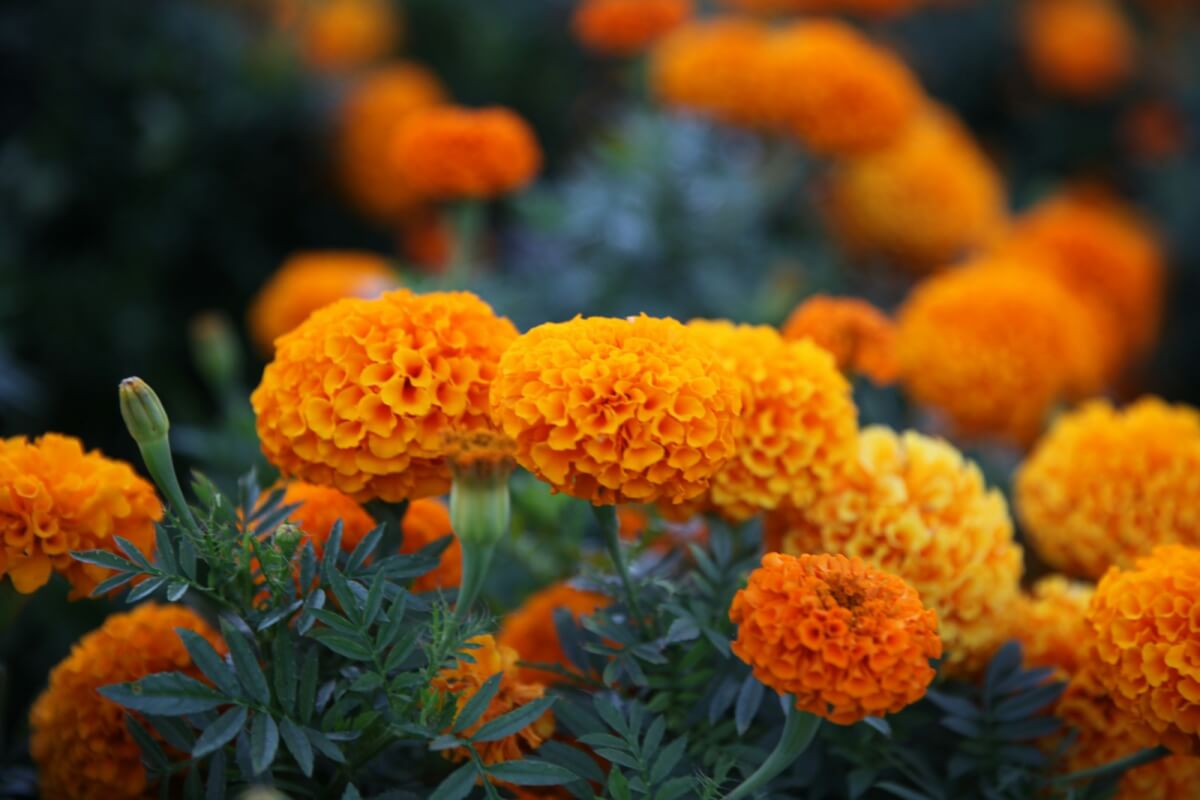
Marigolds (Photo by Julia Kwiek on Unsplash)
In A Nutshell
- A new lab study found that proteins from marigold flowers, a crop often discarded as waste, perform well across key food-science tests.
- Albumin, the dominant protein type in marigold, held water and oil effectively and stayed stable at higher temperatures than several proteins already used in food production.
- The proteins also showed antioxidant activity and held up better under heat than green pea, chickpea, and fava bean proteins tested in earlier research.
- The findings are still lab-only, so a marigold-based food ingredient is not yet ready for grocery shelves or factory production lines.
Every year, enormous quantities of marigold flowers get thrown away, tossed out after harvest, left to rot in floral industry bins, or discarded as agricultural waste. In India alone, roughly 40% of marigolds produced are simply discarded. A new study published in ACS Food Science & Technology suggests those flowers might be hiding something valuable: a protein that holds up to heat and performs well in lab testing, with potential as a sustainable food ingredient.
Researchers analyzed proteins from pre-dried marigold flowers purchased from a local supplier, running them through a battery of tests used to judge whether a protein could work in real food products. The results were encouraging. Marigold flower protein held onto water and oil well, helped form stable oil-and-water mixtures, showed antioxidant activity, and stayed structurally intact at higher temperatures than several other plant proteins already used in food production. For food scientists hunting for the next viable plant protein, this bright-orange garden staple might be worth a second look.
Animal-based proteins carry a heavy environmental price tag, requiring substantial land and water and contributing to greenhouse gas emissions, and the push for alternatives runs deeper than wellness trends. Global protein demand is also projected to keep rising as the population grows. Finding proteins in underused or wasted plant materials could help close that gap without clearing more land or raising more livestock.
Four Protein Types, One Clear Standout
Researchers at the University of Georgia, who led the study, broke marigold flower proteins into four groups based on how they dissolve: albumin (water-soluble), globulin (salt-soluble), glutelin (alkali-soluble), and prolamin (alcohol-soluble). Splitting proteins this way is a long-standing technique for studying how each group behaves on its own.
Albumin emerged as the dominant fraction by a wide margin, making up about two-thirds of the total protein extracted. It also topped the charts in nearly every test run, including how well it held water and oil, helped bind fat and water together, and generated foam, the quality that gives whipped toppings and baked goods their light, airy texture. Glutelin came in as a strong second, particularly for its emulsifying performance and heat resistance. Researchers also recovered more than 92% of the available protein during extraction, meaning the process was efficient and lost very little along the way.

A Protein That Shrugs Off High Heat
One of the standout findings involved how well marigold proteins held up under high heat, a critical factor for any ingredient destined for real food manufacturing, where things get baked, boiled, or pasteurized. Albumin remained stable up to about 105°C before breaking down, and glutelin held up to about 98°C. Those numbers beat out green pea protein and certain chickpea and fava bean proteins tested in earlier research. The study did not test marigold proteins under actual commercial conditions like extrusion equipment, so this heat tolerance is a promising sign rather than proof it will perform the same way on a factory line.
Researchers also used mass spectrometry to catalog roughly 620 proteins in marigold flowers, including 33 short-chain proteins built from fewer than 120 amino acids. Smaller protein units tend to move quickly to the surface between oil and water, the same principle that keeps a good mayonnaise from separating into an oily mess. Microscopy images backed this up, showing that albumin had a porous, irregular structure the researchers linked to its strong water absorption and emulsifying ability. Albumin and glutelin also showed the strongest antioxidant activity of the four fractions, a property that could help foods resist spoilage from oxidation.
Flavor Hints and the Road to Commercial Use
Amino acid analysis showed proline, cysteine, and glutamic acid were the most abundant across the board. Because glutamic acid and aspartic acid are often linked with savory, umami-like taste, the amino acid profile may also interest food developers, though the study did not test flavor or run any taste panels, so that’s a possibility worth watching rather than a proven perk.
Marigold’s protein content on a dry-weight basis is comparable to that of corn, oats, wheat, and banana peel, conventional plant sources already widely used in food production. That alone makes it a more compelling candidate than its garden-center reputation might suggest.
This is a foundational study. It tells us what marigold proteins can do in a lab, not how they would behave inside an actual cracker, sauce, or veggie burger, and not at the scale a food company would need. The researchers say future work should test these proteins in real food formulations and figure out how to reliably source marigold flowers at scale rather than buying dried batches from a local supplier. Marigold itself has a long history of use in foods and herbal remedies and is recognized as safe for human consumption by the FDA, but that status covers the plant, not a new commercial protein ingredient, which would still need its own testing and review before showing up on a label.
Even with those open questions, the basic case is compelling. Millions of marigold flowers are already being grown and tossed out, and the proteins inside them just proved they can handle heat and multitask in the kitchen. That’s a rare enough combination to be worth a longer look.
Disclaimer: This article is based on peer-reviewed research and is intended for general informational purposes. It is not intended as food safety, regulatory, dietary, or medical advice. Findings described here come from laboratory testing and may not reflect how an ingredient would perform in commercial food products.
Paper Notes
Limitations
The study was conducted under controlled laboratory conditions and did not test marigold flower proteins in actual food products or simulate industrial-scale processing conditions. The researchers acknowledge that high-resolution structural techniques should be applied in future work to better understand protein behavior during commercial food manufacturing. The protein extraction was performed on pre-dried marigold flowers purchased from a local supplier, and variability in flower source, growing conditions, or drying methods were not addressed as potential factors affecting results. Approximately 7.83% of the crude protein was not recovered during extraction, which the authors attribute to insoluble protein particles or inefficiencies in the extraction process.
Funding and Disclosures
The authors acknowledged support from the U.S. Department of Energy, Office of Science, Basic Energy Sciences, Chemical Sciences, Geosciences, and Biosciences Division for the protein amino acid identification component of the research, under award number DE-SC0015662. The authors declared no competing financial interest.
Publication Details
Authors: Fidele Benimana, Nancy Alila, Kentaro Kawata, Christopher Kucha, Anupam Roy, and Anand Mohan. Benimana, Alila, Kawata, Kucha, and Mohan are affiliated with the Department of Food Science and Technology, University of Georgia, Athens, Georgia. Roy is affiliated with the Centre for Rural Development and Technology, Indian Institute of Technology-Delhi, New Delhi, India. | Journal: ACS Food Science & Technology | Paper Title: “Assessing Structural, Thermal, and Functional Characteristics of Marigold Flower Protein as a Sustainable Food Ingredient” | DOI: 10.1021/acsfoodscitech.5c01215 | Published: April 2, 2026 (issue version: April 17, 2026; corrected repost: May 14, 2026)


