(Credit: gkrphoto/Shutterstock)
WASHINGTON — A startling new study reveals that one in four American households may be sitting on a hidden health hazard: dangerous levels of lead in their soil. This revelation comes on the heels of updated guidance from the Environmental Protection Agency (EPA), which recently lowered its recommended screening level for lead in residential soils from 400 to 200 parts per million.
The financial implications of this policy change are staggering. Researchers estimate that addressing this widespread contamination could cost the nation between $290 billion and $1.2 trillion. That’s more than the entire 2021 infrastructure bill passed by Congress.
Dr. Gabriel Filippelli, lead author of the study published in GeoHealth, warns that the scale of the problem is “astounding.” His team’s findings suggest that nearly 30 million households across the United States may need to take action to mitigate potential soil lead hazards.
“I was shocked at how many households were above the new 200 ppm guideline,” says Filippelli, a biochemist at Indiana University, in a media release. “I assumed it was going to be a more modest number. And results for the 100 ppm guideline are even worse.”
Methodology: Unearthing the Data
To uncover the extent of lead contamination, Filippelli and his colleagues tapped into an innovative source: citizen scientists. Through initiatives like MapMyEnvironment, everyday people collected soil samples from their backyards and neighborhoods. This grassroots approach yielded a treasure trove of data — over 15,000 soil samples from various cities and communities across the country.
The researchers analyzed these samples, looking specifically at lead concentrations. They then compared the results to both the old EPA guideline of 400 parts per million (ppm) and the new, stricter standard of 200 ppm. What they found was eye-opening. Under the previous guideline, about 12% of residential soil samples exceeded the safe threshold. But with the new, more protective standard in place, that number jumps to nearly 25% – or one in four households.
Results: A Nationwide Problem with Local Variations
The study’s results paint a picture of widespread contamination but with significant local variations. Some cities fared worse than others:
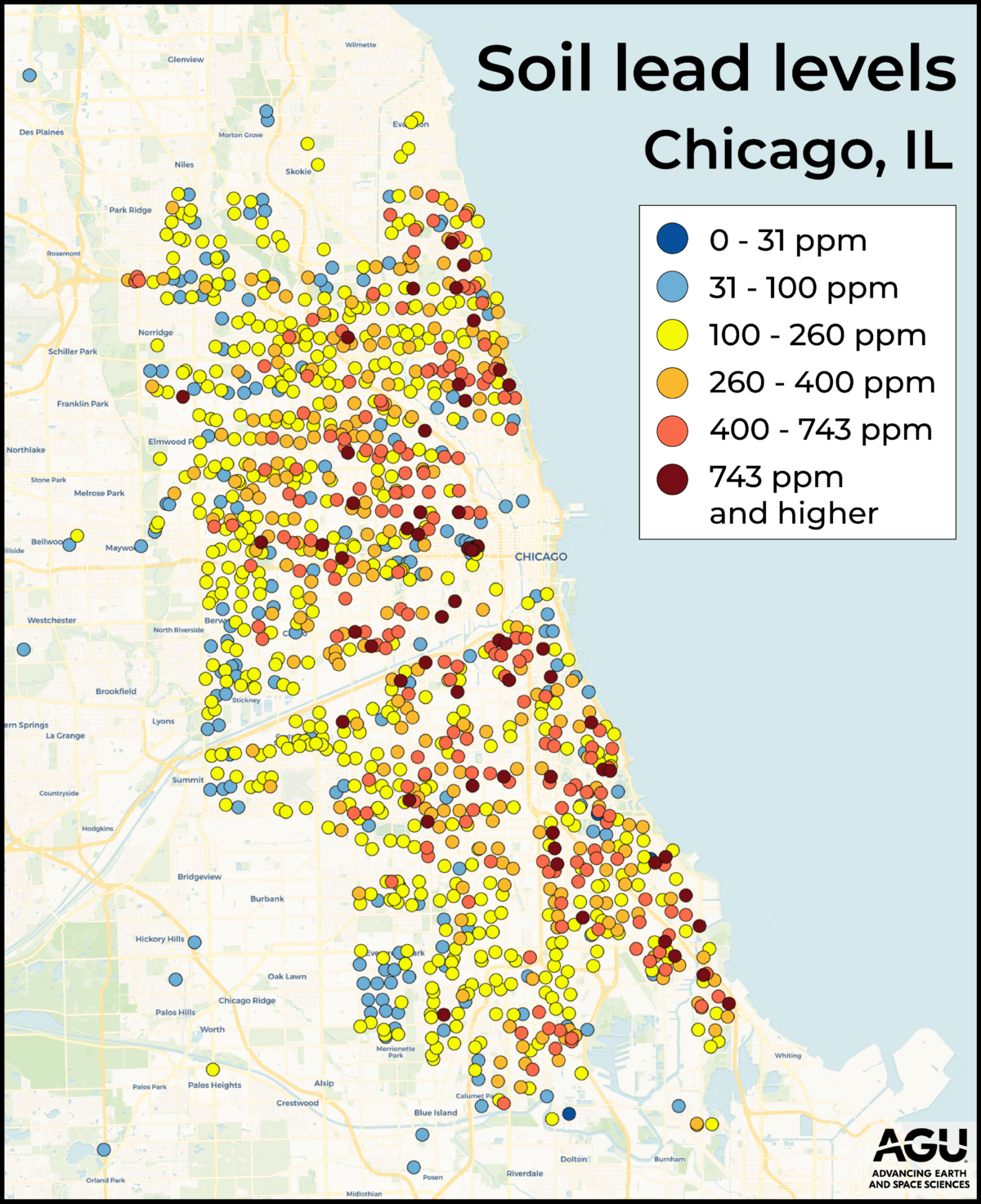
- Chicago topped the list, with a whopping 53% of household soils exceeding the new 200 ppm guideline.
- Indianapolis and Burlington, VT also showed high rates of contamination, with 37% and 24% of samples above the threshold, respectively.
- Other cities, like Columbia, SC and Raleigh, NC, fared better, with very few samples exceeding even the stricter guideline.
These variations likely reflect differences in factors such as industrial history, the age of housing stock, and past use of leaded gasoline.
The researchers note that their data set has limitations. Some cities had more robust sampling than others, and the voluntary nature of citizen science means the distribution of data points isn’t perfectly even. However, the overall trend is clear: soil lead contamination is a significant and widespread issue.
Remediation Too Costly for Many Households
With millions of households potentially affected, traditional approaches to lead remediation may not be feasible. The standard “dig and dump” method – removing contaminated soil and replacing it with clean fill – could cost tens of thousands of dollars per household.
Instead, Filippelli and his team advocate for a simpler, more cost-effective approach: capping contaminated soil with clean soil or mulch. This method, while not permanent, can provide immediate benefits at a fraction of the cost.
“Even the act of covering polluted soil with clean soils will permanently dilute the lead concentration of the total soil profile if soil perturbation occurs,” Filippelli explains in GeoHealth. In other words, mixing in clean soil helps reduce overall lead levels.
The researchers suggest that this capping approach, combined with targeted removal of the most contaminated soils (often found near the drip lines of older houses), could offer a practical path forward.
Takeaways: The Next Steps for U.S. Backyards
The study’s findings underscore the ongoing challenge of lead exposure in the United States. Despite significant progress since the phaseout of leaded gasoline and lead-based paint, the legacy of these past practices continues to pose risks, particularly in urban areas and communities of color.
“Given the scale of the urban soil lead contamination issues and the disproportionate exposure potential faced by environmental justice communities, this issue finally needs to be fully grappled with,” the study authors write in their report.
For concerned homeowners, the first step is awareness. Testing your soil for lead can provide valuable information about potential risks. While the prospect of widespread contamination may seem daunting, the study offers hope that simpler, more affordable mitigation strategies can make a real difference in reducing lead exposure and protecting public health.
“Lead is the most easily solvable problem that we have. We know where it is, and we know how to avoid it. It’s just a matter of taking action,” Filippelli concludes.


