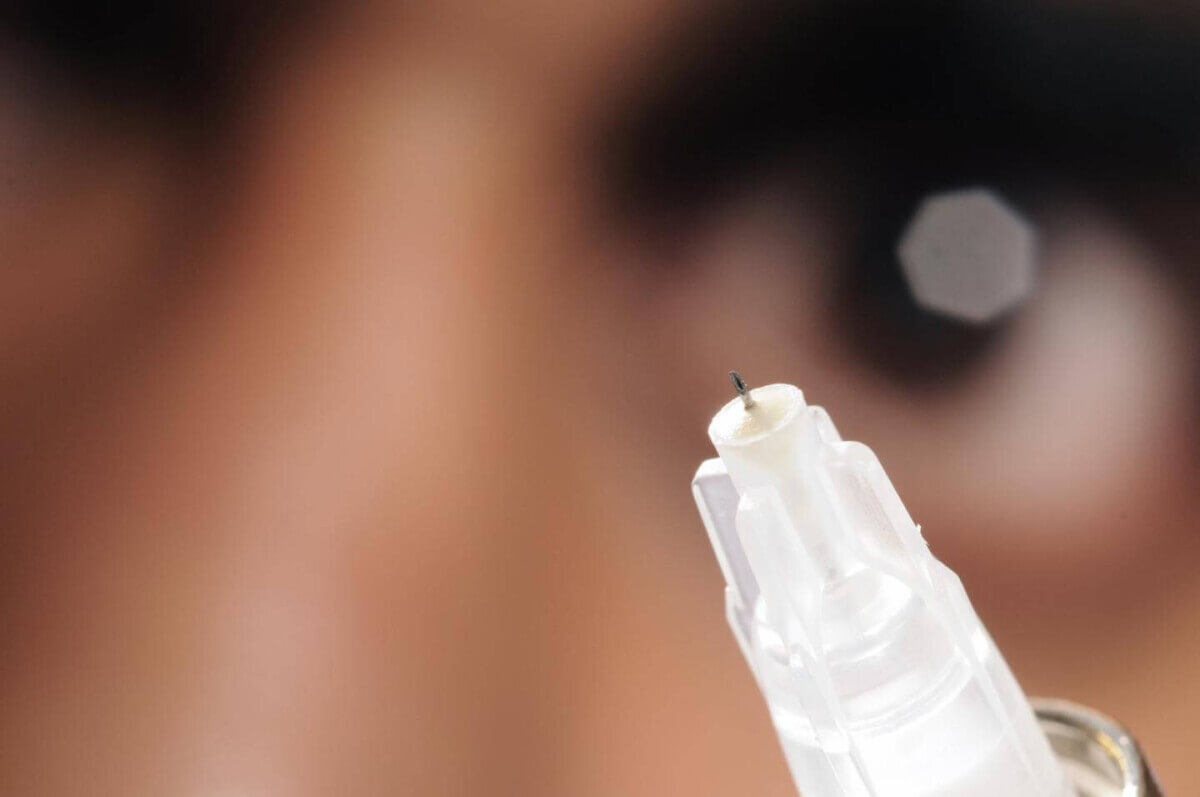
Researchers use a microneedle less than a millimeter in length to inject a natural and biodegradable polymer material into a structure in the eye. The material forms a hydrogel that holds open a pathway to release pressure from the eye. (Credit: Gary Meek, Georgia Tech)
New twice-yearly treatment using microneedle could be ‘holy grail for glaucoma,’ scientists say.
ATLANTA, Ga. — Glaucoma is the leading cause of irreversible blindness in the world. While medication and surgery can help to relieve the pressure that the condition places on the eyes, these treatments are often unsuccessful. Now, researchers from Georgia Tech have developed a procedure that may replace all those treatments with a twice-a-year injection.
The possible treatment could become the first treatment for glaucoma which doesn’t involve eye drops, surgical procedures, or implants to reduce eye pressure. Instead, the injection utilizes a biodegradable material which forms a hydrogel in the patient’s eye. Hydrogel is a water-absorbing polymer which is compatible with the human body and can even transmit bioelectrical signals.
The procedure injects a tiny amount of this substance into the patient’s eye, keeping open a pathway for excess fluid to drain out and reduce pressure from building up.
“The holy grail for glaucoma is an efficient way to lower the pressure that doesn’t rely on the patient putting drops in their eyes every day, doesn’t require a complicated surgery, has minimal side effects, and has a good safety profile,” says Professor Ross Ethier in a university release. “I am excited about this technique, which could be a game-changer for the treatment of glaucoma.”
A pathway to better vision
Ethier teamed up with Professor Mark Prausnitz to create the hydrogel procedure. Using a small hollow needle, researchers inject the polymer precursor into the suprachoroidal space (SCS), a structure right below the surface of the eye.
Once in the eye, the material chemically links to form the hydrogel and hold open a channel in the SCS. This allows aqueous humor fluid to drain from the eye. Normally, the human body has two pathways for eye fluid to leave the area. The main path, the trabecular meshwork, is in the front of the eye. Patients dealing with glaucoma see this main route blocked off, making the smaller SCS pathway the only way to get rid of excess fluid.
The hydrogel works by propping open this backdoor so aqueous humor can leave the eye for several months at a time. The injection delivers just 50 microliters of hydrogel-forming material to the eye, about the same as a drop of water.
“We inject a viscous material and keep it at the site of the injection at the interface between the back of the eye and the front of the eye where the suprachoroidal space begins,” Prausnitz says. “By opening up that space, we tap a pathway that would not otherwise be utilized efficiently to remove liquid from the eye.”
Part of the regular checkup?
Researchers conducted the initial tests on animals. Those results reveal the injections could significantly lower intraocular pressure in patients dealing with glaucoma. The team, including study first author and veterinary ophthalmologist J. Jeremy Chae, say none of the animals experienced significant inflammation from the injections.
Right now, the pressure drop last about four months. The Georgia Tech team is now working to improve the results by modifying the polymer so it can last at least six months. The procedure takes just a few minutes to complete and study authors believe it could become a part of the regular exam for glaucoma patients.
“If we can get to a twice-a-year treatment, we would not disrupt the current clinical process,” Prausnitz said. “We believe the injection could be done as an office procedure during routine exams that the patients are already getting. Patients may not need to do anything to treat their glaucoma until their next office visit.”
Besides extending the length of the treatment’s effect, researchers say they’ll also have to prove the injections can be repeatedly given to patients without damaging the eye. More tests are planned on animals before the study moves on to human trials.
“The idea of having a ‘one-and-done’ treatment that lasts for six months would be particularly helpful for those whose access to healthcare is non-optimal,” Ethier concludes. “Having a long-acting therapy would have an additional advantage during times of pandemic or other disruption when access to healthcare is more difficult.”
The study appears in the journal Advanced Science.


