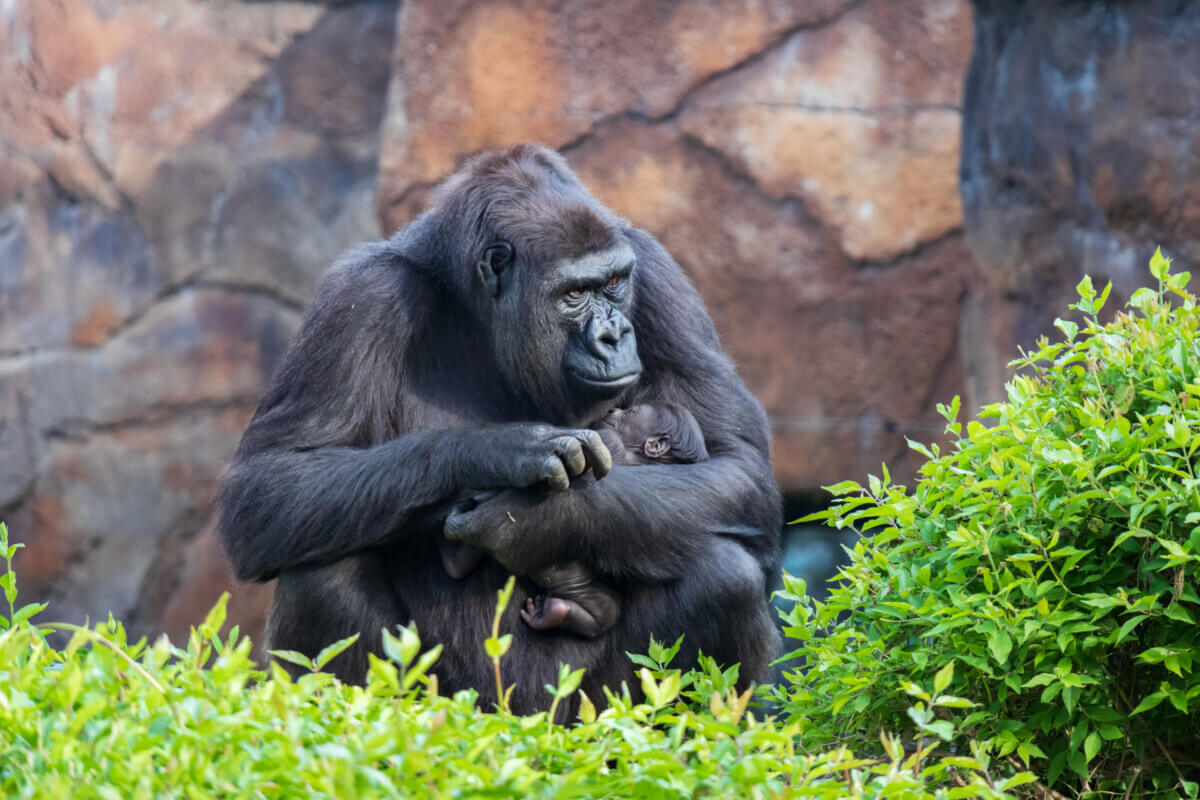
A mother gorilla holds her baby. (© Martina - stock.adobe.com)
No Two Great Apes Think Alike, Study Finds
In A Nutshell
- Individual identity was the strongest predictor of how well a great ape performed on cognitive tasks, outweighing species, age, sex, and social rank.
- Apes that scored near the top early in the study tended to stay there across 18 months of repeated testing, pointing to stable personal traits shaped well before the research began.
- Non-social thinking skills, like memory and reasoning, clustered together across individuals, but social thinking did not follow the same pattern.
- No single species dominated across all tasks, with different groups leading on different challenges, undermining the idea of one “smartest” ape species.
Put two chimpanzees in front of the same puzzle and they won’t necessarily respond the same way. One might solve it quickly, the other might not figure it out at all. According to a new study that followed 48 great apes for a year and a half, that gap has surprisingly little to do with species, age, or where an animal ranks in its social group. What it comes down to is the individual animal itself.
A study published in Psychological Science by researchers from the Max Planck Institute for Evolutionary Anthropology in Leipzig, Leuphana University Lüneburg, and the University of Veterinary Medicine Vienna set out to answer a question scientists have barely begun to tackle in animals: what actually explains the cognitive differences between individuals?
Turns out it has less to do with species, age, or social rank than with something much harder to pin down: stable personal traits that likely took shape long before any testing began.
Six Tasks, Four Species, 18 Months of Testing
Bonobos, chimpanzees, gorillas, and orangutans were followed across 10 rounds of testing, with each animal put through six different mental challenges.
Some tasks measured social awareness. In one, an ape had to follow where a human experimenter was looking to figure out which of two food-hiding cups to pick. In another, the experimenter gave obvious signals, looking directly at a cup, calling the ape’s name, and tapping it to indicate where a treat was hidden.
Other tasks tested non-social reasoning. One asked an ape to remember where a hidden treat had been placed while ignoring a clearly visible piece of food nearby, a test of resisting distraction. Another tested working memory: all three cups were baited, and the ape had to choose each one without revisiting a cup already emptied. Each round was repeated at all 10 time points the same way, letting researchers track whether individual apes kept performing similarly session after session.
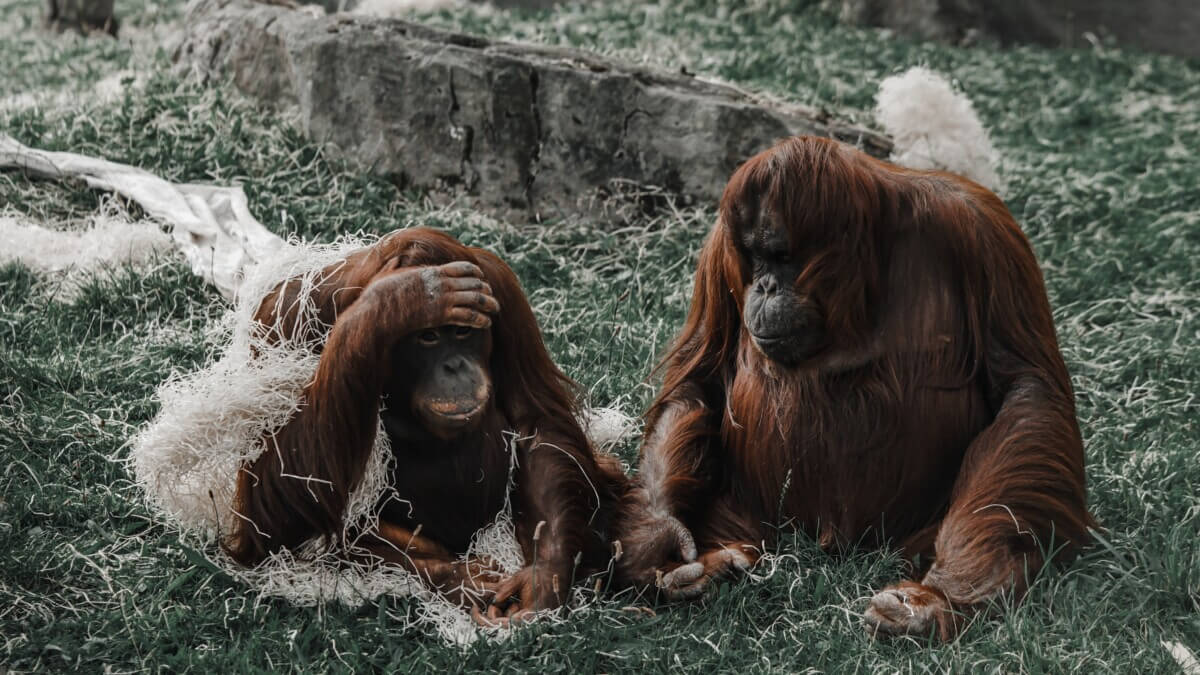
Individual Identity Outpredicted Almost Everything Else
When researchers examined what actually drove performance, one factor kept rising to the top: the individual animal. Stable, individual-specific traits explained more about how any given ape performed than its age, sex, rank, health status, or testing conditions.
Even as many apes improved over time through repeated exposure, the relative ranking of individuals stayed largely the same. Apes that started near the top tended to stay there. That pattern points to influences that long preceded the study, though researchers could not separate genetic predispositions from early developmental experiences, since both operate on timescales longer than the study’s year-and-a-half window.
Housing group was the one outside predictor that appeared consistently across all tasks. But the picture it painted was messy: different groups led on different tasks, and no single species or housing group dominated across the board. Gorillas performed best on certain memory and impulse-control tasks, bonobos led on the social attention task, and one chimpanzee group came out ahead on others. That inconsistency sits uneasily with any idea that one species simply outperforms another across cognitive tasks.
Rearing history mattered on some tasks, too. Apes raised by their mothers outperformed others on certain challenges, and those with more time in research settings tended to do better on some tasks, suggesting that familiarity with human experimenters helps apes engage with what’s being asked of them.
Social and Non-Social Thinking Did Not Move Together
Not all types of thinking turned out to be linked, and that gap may be the study’s most interesting wrinkle.
For non-social tasks (memory challenges, quantity reasoning, and resisting distractions), there were meaningful positive connections. Apes that did well on one tended to do well on others, hinting at some shared underlying reasoning capacity across those domains, though researchers stopped short of claiming it amounts to a single general intelligence.
Social tasks told a different story. None of the social-cognition tasks moved together in any meaningful way, and most did not connect to non-social tasks. One exception turned up between a task where apes read an experimenter’s communicative signals and a task involving physical reasoning about hidden food. Researchers suspect some apes may have treated the experimenter’s action as a social cue rather than a physical one, effectively solving the second task through a different route.
Not every task held up as a reliable measuring tool. A separate probabilistic reasoning task asked apes to choose the cup that definitely contained food over cups that only might. Performance was no better than random guessing, and researchers excluded it from the structural analyses.
Why It Matters Beyond the Zoo
Understanding how individual differences in thinking are structured sits at the heart of understanding how intelligence evolved. If social and non-social reasoning show little overlap in our closest animal relatives, it raises pointed questions about how and when those two systems may have become more connected in humans, and what that eventual connection made possible.
Paper Notes
Limitations
Authors acknowledge several constraints. With 48 individuals, the sample is substantial for great ape research but still relatively small for detecting some statistical patterns, and total sample size varied across time points. One task proved unsuitable for measuring individual differences in this population and was excluded from structural analyses. Reliability estimates across tasks were generally lower than in a previous study of the same individuals, which researchers attribute partly to learning effects: at early time points, more apes may have responded randomly rather than using available information. The study design did not allow the team to fully untangle genetic predispositions from early developmental experiences, since both operate on timescales longer than the study’s window. Control conditions for individual tasks were not run; the study instead relied on published procedures from prior research that included such controls. The method for computing correlations between trait estimates was not preregistered, though the general study design and analysis plan were partly preregistered prior to data collection.
Funding and Disclosures
This work was funded by a Jacobs Foundation Research Fellowship (Grant No. 2022-1484-00, awarded to M. Bohn) and a Lower Saxony Impulse Professorship through the zukunft.niedersachsen program. Additional support came from the Max Planck Society for the Advancement of Science. All authors declare no conflicts of interest. GPT-4.1 was used for spell-checking only; no other AI tools were used in the research or writing. Ethical clearance was obtained from the Max Planck Society Ethics Commission.
Publication Details
Authors: Manuel Bohn, Christoph J. Völter, Daniel Hanus, Nico Eisbrenner, Johanna Eckert, Jana Holtmann, and Daniel Haun | Institutional affiliations: Institute of Psychology in Education, Leuphana University Lüneburg; Department of Comparative Cultural Psychology, Max Planck Institute for Evolutionary Anthropology, Leipzig, Germany; Comparative Cognition Unit, Messerli Research Institute, University of Veterinary Medicine Vienna; Wilhelm Wundt Institute of Psychology, Leipzig University | Journal: Psychological Science, Vol. 37(5), pp. 331–346 | Title: “Individual Differences in Great Ape Cognition Across Time and Domains: Stability, Structure, and Predictability” | DOI: 10.1177/09567976261434817 | Published: 2026


