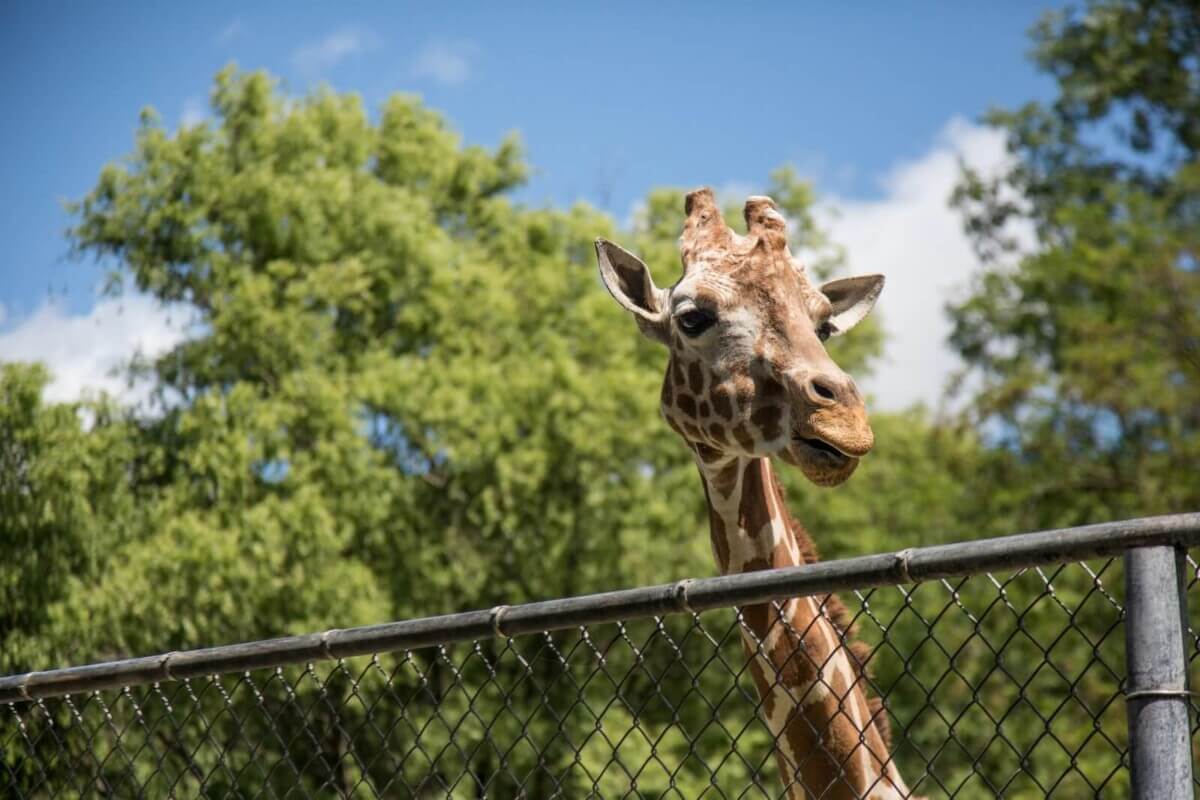
(Photo by Alexander Ross on Unsplash)
Scientists Tested Giraffe ‘Math’ Skills, and the Results Surprised Them
In A Nutshell
- Four giraffes at the Barcelona Zoo were tested on whether they could mentally track food quantities hidden inside covered containers.
- The giraffes succeeded at tracking combined quantities, choosing correctly about 68% of the time, well above random chance.
- They failed at tracking removed quantities and at a task requiring them to follow food moved between containers, performing at chance level on both.
- Two giraffes, Nuru and Njano, kept succeeding even when a simpler shortcut strategy wasn’t available, hinting at genuine mental tracking rather than guesswork.
When people think of animals doing math, they likely picture chimpanzees or parrots. Giraffes don’t exactly come to mind. But a new study suggests the world’s tallest animal might be doing some surprisingly careful mental tracking, quietly keeping tabs on their food.
Researchers tested four captive giraffes at the Barcelona Zoo to see whether they could mentally track changes in food quantities: whether they could figure out which dish held more food after watching pieces get moved around, without ever seeing the final result. The scientists are careful to frame this as quantity tracking, not proof that giraffes do arithmetic the way humans do. The giraffes handled combination well, but fell short on removal and on a task requiring them to track food moved between containers, with performance at roughly chance level on both.
This kind of research matters because scientists want to understand where human math ability came from. By studying which animals can track, combine, or separate quantities, researchers piece together the evolutionary story of numerical thinking. The findings, published in the journal Scientific Reports, suggest giraffes, rarely studied for cognitive skills, may be more capable of tracking hidden quantities than many would assume.
Giraffes Tracked Hidden Food Without Any Training
Led by Iker Loidi at the University of Barcelona, with colleagues from the University of Leipzig and the Max Planck Institute for Evolutionary Anthropology, the research team devised a setup requiring no training. There were no symbols, no rewards for learning rules. Giraffes simply watched what happened to the food and then chose.
Two yellow containers were placed in front of a giraffe, each holding a different number of carrot pieces, visible to the animal. Then both containers were covered. A third, green container held additional pieces that were moved, one by one, into one of the covered yellow containers. The giraffe never saw the final count. To get the most food, it had to mentally track what had been added and choose the larger total.
All four giraffes were tested across multiple sessions, totaling more than a thousand trials. In the combination task, giraffes chose correctly about 68% of the time, well above random chance of 50%. The dissociation task, where pieces were removed from one container, and a third task tracking food moved from one container to the other, both showed performance at roughly chance level, meaning the giraffes were just guessing. The third task also had fewer trials than the others, which may have made it harder to detect any real ability even if it existed.

Not All Four Giraffes Were Playing the Same Game
One complicating factor: some giraffes might have been using a simpler trick rather than mental tracking. If a giraffe simply learned to choose, or avoid, whichever container the experimenter had touched, it could score well without tracking quantities at all. The researchers called this the Dish Manipulated by the Observer strategy, which had a marginally significant effect on overall performance.
Two of the four giraffes, Nuru and Njano, performed above chance even in trials designed so the shortcut wouldn’t work, suggesting they may have been tracking quantities mentally rather than watching the experimenter’s hands. Nakuru and Yalinga only outperformed chance when the shortcut was available.
Nuru, described in the paper as having excelled in previous numerical tasks at the same zoo, once again stood out. She performed below chance in a simpler control task, where quantities were visible and then covered before a choice, but succeeded in the more demanding combination task. The researchers tentatively suggest this may reflect context-dependent engagement, though they note this remains speculative.
Giraffes Join a Short List of Quantity-Tracking Animals
Giraffes aren’t the first non-primates shown to handle simple addition-style tracking. Horses, dogs, fish, and newborn chicks have shown versions of this in prior research. But giraffes had never been tested on tasks involving mental manipulation of quantities, only simpler tasks picking the larger of two visible options. This study pushes them into tougher territory: tracking quantities hidden from view.
Handling combinations but struggling with removals lines up with patterns across other species. Even in humans, subtraction is harder than addition, activating different brain regions and taking longer for children to learn. Chimpanzees, vervet monkeys, and rhesus macaques show similar limitations with removal-style tasks.
Why might giraffes have developed this tracking ability? The paper points to their ecology. Giraffes live in social groups that are constantly splitting and reforming, which could create pressure to track how many individuals are around. They also feed on scattered vegetation across wide areas, which could require remembering where food sources are and how plentiful they are. These pressures don’t guarantee such ability, but they create an environment where it could offer a survival edge.
A small sample of just four giraffes also means broad conclusions should be treated with some caution, a point covered further in the notes below.
Still, two giraffes in Barcelona may have been mentally tracking quantity manipulations beyond simple shortcuts. Science is only beginning to understand how far that ability extends across the animal world.
Paper Notes
Limitations
Several important constraints apply. The sample size was very small, only four giraffes, which limits how confidently the results can be generalized. The experimental setup could not determine which specific aspect of quantity the giraffes were tracking, since number of pieces, mass, volume, and surface area were not separated from one another. The experimenter had to manually manipulate the containers, which introduces the possibility of unintentional cues influencing animal choices despite precautions taken, including the experimenter wearing sunglasses and maintaining neutral facial and body expressions. The number of trials in the Subsequent Events task was lower than in other tasks, which may have reduced the statistical power to detect real effects. The authors recommend future studies use automated, blind methods and larger sample sizes.
Funding and Disclosures
According to the paper, this research was funded by Fundació Barcelona Zoo Grant 2025. Lead author Iker Loidi was supported by a PreDocs UB Fellowship from the University of Barcelona. Co-author Jordi Galbany received support from the Generalitat de Catalunya, grant 2021SGR00366. Open Access funding was enabled and organized by Projekt DEAL. The authors declare no competing interests.
Publication Details
Authors: Iker Loidi (University of Barcelona), Álvaro L. Caicoya (Research Institute for Farm Animal Biology, Dummerstorf, Germany), Federica Amici (University of Leipzig; Max Planck Institute for Evolutionary Anthropology), Pilar Padilla-Solé (Barcelona Zoo), and Jordi Galbany (University of Barcelona). | Journal: Scientific Reports | Paper Title: “Assessing quantity combination and dissociation in giraffes” | Published: June 26, 2026 | DOI: https://doi.org/10.1038/s41598-026-54126-7


