
Adult male capuchin feeding on bird prey. (Credit: Luciano Candisani, CC-BY 4.0 (https://creativecommons.org/licenses/by/4.0/))
In a Nutshell
- Wild capuchin monkeys that received daily food handouts hunted small animals far less often than monkeys that had to find all their own food.
- Adult male monkeys caught small prey more often than females, and only males were ever seen eating snakes.
- Monkeys tended to eat the brains and guts of their prey first, a pattern also seen in chimpanzees and suspected in ancient human ancestors.
What happens to a wild animal’s drive to hunt when its next meal is guaranteed? For two groups of monkeys in Brazil, the answer turned out to be simple but telling: the ones with a steady handout hunted far less. The discovery is helping scientists rethink one of the oldest questions about human evolution: why early humans started hunting animals in the first place.
Researchers spent nearly four years following two groups of bearded capuchin monkeys in northeastern Brazil, tracking their feeding closely, down to details like lizard tails and bird eggs. One group received a small daily handout of nuts, corn, and water. The other group found every meal on its own. When the team crunched the numbers, published in the journal PLOS One, the unprovisioned monkeys caught and ate small animals like lizards, snakes, and rodents at nearly double the rate of their fed counterparts.
That gap matters beyond monkey watching. Scientists have long debated why humans, alone among primates, evolved into hunters capable of taking down animals as big as or bigger than themselves. One leading idea is that this habit grew out of a much older, humbler behavior: opportunistically snacking on small animals when preferred plant foods ran low. Capuchin monkeys, with their sharp minds and nimble hands, give researchers a rare look at what that earlier stage might have resembled.
How Scientists Tracked Nearly Four Years of Capuchin Monkeys’ Meals
Scientists observed two wild groups of bearded capuchin monkeys living at a site called Fazenda Boa Vista, a dry, cliff-lined landscape in northeastern Brazil. One group, which generally numbered 17 to 19 monkeys, got a modest daily supply of food from researchers. A second group, ranging from 8 to 16 monkeys, lived entirely off the land.
Between 2006 and 2010, observers logged more than 5,000 hours watching these monkeys, tracking every time one caught or ate a small animal. Over that stretch, they documented 446 separate feeding events involving animals with backbones, everything from lizards and snakes to birds, bats, rodents, and even opossums. Researchers also tracked rainfall, temperature, humidity, and how much fruit and insect food was available each month, since any of these factors could push the monkeys toward hunting.
Plenty of days had zero hunting events at all, which made the data messy to work with. To make sense of it, the team used a statistical approach built to handle exactly that kind of unevenness, one that let them figure out which factors, like sex, age, season, or access to handouts, actually predicted how often a monkey went after small prey.
What Capuchin Monkeys Hunt and Eat
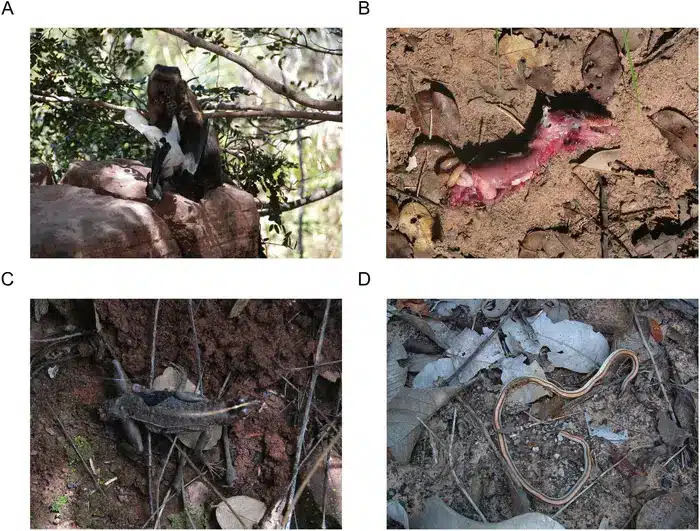
Lizards and other reptiles made up the biggest share of what these monkeys ate, followed by mammals such as rodents and opossums, then birds, mostly nestlings and eggs. Researchers also spotted something never documented before in this species: capuchins eating opossums, iguanas, and bird eggs.
Eating habits varied by prey. Birds were often eaten whole. With mammals, the monkeys favored the tail, paws, and sometimes the eyes. Lizards and geckos got picked apart for their feet, tails, eyes, skin, and brains. Snakes were handled differently: monkeys usually tossed aside the head and went straight for the body and organs. Only male monkeys were ever observed eating snakes, which hints that females may steer clear of riskier prey altogether.
Age and sex mattered a lot in who hunted and how often. Infant monkeys hunted far less than adults, catching prey at only about a fifth the rate of grown-ups, while juveniles hunted about as often as adults did. That fits the idea that catching small, fast-moving animals takes practice that young monkeys haven’t built up yet. Adult males outhunted adult females across both groups, a pattern also seen in other capuchin populations, as well as in chimpanzees and baboons. One possible explanation is body size: male capuchins in this population weigh noticeably more than females on average, and bigger bodies need more fuel. Another possibility is that females stick to lower-risk foods like insects rather than chasing prey that might bite back, a pattern also seen in chimpanzee troops.
One of the more visceral details in the study involved eating order. Across prey types, these monkeys tended to go for the brain and internal organs first, saving muscle and tougher tissue for later, if they ate it at all. Chimpanzees do something similar, cracking open skulls to get at brain tissue before working through the rest of a carcass. Researchers think this makes sense: brains and organs are rich in fat and nutrients, which could help explain why the monkeys went for them first, especially in a place where another animal might steal the carcass at any moment. If early human ancestors did the same thing with the small animals they scavenged or caught, that habit could have left telltale marks on ancient bones, something the study’s authors suggest future fossil research should specifically look for.
Hunting itself was mostly a solo affair. Out of 280 recorded feeding events, observers witnessed an active hunt beforehand in only 51 cases; in the rest, the monkeys still caught the prey themselves, but the chase happened too quickly or out of view for researchers to see it, so it was only noticed once the animal was already in the monkey’s hand. When monkeys did hunt in groups, sharing sometimes followed, but most kills, even ones caught cooperatively, ended up eaten by a single monkey. Small prey, it seems, just isn’t big enough to fight over or divide up.
Free Food Meant Less Hunting for Capuchin Monkeys
Comparing the two groups directly produced the clearest result in the whole study. Monkeys that received daily handouts hunted small animals far less than monkeys without that safety net. The unprovisioned group’s hunting rate came in at about 1.88 times higher than the fed group’s, a gap the researchers described as statistically strong.
Fruit availability told a similar story. When wild fruit was scarce, particularly certain fatty palm nuts that are a favorite food at this site, monkeys turned to hunting small mammals more often. Oddly, how many insects were around didn’t seem to matter much, even though insects are another easy, high-protein backup food the monkeys might have leaned on.
Weather played a role too, though a more puzzling one. Hunting was recorded more often during rainier, warmer stretches and less often when humidity was high. Researchers suspect this isn’t really about the weather itself but about timing: wetter, warmer periods may line up with when certain prey species give birth, flooding the area with easy-to-catch babies.
What This Means for Human Evolution
What happened at Fazenda Boa Vista goes beyond a quirk of monkey behavior. Access to easy food changed how much effort these capuchins put into getting meat, and scientists studying human origins see a useful parallel there. Many have proposed that early human ancestors may have leaned more on small animals when preferred plant foods grew unreliable, potentially setting the stage for hunting larger game much later. Watching capuchin monkeys work harder when fruit disappears and ease off when food is handed to them gives that long-standing idea something concrete to point to.
Paper Notes
Limitations
Some open questions are worth flagging. The study’s measure of fruit availability lumped together regular fruits and palm nuts, an important high-fat food at this site, so it’s not fully clear whether the drop in hunting during fruit-rich periods is about fruit in general or palm nuts specifically. A broader review of primate hunting across many species also found less overall support for the idea that animal food fills in during lean plant seasons, so this capuchin population’s pattern may not apply universally to other primates, including chimpanzees studied elsewhere. Future work, the authors recommend, should directly measure how much fruit the monkeys are actually eating, rather than just how much is available, and compare how other capuchin populations order their meals when eating prey.
Funding and Disclosures
Support came from a postgraduate study scholarship from the University La Sapienza of Rome, the EU FP6 NEST Programme, FAPESP PhD scholarships and research funding, a CNPq research grant, a CAPES scholarship, a CNR Short-term Mobility Program grant, and funding from Ethoikos srl. Fundação para a Ciência e a Tecnologia financed the open-access publication through the ICArEHB project. According to the authors, none of the funders had a role in the study’s design, data collection, analysis, publication decision, or manuscript preparation, and they declared no competing interests.
Publication Details
Paper Title: “Small vertebrate consumption by capuchin monkeys (Sapajus libidinosus): Insights into the human predatory pattern”
Authors: Susana Carvalho, Noemi Spagnoletti, João d’Oliveira Coelho, Megan Beardmore-Herd, Olívia Mendonça-Furtado, Michele Verderane, Joana Prieto, Dominique I. Cavallaro, Patrícia Izar, and Elisabetta Visalberghi
Journal: PLOS One (2026, volume 21, issue 8, article e0355204).


