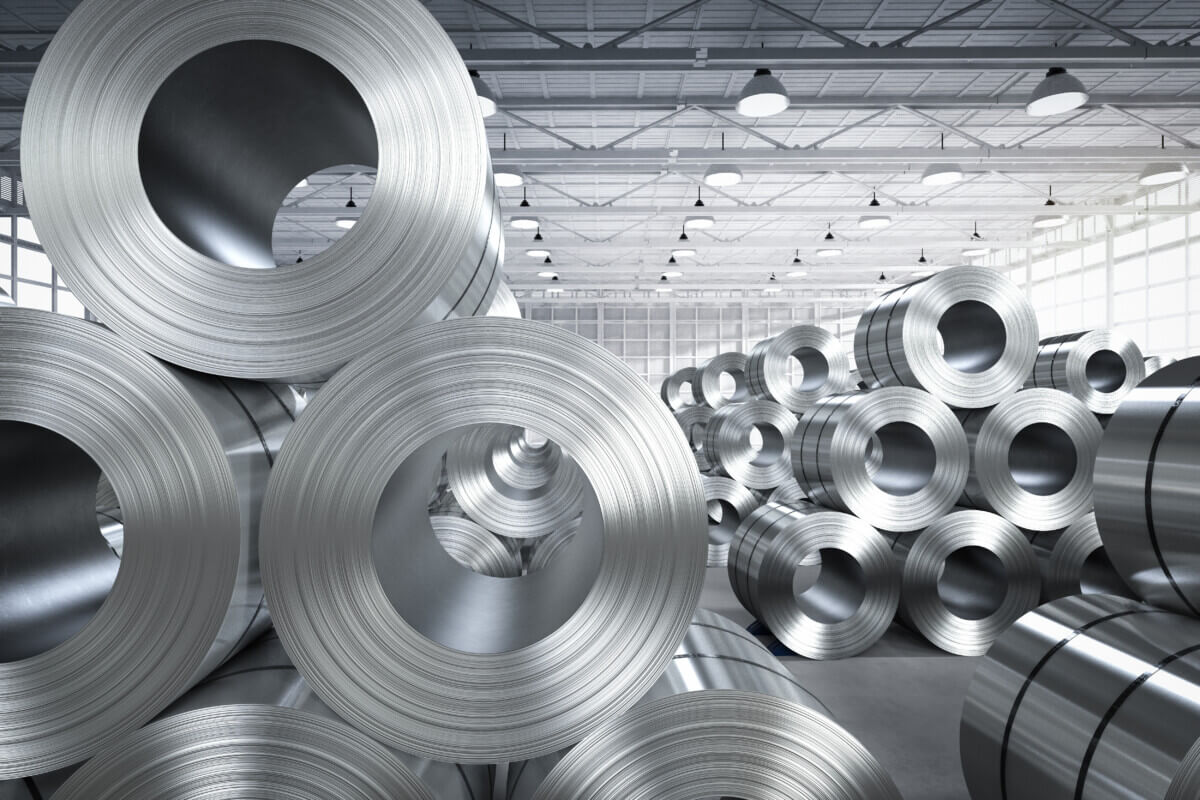
3d rendering roll of steel sheet in factory (© phonlamaiphoto - stock.adobe.com)
WEST LAFAYETTE, Ind. — Imagine a piece of steel that can bend without breaking! Researchers at Purdue University have developed an innovative treatment for a high-quality steel alloy that has resulted in remarkable strength and plasticity, two properties that are typically difficult to combine. The treatment creates ultra-fine metal grains on the outermost layer of the steel, which exhibit a unique behavior under strain, leading to super plasticity. While the exact mechanism behind this phenomenon remains unclear, the implications of this research are significant.
The steel alloy used in the study, known as T-91, is commonly employed in nuclear and petrochemical applications. However, the researchers believe that this treatment could have wide-ranging applications, including car axles, suspension cables, and other structural components that require strong and ductile steel.
A unique discovery!
One of the most intriguing aspects of this research is the discovery of a “nanolaminate” structure within the treated steel. This nanolaminate consists of ultra-fine metal grains extending approximately 200 microns from the surface. Microscopy images have revealed unexpected deformation patterns in the treated steel, which has been named G-T91 (gradient T91).
“This is a complex process, and the research community has not seen this phenomenon before,” says lead study author Xinghang Zhang, a professor in the School of Materials Engineering, in a university release. “By definition, the G-T91 is showing super-plasticity, but the exact mechanism that allows this is unclear.”
Although metals like steel may appear uniform, under magnification, they are composed of individual crystals called grains. When a metal is subjected to strain, these grains can deform in a way that maintains the metal’s structure without causing rupture, enabling it to stretch and bend. Larger grains can withstand more strain than smaller grains, creating a trade-off between large-grain deformable metals and small-grain strong metals.
In their study, the researchers used compressive and shear stresses to break the large grains at the surface of the T-91 sample into smaller grains. The grain sizes were found to increase from the surface toward the center of the material. At the surface, the smallest ultra-fine grains measured less than 100 nanometers, while the grains in the center were 10 to 100 times larger.
The modified G-T91 sample exhibited a yield strength of approximately 700 megapascals and demonstrated a uniform strain of about 10 percent. These results represent a significant improvement over the combined strength and plasticity achieved with standard T-91 steel.
The remarkable characteristic of G-T91 lies in its structure. The center of the material is soft, allowing it to sustain plasticity. By introducing the nanolaminate, the surface becomes much harder. This gradient structure enables a synergistic deformation, with the large grains responsible for stretching and the small grains accommodating stress. As a result, a material is created that possesses both strength and ductility.
What did scientists find during testing?
During the tension testing, scanning electron microscopy images taken at various intervals revealed a mysterious phenomenon. Electron backscattered diffraction images showed the grains in the nanolaminate of G-T91 undergoing a transformation as the true strain increased. Initially, the grains had a vertical, lenticular shape. However, as the strain intensified, they stretched into a more globular shape, rotated, and eventually elongated horizontally.
Zhang explained that these images illustrate the movement of grain boundaries, the interfaces between grains, which allow for stretching, rotation, and plastic deformation of the steel. The team has secured funding from the National Science Foundation to further investigate this movement and gain a better understanding of the intriguing behavior of gradient materials.
The collaborative study, conducted with Sandia National Laboratories and already patented, is published in Science Advances.


