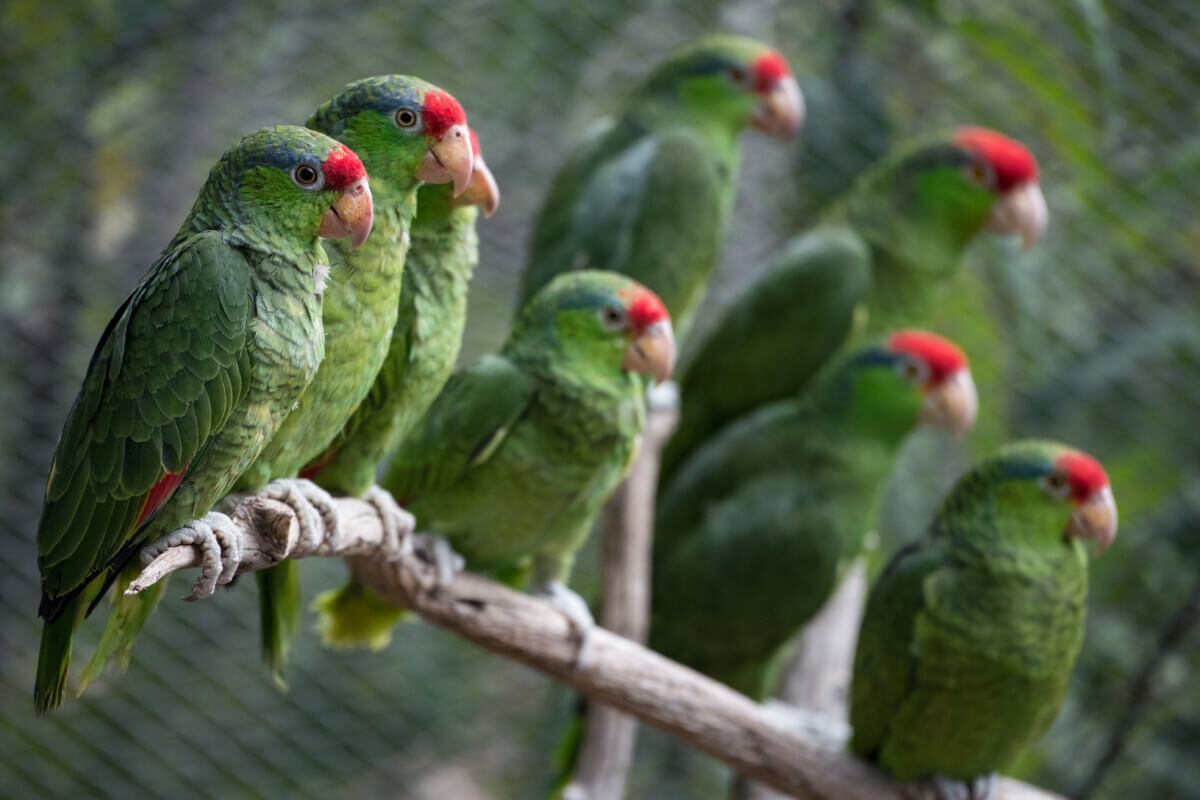
Red-Crowned Parrots perched in a tree. (Photo credit: Charles Bergman on Shutterstock)
COLLEGE STATION, Texas — Man-made environments like bustling cities and crowded urban areas usually spell trouble for local wildlife, but a noteworthy new piece of research suggests certain animals can actually live quite comfortably in urban settings. Turns out certain birds, just like people, prefer fast-paced cities over rural settings. Scientists at Texas A&M University report a population of red-crowned parrots are “thriving” in urban areas of Southern Texas. Importantly, red-crowned parrots are considered an endangered species, which makes these findings all the more notable and potentially useful in the fight to preserve our planets’ wildlife.
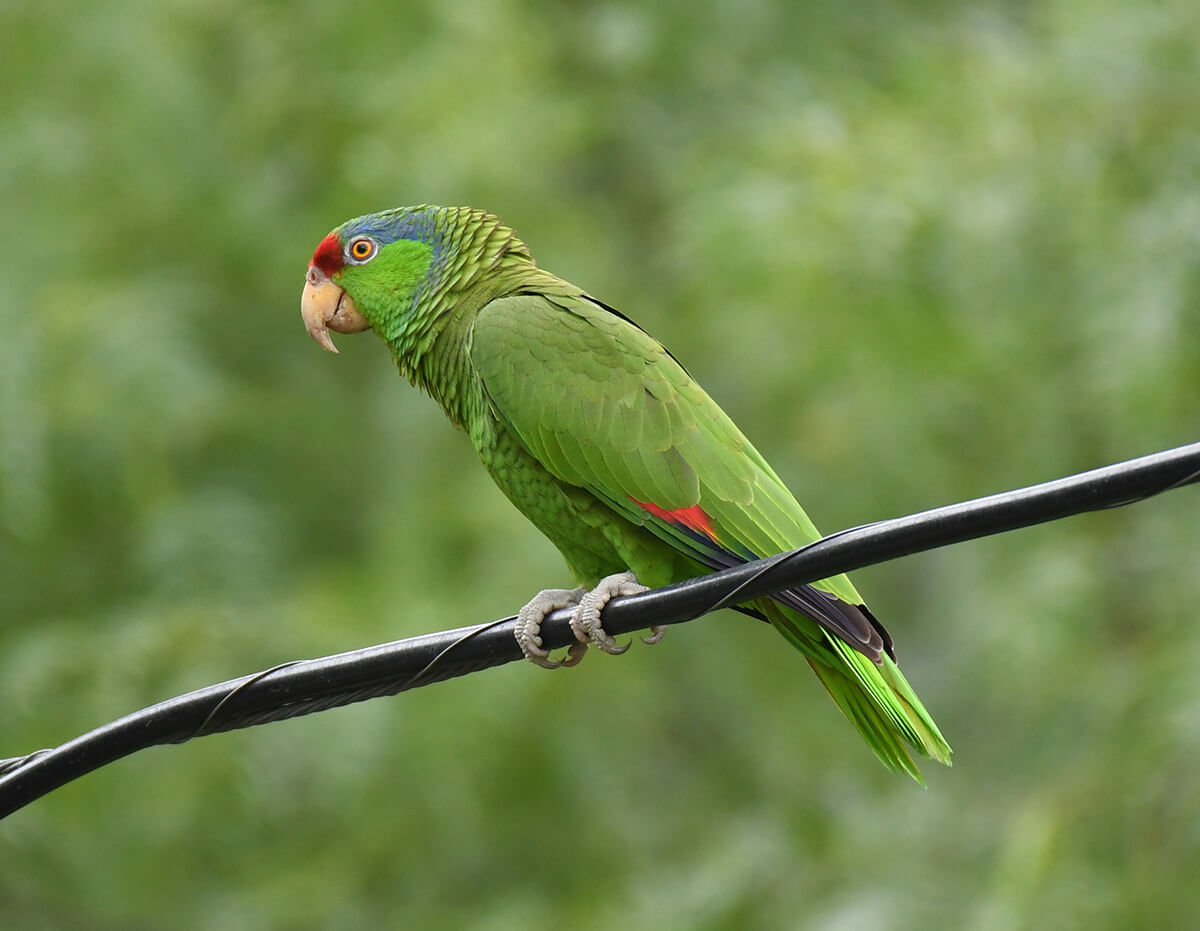
Red-crowned parrots are actually mostly green, but sport a cluster of bright red feathers on their heads. These birds are a rare example of a species that has successfully adapted and endured man-made problems like poaching and the pet trade moving them from their native areas.
This research was led by Dr. Donald J. Brightsmith and graduate student Simon Kiacz, from the university’s School of Veterinary Medicine & Biomedical Sciences’ Department of Veterinary Pathobiology. Study authors’ recent documentation of the red-crowned parrot’s habitat ranges and urban dependency will hopefully assist the Texas Parks & Wildlife Department and other conservationists as they continue working to protect these endangered birds.
What are Red-Crowned parrots?
Originally native to a small area located within Northeastern Mexico, red-crowned parrots are now classified as an endangered species due to both habitat loss and poaching tied to the illegal animal trade. For parrots, this usually means poachers stealing eggs or even young offspring right out of nests to be sold, in some cases for hundreds of dollars each.
“Parrots are popular pets in places like South Texas and Latin America,” Kiacz says in a university release. “Unfortunately, most people, even law enforcement officers, don’t realize that these parrots are protected.”
In fact, researchers note that the animal trade is a big reason why red-crowned parrots live in Texas nowadays. Eventually, the birds were granted native species status in the Lone Star state.
“Some of them certainly flew across the border, but many were brought over during the 1980s when it was still legal to buy and sell them,” Dr. Brightsmith adds. “Without native species status, it would be much more difficult to provide protection for the species.”
Thanks to its native species local status, Texas Parks & Wildlife have devoted considerable time and resources to tracking and analyzing the parrots. In simpler terms, state wildlife personnel want to make sure the parrots are getting along OK and surviving in Texas. Those efforts set the stage for Brightsmith and Kiacz’s project.
“During data collection, I was looking for population information, trend information, the threats to the populations here in Texas, and habitat usage,” Kiacz notes. “We wanted to understand how these birds are doing and what we might be able to do to help them.”
Where are these parrots mostly found?
After counting birds and mapping out their usual habitat ranges, the research team eventually uncovered that the red-crowned parrots actually appear to be living comfortably in South Texas. Population numbers are robust in areas in the Rio Grande Valley, including towns like Brownsville (which even made the red-crowned parrot its official mascot!).
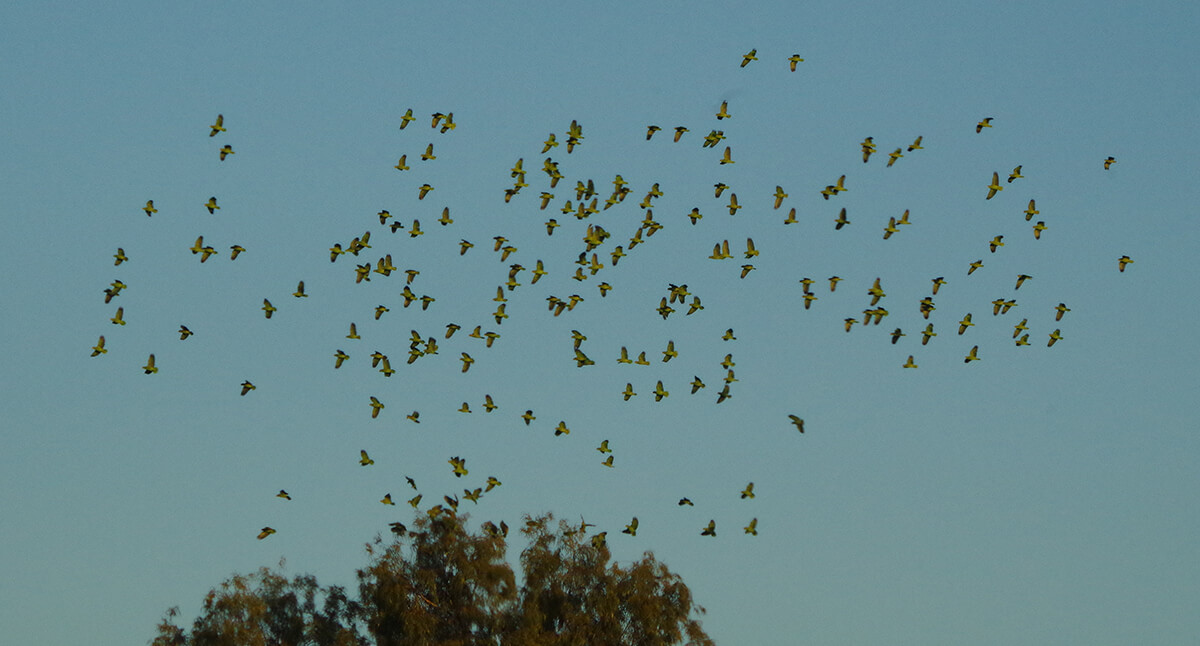
“There are four main roosts in South Texas,” Kiacz explains. “Brownsville, Harlingen, Weslaco and McAllen all have a group of parrots living in those communities. We used trackers, mapping software and local knowledge to see where these birds were roosting, and then we just had to count them.” He said the South Texas population is around 900 birds.
“We can get a really good idea of the population’s breeding activity this way,” he continues. “If there is a decrease in the number of birds at the roost in the breeding season, that’s a good thing, because the females are probably nesting somewhere else with their offspring. Then in the fall, we’ll see all the juveniles join the adults at the roost.”
Study authors admit this observed success is quite unusual considering most endangered species (plants/animals) tend to fare worse in urban areas as opposed to more natural settings. In most cases, species that have adapted to urban environments (“synanthropes”) are considered neutral, or even invasive.
For whatever reason, red-crowned parrots have no issue living alongside people. “Humans have basically created the perfect environment for these parrots,” Kiacz says. “They want what we want — ornamental plants with fruit and seeds that are well-watered and look attractive all year-round.”
For example, even the human habit of planting palm trees where they don’t tend to survive has turned out to be a major positive for these parrots.
“All of the palm trees that we plant in South Texas are non-native,” Kiacz adds. “They eventually die, and then woodpeckers come and make holes that are perfect nesting cavities for these parrots. But they’re also happy to use holes in the sides of buildings.”
Since these parrots love to eat non-native species of plants, they haven’t caused much competition among other local species over food sources either. Currently, the only downside these parrots may represent for humans is the disruptive noise they may create.
“You’ll often see these birds roosting together,” Dr. Brightsmith comments. “They sleep in groups of a hundred or more, and they may end up choosing someone’s front yard, even right over the mailbox. Then, when it gets light outside, they’ll start making noise and flying around. Some people find that to be a nuisance.”
Being ‘good neighbors to these birds’
In summation, researchers say if there’s one big lesson to learn from this study, it’s that life finds a way. Urbanization, of course, shows no signs of slowing all over the planet, so it’s very likely we will begin to see more and more species living in urban areas, perhaps with unexpected results in some cases.
While study authors stress that it is not a positive to see animals and species be pushed out of their natural environments and forced to settle somewhere urban, they admit such scenarios represent compelling research opportunities. It is very likely similar developments will eventually appear among other species all over the country.
For now, study author hope that this study will raise awareness about red-crowned parrots and promote improved conservation efforts.
“What we actually need is for people to understand how these birds live in urban environments,” Kiacz adds. “Instead of trying to fund large nature preserves, which you might need to do for other species, the best help we can give these parrots is to teach people how to live with parrots as neighbors.
“For example, maybe you have a dead tree in your yard that doesn’t look very pretty, but it’s not a danger to you or your home,” he concludes. “Consider keeping it so these parrots can nest there.
“That’s the best way to be a good neighbor to these birds.”
The study is published in Diversity.


