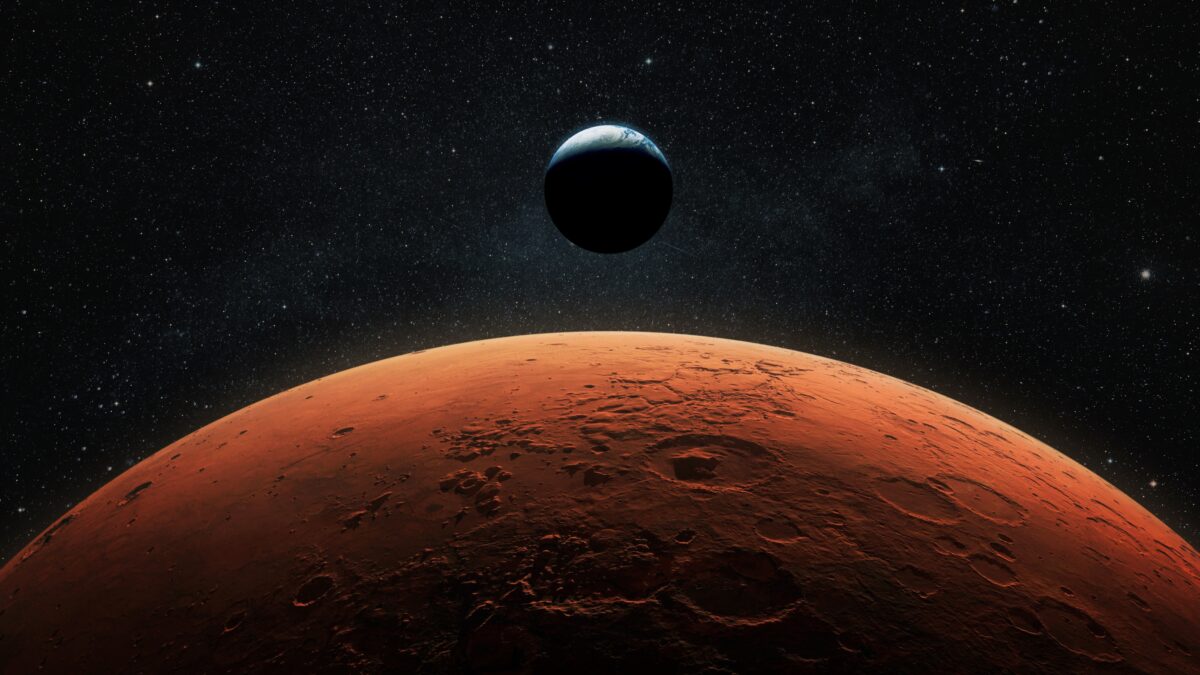
(Credit: Alones on Shutterstock)
In a Nutshell
- A new study in Nature Astronomy finds Earth and Mars formed through two different recipes, settling a long-running debate by showing both pebble accretion and rocky collisions played a role.
- At least 75% of Earth’s rocky bulk came from two bodies that grew by sweeping up tiny space pebbles, with up to about 25% added by Vesta-like planetesimals.
- Mars formed the opposite way: roughly 73% of its rocky material came from the buildup of planetesimals, with only about 27% from pebbles.
Earth and Mars did not form the same way, and the proof is baked into their chemistry. A new study finds that at least 75% of Earth’s rocky bulk came from bodies that grew by gradually vacuuming up tiny space pebbles, while Mars got the opposite treatment, with about 73% of its rocky material traced to the buildup of larger rocky bodies called planetesimals.
For decades, planetary scientists have argued over how rocky planets actually come together. Some models point to a quiet process of slowly sweeping up pebble-sized grains drifting through the young solar system. Others favor a rougher path, built on repeated smashups between bigger rocky chunks called planetesimals. A new study published in Nature Astronomy says the real answer is both, just in very different proportions depending on the planet.
Researchers from the University of Copenhagen’s Center for Star and Planet Formation cracked the mystery using a chemical clue buried in the rocks themselves: a strange shortage of certain “moderately volatile” elements in the mantles of both planets. Collaborators came from institutions in Switzerland, the United States, and Denmark.
Missing Ingredients in Both Planets
Earth and Mars are both missing a predictable chunk of elements like lithium, manganese, sodium, potassium, and zinc compared to the Sun’s own chemical makeup, elements that condense into solid form at intermediate temperatures. Scientists call this pattern “volatile depletion,” and it shows up consistently in both planets. A central question has been what process strips these elements away, and whether the pattern can reveal anything about how the planets grew in the first place.
Researchers modeled a process they call “devolatilization during pebble accretion.” As a growing protoplanet pulls in a swirling envelope of hydrogen and helium gas from the surrounding disk while vacuuming up pebbles, the heat at the bottom of that envelope can be high enough to vaporize moderately volatile elements out of the incoming pebbles. Those vaporized elements then get swept away by gas flows and lost back into the disk, while heavier, more heat-resistant elements like magnesium and silicon stay locked in a protective vapor layer near the planet’s surface and eventually become part of the planet.
To make sure this wasn’t just a theoretical guess, the researchers ran detailed 3D simulations of the convective gas flows inside a growing protoplanet’s envelope. They found that once volatile elements are vaporized, convection carries them upward and large-scale gas recycling sweeps them out. Within about a year, only around 30% of those elements remain, and more than 97% are gone within five years. That makes the loss of volatile elements during pebble accretion a one-way, efficient process.

How Earth and Mars Formed Differently
But pebble accretion alone doesn’t perfectly match the chemical signatures measured in real rocks from Earth and Mars. So the team also factored in contributions from early-formed planetesimals, chunks of rock that formed fast and were themselves “cooked” by radioactive decay or ancient collisions, losing their own volatile elements in the process. As a stand-in for this kind of body, the researchers used the chemistry of Vesta, the large asteroid whose fragments reach Earth as HED meteorites (short for howardite-eucrite-diogenite), since Vesta shows strong depletion of elements with lower sublimation temperatures.
Using Bayesian statistical modeling, a method for weighing how well different mixes of ingredients explain the observed data, the team tested various combinations of pebble-grown bodies, giant impactors, and Vesta-like planetesimals.
For Earth, the best-fitting model required at least about 75% of the planet’s rocky mass to come from two pebble-accreted bodies: a “proto-Earth” and a single giant impactor (similar in spirit to the Moon-forming collision with the hypothesized planet Theia), with up to about 25% contributed by Vesta-like planetesimals. If the researchers instead allowed for a hypothetical population of planetesimals with an even more extreme, and currently unobserved, volatile-depletion pattern, that planetesimal contribution could rise as high as 40%, albeit with sizable uncertainty (+15/-14 percentage points).
Mars tells a very different story. There, the statistics favor a model dominated by planetesimal accretion: about 73% (±5%) of Mars’s rocky material is best explained by Vesta-like planetesimals, with only around 27% (±5%) coming from pebble accretion. In other words, while Earth’s growth leaned on pebble accretion with a meaningful planetesimal contribution, Mars appears to have formed mostly the “old-fashioned” way, through collisional buildup, with pebbles playing a smaller supporting role.
One possible reason for this split, the team suggests, is that Mars may have had its orbit gravitationally stirred up early on by other, more massive protoplanets, which could have curbed its ability to efficiently accrete pebbles, leaving collisional growth to do more of the work.
Researchers also tested whether a single giant impact was really necessary to explain Earth’s chemistry, and found that scenarios with two smaller impactors remained plausible, while three impactors was statistically disfavored, interestingly fewer collisions than some computer simulations of planet formation typically predict. They argue this makes sense: if pebble accretion is already doing a lot of the work building up planetary mass, fewer separate planetesimal-sized “seeds” are needed, and so fewer giant collisions occur along the way.
How Earth and Mars Formed: Clues for Other Worlds
Authors note that this volatile-depletion “fingerprint” isn’t unique to the solar system. Spectroscopic studies of polluted white dwarf stars, whose atmospheres sometimes carry the vaporized remains of rocky planets or asteroids they’ve consumed, and of stars that appear to have swallowed planetary material show similar volatile-element depletion patterns. That points to the same two-pronged accretion process, pebble accretion plus collisional assembly, as a possibly universal feature of how rocky planets form throughout the galaxy. Understanding how planets shed and regain volatiles also gives scientists a way to weigh the chemical makeup and potential habitability of rocky worlds elsewhere, including whether they hold life-essential volatile elements like carbon, hydrogen, nitrogen, oxygen, phosphorus, and sulfur.
Paper Notes
Limitations
The authors are upfront that parts of the picture remain fuzzy. Their model assumes volatile elements, once vaporized, escape completely during pebble accretion, yet they caution that volatile loss driven by collisions during the disk phase is “still poorly understood” and could complicate that assumption. By their own account, the devolatilization model “may not be precise enough” to fully capture a brief, very hot transitional stage in a growing planet’s envelope, which could shift exactly where the line falls between elements that are lost and elements that are kept. Three heavy halogens, chlorine, bromine, and iodine, were also left out of the statistical fitting because their measured abundances in the reference meteorites are disputed. One more point of context: the headline percentages describe bulk silicate Earth and Mars, meaning the rocky mantle and crust, not the planets’ metallic cores.
Funding and Disclosures
Funding came from the Carlsberg Foundation’s Semper Ardens grant (“FIRSTATMO”), with additional support from NASA’s Emerging Worlds program (80NSSC23K0653), Astrophysics Theory Program (80NSSC24K0133), and Theoretical and Computational Astrophysical Networks program (80NSSC21K0497), a NASA Exoplanet Research Program grant (80NSSC25K7144), and the Kephalos Research Fund. The authors declare no competing interests. The paper was published open access under a Creative Commons license.
Publication Details
Paper Title: “Volatile depletion in rocky planets as a chemical fingerprint of hybrid accretion”
Journal: Nature Astronomy, September 25, 2026
DOI: 10.1038/s41550-026-02984-6
The study was led by corresponding authors Haiyang S. Wang ([email protected]) and Anders Johansen ([email protected]) of the Center for Star and Planet Formation, Globe Institute, University of Copenhagen, with co-authors Ziyan Xu, Marie-Luise Steinmeyer, Michiel Lambrechts, Elishevah van Kooten, Chao-Chin Yang, Zhaohuan Zhu, Dante S. Lauretta, and Martin Bizzarro.


